

Stalled Cycle – Reasons Your Marine Aquarium Cycle May Be Slowing Down
Welcome to Simple Reefs. This is a brand new website dedicated to taking the complexity out of Marine Aquarium Ownership. Our goal is to show you how you can own your very own slice of the ocean without spending a fortune. As well as giving you tons of easy to digest information on all things marine. Today, we are following on from our article on stalled cycles in a marine aquarium by looking at reasons your marine aquarium cycle may be slowing down.
Table of Contents
Marine Aquarium Cycling
Ah.. Stalled cycles. The bane of many a new saltwater hobbyists existence. Is there anything that can stop you in your path to gorgeous reef greatness quite like a stalled cycle? I have experienced it myself and it is such a huge pain. If anything can put the emphasis on the phrase “nothing good happens quickly in marine fishkeeping” it is a stalled cycle.
The topic of marine aquarium cycling is a pretty hefty one; hence why I have split these articles up to avoid overloading you with information. You are likely, at this point, well aware of what the entire process entails. Especially if you are experience a stalled cycle.

Cycling a marine aquarium involves adding a source of ammonia (ammonium chloride, fish food, shrimp, etc) to feed ammonia converting bacteria. Forcing it to reproduce (split in a process called binary fission) with the end goal being the production of enough bacteria to make your aquarium safe for fish. We are, basically, recreating the nitrogen cycle in our tanks.
Stalled Cycles in Marine Aquariums
But what happens when that process of cycling your marine aquarium appears to stop. Or, as it is more commonly known, stall. As we mentioned, previously, there, in reality, is no such thing as a stalled cycle. What is really happening is that your cycle is just slowing down. Likely due to less than optimal condition for the bacteria in the aquarium.

It seems complex but it is really that simple. Our bacteria doesn’t have optimal conditions to enable fast reproduction. Just like a house plant that won’t grow because it isn’t getting enough light or water. Your cycle is not progressing quickly because the bacteria is getting, either, too much or not enough of what it needs.
Before we move on, I will say that this next section, really only applies to ammonia levels that won’t drop or are off the charts and aquariums with low levels of ammonia and nitrites and non-existent nitrates.
If you are experiencing high nitrites, your cycle is not stalled at all and I am going to tell you exactly why in an article coming soon. Similarly, if you are seeing high levels of nitrates or no nitrates at all despite your aquarium being able to process ammonia in under 24 hours, you are also in luck. Your cycle isn’t stalled and it is, in reality, most likely finished. I will be explaining why very soon.
But Why Did My Marine Aquarium Cycle Stall?
There are a whole bunch of different reasons why your marine aquarium’s cycle might slow down or, as it is more commonly known, stall. We are going to list a few possible causes, here. I will be going into these reasons more in upcoming articles. I don’t want to overload you with information you don’t need so you can click the section that you feel might be applicable to your own situation and find answers right there.

With that being said, these are some of the most common reasons that you may find yourself staring at an empty aquarium that simply won’t finish cycling. As I mentioned earlier, I have experienced this, myself. I will point out exactly what it was that caused my own personal experience, with a marine aquarium cycle stalling, after we are done.
- Organic die off from live rock, dry rock, or live sand, causing an overload of ammonia. (Evident by high ammonia levels in test result)
- Too much ammonia being added to the tank in the form of food or ammonium chloride. (Evident by high ammonia levels in test result)
- Too Hot. (Evident by high ammonia levels in test result)
- Too Cold. (Evident by high ammonia levels in test result)
- Not enough ammonia added to the water. (Evident by lower than expected ammonia levels in test result without presence of nitrites and nitrates)
- Protein skimmer stripping the water of ammonia. (Evident by lower than expected ammonia levels in test result without presence of nitrites and nitrates)
- Salinity too high or too low. (Evident by high ammonia levels in test result)
- Not enough surface area for bacteria to grow on (inadequate filtration media) (Evident by high ammonia levels in test result)
These are all pretty obvious and fairly self explanatory but let’s take a closer look at what we mean by these bullet points. As I explained earlier, dedicated articles are coming for these issues so these are only brief summaries.
Stalled Cycle Caused By Problems With Your Water
These are all the problems that may occur with the aquarium itself and the way you have set it up. For example, temperature can be a big problem as bacteria is a little on the picky side of life when it comes to ideal conditions. If you are running your aquarium over 27 degrees Celsius, you may be slowing things down a bit.
Remember when we talked about optimal conditions for bacterial growth and reproduction? Well bacteria prefers the cold. On top of that, cold water has more of something else that bacteria loves – oxygen. We will be talking about this more in depth in an article that is coming soon but, again, the solution is simple.

Drop your aquarium’s temperature to somewhere between 24.4 – 25.5 degrees Celsius (75-78 Fahrenheit). Conversely, if your temperature is below 20 degrees, you may find that bacteria struggles to reproduce and to process ammonia so up that heater a little bit.
Salinity is another potential cause of a marine aquarium cycle stalling. Saltwater Nitrosomonas bacteria prefer a salinity range somewhere between 20PPT (Parts per thousand) – 40PPT (1.015SG – 1.030SG). If your salinity is off, this can easily be the cause of your problems. After all, we need to create optimal conditions in our tank. This is why a reliable refractometer is so important.
Check your salinity and if it is too low or too high, adjust it. The best thing we can do here is to have our salinity settle at between 30PPT and 35PPT (1.022SG – 1026SG). The magic number tends to be around 33PPT which is, approximately, 1.025SG. This is the Goldilocks number, if you will, that most fish and coral will be happy at.
Either add more saltwater to raise it or more fresh water to lower it. The same goes for PH level. If your PH level is very low, you may encounter similar problems. Raising it may be a bit tough, at this stage, so check out this article from Bulk Reef Supply for some more information on this process.
Stalled Cycle Caused By Problems With Your Aquarium Setup
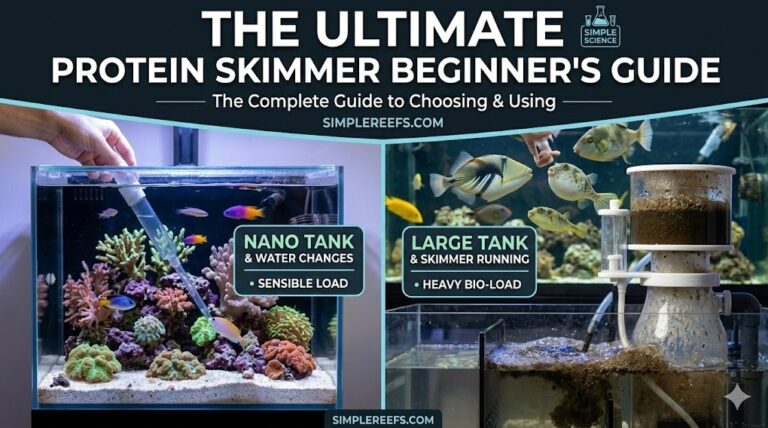
The biggest problem, here, might be the use of a protein skimmer while cycling your aquarium. This will manifest in low levels of ammonia, low levels of nitrites and practically non-existent nitrites. I see so many ill informed hobbyists suggesting the use of a protein skimmer while cycling. Don’t do it. Turn it off and wait until you have livestock in your tank.

A protein skimmer may be stripping the ammonia out of the water before it has a chance to get to the bacteria. It will probably be stripping bacteria from the water as well. Protein skimmers are very indiscriminate like that.
This next point only applies to those hobbyists who don’t have rocks or sand in their aquarium. If you don’t have any rocks or sand and you have limited filter media in your filtration system. You could be slowing things down because the bacteria does not have enough room to populate and reproduce. After all, bacteria needs somewhere to live.
Whereas rocks and sand provide an ideal home for bacteria thanks to their many nooks and crannies. People who choose to avoid including these things in their tanks will need to provide alternate accommodation in the form of filtration media.
Luckily, there are products made specifically for this. Things like Bio-orbs, Bio-balls, and marine blocks are designed to go in your filter or sump. They are extremely porous. Meaning they provide extensive surface area for bacteria to populate. Fixing your stalled cycle may be as simple as adding these things to your filter. We will talk more about this in an upcoming article.
Stalled Cycle Caused By Mistakes In The Cycling Process
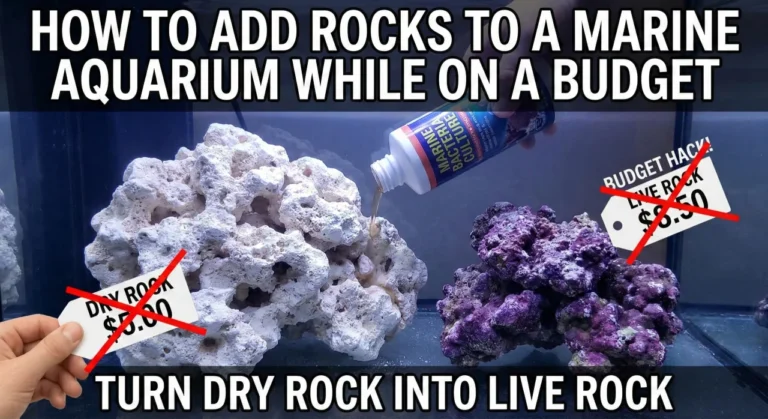
These next points are, all, related to the cycle process itself. The first of which is a biggie. If you started your aquarium with live rock, dry rock, or live sand. You may be experiencing some organic die off that is overwhelming your aquarium’s bacterial profile by contributing extra ammonia to your water.
If you didn’t cure your live rock, or dry rock, before adding it to your aquarium. There is a solid chance that the organic matter on the rocks is rotting in your water. This can even happen with dry rock that appears to be bright white and completely clean.

In fact, the only rock that this can’t happen with is speciality rocks like Life Rock and Reef Builder rock that is pre-prepared and rock that has been mined from a terrestrial source like a quarry. If it was ever wet or in water, it has potential for die off.
This rotting waste will throw off the calculation on how much ammonia you need to add to your aquarium while cycling. We talk all about this in this article but, suffice to say, the solution is to stop adding ammonia, keep testing your water daily and wait for the levels to drop on their own.
Speaking of ammonia, there is a chance that you are, simply, adding too much to your aquarium. Be it in the form of fish food, a piece of frozen shrimp, or bottled ammonium chloride. It is quite easy to miscalculate how much you need to be adding. The solution, here, is to simply stop adding ammonia, or food, and wait for the ammonia levels to drop. When they drop, you can resume your cycle but reduce the amount of food or ammonia you add.
These Problems Are Easy to Solve
Don’t worry, though. All of these problems are easy to rectify. We just need to create optimal conditions for the bacteria in our aquarium. Click the links to check out the respective articles for each of these problems. I will, also, give you a few solutions to help you fix the issues.
But what about my own, personal, stalled cycle experience? Well, this is a funny story and it involves me being a little on the careless side with my brand new, sparkling white, dry rock. I won’t bombard you with it here so look out for the story in my next Mistakes and Mishap Mondays Article. Thanks for reading and spending your time with Simple Reefs.