
Hang On Back Protein Skimmers: The Good, The Bad, and The Soggy Carpet
Welcome to Simple Reefs. Today, we are bringing you the ultimate deep dive into a subject that many sumpless reefers find themselves obsessing over: Hang On Back Protein Skimmers: The Good, The Bad, and The Soggy Carpet.
Table of Contents
The Complete Hang on Back Protein Skimmer Guide: In this comprehensive guide, we are going to break down everything you need to know about HOB skimmers. We will explore how they work, the significant benefits they offer for freshwater conversions, the common downsides like micro bubbles and aesthetics, and the potentially catastrophic overflow risks you must avoid. Finally, we will help you choose the right model for your specific water volume and bioload.
The Definitive HOB Skimmer Key Takeaways
- The Conversion King: HOB skimmers are the single most important piece of gear for turning a standard freshwater tank into a thriving reef without drilling the glass.
- Ease of Access: Being visible means they are easier to dial in and maintain compared to skimmers hidden in dark cabinets.
- The Gravity Threat: Because they sit outside the tank, any overflow is external. This requires specific safety protocols to prevent home damage.
- Efficiency Trade-off: HOB units are generally less efficient than in-sump equivalents and are best suited for small to moderate systems.
A Quick Protein Skimmer Refresher
Let’s quickly catch up on this subject for anyone who is a little confused about what exactly a protein skimmer does. Essentially, a protein skimmer is a type of filter that acts as the “kidney” of your marine aquarium. It’s going to take all of the dissolved organic compounds (think fish waste, uneaten food, and fats) in your tank’s water column and remove them.

It works through a process called foam fractionation, where a pump injects millions of tiny micro bubbles into a reaction chamber. Dissolved organic compounds are chemically attracted to the surface of these bubbles.
As the bubbles rise, they form a thick, dark foam (Skimmate) that eventually spills into a collection cup. This allows you to physically remove waste from the system before it has the chance to break down into toxic nitrates or phosphates.
Beyond just cleaning the water, these devices are powerhouses for oxygenation and PH stability. By vigorously mixing air and water, they drive off excess carbon dioxide and ensure your livestock has plenty of oxygen. We have a huge beginner’s guide on Protein Skimmers if you need to catch up.
💡 The Science: Foam Fractionation Explained
Inside the reaction chamber, a pump chops water and air into thousands of micro bubbles. The rule here is simple: more bubbles equals better cleaning. Smaller bubbles provide more total surface area, allowing them to trap more dissolved matter as they rise through the water column.
This process relies on electrical polarity. Organic waste is made up of “hydrophobic” and “amphipathic” molecules. This is just a fancy way of saying these molecules dislike water and will desperately cling to air instead. Because they want to escape the water, they grab onto the dry air inside our tiny bubbles and become trapped.
As the bubbles rise, they form a thick foam that eventually collapses into the collection cup, leaving behind that foul smelling liquid we call skimmate. Clean water stays behind because water molecules are highly attracted to each other and prefer to stick together rather than attaching to the rising air.
A Natural Process: Having grown up on the coast, I always think of sea foam as the perfect analogy. If you have ever seen thick, yellowish foam washing up on a beach, you have witnessed this exact process in nature. A protein skimmer simply takes that natural oceanic cleansing and shrinks it down into a plastic tube for your aquarium.
What is a Hang on Back Protein Skimmer?
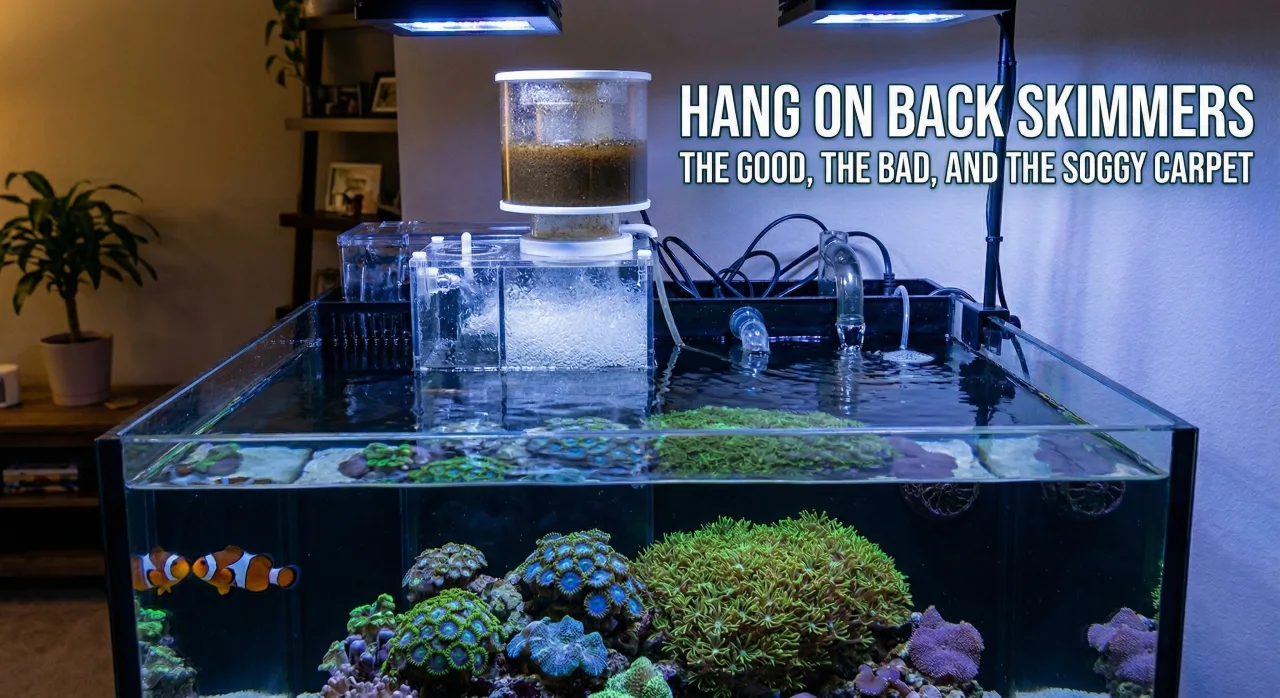
A hang on back protein skimmer is exactly what it sounds like. It is a type of skimmer designed to hang on the back of your aquarium rather than sit in the display, in a filtration chamber, or in a sump. They are made, specifically, for those of us who don’t have a sump.
I actually started my marine aquarium ownership journey using a hang on back protein skimmer. Specifically, the Bubble Magus E3. I spent many hours staring at that reaction chamber, so I feel I am pretty well qualified to talk about them.
Hang-on-back protein skimmers come in all shapes and sizes for a variety of different tanks, offering a convenient solution to the problem of incorporating a protein skimmer into a sumpless tank.
Are they perfect? Not by any shot, but they definitely serve a valuable purpose and open a window to complex reef keeping that we otherwise might not have. Before we get into the pros and cons, let’s look at how they work.
How Do Hang-on-Back Protein Skimmers Work?
A hang on back protein skimmer does exactly what a normal protein skimmer does: it keeps your aquarium’s water cleaner by removing dissolved organic. The only difference is that it does all of this while hanging off the back of your aquarium.
The idea of having to include a protein skimmer in your actual aquarium’s display section is rather unappealing. After all, protein skimmers are large, cumbersome, and not aesthetically pleasing. Hanging one on the back of the tank simply keeps most of that equipment out of the way.

This does pose a few technical complications, however. For one, how do we get the water into the skimmer? This is how hang-on-back protein skimmers function:
- Intake: They pull water into their reaction chamber from your aquarium, often via a siphon or a small pump.
- Air Injection: Air is introduced to the water, usually through a venturi effect or a needle wheel impeller chopping the water.
- Reaction: Bubbles form in the reaction chamber. Dissolved organics bind to the air in the bubbles thanks to their electrical polarity.
- Collection: The bubbles climb as a dirty foam known as skimmate, eventually ending up in the collection cup.
- Return: The clean water is returned to the aquarium via a return pipe or gravity spillway.
It’s almost entirely the same process as with an internal protein skimmer. The only real difference is that the water needs to be pulled from your tank using a pump and intake and sent back to your tank using a gravity feed or spillway.
💡 Spillways vs Gravity Returns: The Jargon Buster
Manufacturers love using fancy words for what is essentially a hole in a plastic box. A “spillway” is basically a little waterfall. The water flows over a flat lip and crashes back into your display. While it looks quite nice, it is often a total nightmare for “salt creep”. You will likely find yourself scrubbing crusty salt off your tank rim every single day because of the constant splashing.
A “gravity return” usually involves a dedicated pipe or submerged tube. The water simply falls through the plumbing and back into the tank. These are generally much quieter and cleaner than spillways, but they can sometimes trap air and make a gurgling noise that sounds like a blocked drain. If you have the choice, a pipe-based return is almost always the superior option for keeping your lounge dry.
The Benefits of a Hang On Back Protein Skimmer
As with most things in the saltwater hobby, hang-on-back protein skimmers come with both strengths and weaknesses. While they may not be as refined as in-sump systems, they fill a very specific role, and in the right setup, they can be incredibly effective.
Some of the advantages are obvious. Others only become clear once you’ve actually lived with one. To be perfectly honest, the same goes for the downsides, too.
At their core, hang-on-back protein skimmers exist for one reason: they make protein skimming possible in aquariums that would otherwise go without it entirely. That alone makes them an essential piece of equipment for many setups. It would be very difficult to convert a freshwater tank into a marine tank without them.
Let’s break down where they truly shine.
Simplicity and Ease of Use
One of the biggest advantages of a hang-on-back protein skimmer is just how simple it is to get up and running.
There’s no sump to configure, no plumbing to worry about, and no need to fine-tune water levels in a separate chamber. You simply hang it on the back of your aquarium, plug it in, and start skimming.

This low level of complexity makes HOB skimmers ideal for beginners, as well as anyone who wants to avoid the added hassle and potential failure points that come with a sump system. I always miss how easy it was to get the skimmer going without having to spend time crouched in the sump making adjustments.
They also take up very little space, making them perfect for smaller setups, apartments, or tanks where a sump just isn’t practical. Decent quality hang-on-back protein skimmers don’t even tend to be that noisy, though cheaper models are less likely to have this benefit.
Perfect for Freshwater to Marine Conversions
This is where hang-on-back protein skimmers truly stand out.

If you already have a freshwater aquarium, converting it into a marine setup can feel like a major hurdle. Without a sump, you’re often left wondering how you’re going to incorporate essential equipment like a protein skimmer.
A hang-on-back unit solves that problem instantly. Instead of replacing your entire setup, you can reuse your existing tank, heater, and much of your equipment. That makes the jump to saltwater far more accessible and significantly more affordable.
In many cases, a HOB skimmer is the one piece of equipment that makes the entire conversion possible.
Flexibility and Portability
Unlike in-sump skimmers, hang-on-back models are not tied to a single system.
They can be moved between tanks with ease, which opens up a range of practical uses. Whether you’re curing live rock, running a temporary setup, or dealing with a sudden increase in bioload, having a skimmer that you can quickly reposition is incredibly useful.
This flexibility makes them a great tool to have on hand, even for more experienced reef keepers. I still keep one a hang-on-back protein skimmer in storage just in case I ever need it.
Easy Monitoring and Adjustment
One underrated advantage of a hang-on-back protein skimmer is visibility. Now, it sounds crazy but stick with me here.

Because the unit and collection cup are always in plain sight, it becomes much easier to keep an eye on performance. You can instantly see when the cup needs emptying, whether the skimmer is producing enough skimmate, or if it’s running too wet.
This constant visual feedback makes fine-tuning much more intuitive.
In contrast, skimmers hidden away in a sump are easy to forget about, which can lead to inconsistent performance over time. I’ve actually forgotten that I switched my in-sump skimmer off before and didn’t realise until days later. There’s no risk of that with a hang-on-back unit.
Cost-Effective Entry Point
Hang-on-back protein skimmers are often more affordable than building a full sump-based filtration system.
More importantly, they can save you from needing to upgrade your entire aquarium setup. Instead of buying a reef-ready tank, overflow system, and sump, you can achieve effective protein skimming with a much smaller investment.
For many hobbyists, this lower barrier to entry is what makes starting a marine tank possible in the first place.
Effective Filtration Without a Sump
While they may not match the raw performance of high-end in-sump skimmers, modern hang-on-back units are still highly capable.
They remove dissolved organic waste, improve water clarity, and support stable water parameters in much the same way as their in-sump counterparts.
For small to medium-sized aquariums, or systems with a moderate bioload, a well-chosen HOB skimmer can do the job extremely well.
Final Thoughts on the Benefits
Hang-on-back protein skimmers are more about practicality than perfection. You are making a few sacrifices to enable the building of a reef in a tank that wasn’t initially designed with reefs in mind.
They offer a simple, flexible, and cost-effective way to run a protein skimmer without the need for a sump. For freshwater conversions, smaller setups, or hobbyists who value simplicity, they are often the ideal solution.
The Downsides and Cons
While the benefits are great, we have to be real: there are some significant downsides. Some of these are minor aesthetic issues, but others are quite significant and deserve special consideration before you commit to the HOB format.
Noise, Space, Salt Creep, & Aesthetics
These are all downsides to hang-on-back protein skimmers that often gets forgotten. Let’s start with the noise issue. Hang-on-back protein skimmers have all the noise of a regular skimmer and no cabinet to hide it in.
They hiss, you hear the water fizzing, you sometimes here the pump, and they generally create a bit of ambient sound. In a bedroom, that will annoy the hell out of you. I can hear my smallest skimmers from across the room.

Space is the next thing we need to consider. You need a good few inches behind your aquarium. If your tank is flush against the wall, it is a no go. Maintenance can be tough with limited space, too. You need a bit of wriggle room to be able to remove the skimmer when cleaning.
There’s a couple of things that factor into the aesthetics of the tank that are worth considering. They can be on the ugly side. It’s never fun to see equipment around your display, and some people are going to hate staring at that collection cup all day.
You will experience some salt creep (a buildup of salt residue as the water evaporates and it crystalises) around the skimmer and the return that can look very ugly. It can drip down the tank, as well leaving white marks everywhere.
Micro Bubbles & Problems With Live Stock
We have a couple more overlooked issues to look at next. Micro bubbles are the first one. Without a bubble trap in a sump, HOB skimmers can release micro bubbles into your aquarium, making it look carbonated and irritating coral.
Many hang on back skimmers feature a piece of foam to minimise these bubbles but expect them to be noteworthy until the protein skimmer has had a week or two to run in.

Another hidden problem is the potential for harm to your livestock. Hang-on-back protein skimmers often have intake pipes that sit inside the tank. There is a very real possibility that small fish, shrimp, or snails can get sucked into this intake.
This is especially noteworthy in nano aquariums where space is limited. There are foam guards and plastic guards for many protein skimmers to prevent this. Some even come with a guard installed but it is something you should keep in mind.
⚠️ Check Before You Buy: All-In-One (AIO) Compatibility
A very common “newbie” mistake is buying a HOB skimmer for an All-In-One tank without checking the dimensions. Many AIO tanks have rear filtration chambers, plastic rims, or specific lids that physically block a HOB skimmer from being installed. If the “hang” of the skimmer is too narrow for your glass or if your lid doesn’t have a cutout, you are going to be stuck with a very expensive paperweight. Always measure your tank rim and check for lid clearance before you order.
Tuning Sensitivity, Heat, and Priming Issues
Hang-on-back protein skimmers tend to be harder to dial in, requiring a very careful balance between air and water. They suffer a lot more from your water level changing due to evaporation, too.
With an in-sump protein skimmer, the skimmer is always sitting in a body of water with a constant level. It never changes but that isn’t the case with hang-on-back protein skimmers. Water levels change all the time due to evaporation. You really need to stay on top of your freshwater top offs to keep your skimmer diallaed in and working well.

They can also take awhile to get going again after a power cut. They don’t just restart skimming as if nothing happened. You need to actually manually prime them. Sometimes this can involve risking a mouth full of water as you suck air into them.
Another consideration is the extra heat produced by the skimmer. This can actually be a good thing in winter as it may warm your water a little meaning your heater doesn’t have to work as hard. In summer, it can be a pain as you are fighting to keep your water cool. This is a negligible matter in large tanks but becomes noteworthy in nanos.
Limited Options For Larger Aquariums and Quality Problems
There are far fewer options when it comes to hang-on-back protein skimmers for larger aquariums. This can create a bit of a solid ceiling when it comes to how big of a freshwater tank you can convert.
Let’s be honest, if you want to convert a huge freshwater aquarium, you might struggle to find a hang-on-back protein skimmer large enough to accommodate your bio-load. You may even have to opt for two skimmers rather than one or even an expensive external skimmer.
Quality can be a bit hit or miss, too. There are loads of different hang-on-back protein skimmers but they aren’t all created equal. Some are cheap and not very efficient, as well as being hard to dial in.
Be sure to read plenty of reviews before making your purchase.
Can Introduce External Pollutants
This is a standard protein skimmer problem but tends to be a bit worse with hang-on-back simmers because they are not hidden in a cabinet.
We spend an absolute fortune on high-quality salt and RODI water only to let a cheap air freshener ruin the entire system. Because a hang on back skimmer sits right out in the open, it acts as a direct vacuum for every bit of rubbish floating in your room. If the air in your house is full of chemicals, your skimmer is gulping them down and mixing them straight into your water column.
This is a massive risk that often gets ignored. Deodorant, fly spray, scented candles, and even those “fresh linen” plugins are toxic garbage for a delicate reef tank. These pollutants will either collapse your foam head entirely or send your water chemistry into a total tailspin. If you wouldn’t dream of pouring a chemical into the tank, do not let the skimmer breathe it in. Keep the room ventilated or turn the skimmer off while you are cleaning the house.
💡 Pro Tip: The Airline Routing Trick
If you want to drastically improve your tank’s PH and protect it from household pollutants, try this: run a long piece of airline tubing from your skimmer’s air intake out through a nearby window. This allows the skimmer to pull in fresh, CO2-depleted air from outside. It’s a clever solution that bypasses the risk of “breathing in” household chemicals while giving your corals a massive boost.
The Great Overflow Problem
This is the big one. I am not going to lie, this is a massive problem and a major con when it comes to hang-on-back protein skimmers. Water spillages are very possible and can be absolutely catastrophic.
The problem stems from the fact that your hang on back protein skimmer is outside of your aquarium. Meaning the water inside of it can only go to one place if it overflows: down the back of your tank and onto the floor.

This can result in damaged woodwork, ruined flooring, potential electrical issues, and a burnt-out pump. This is why I always advocate for extreme caution. Never run a hang on back protein skimmer while using treatments in your aquarium, and always ensure you have a drip loop on your wiring.
Personal Experience: I have experienced this first hand and it is not pretty. Adding treatments, certain coral foods, or even just dialling the skimmer in can cause it to go haywire and run extremely wet. This leads to the cup overflowing rapidly. If you aren’t home when this happens, the skimmer will continue to empty the aquarium right up to the level of its intake pipe which might be dozens of litres. Take a look at my hang-on-back skimmer mishap Monday article for more information.
Choosing the Right HOB Skimmer for Your Tank
There are two things you absolutely have to consider when choosing a hang on back protein skimmer: the amount of water in your aquarium and the bioload.
Because HOB skimmers are generally less efficient than in-sump models, I recommend following the 25% rule and perhaps even bumping it up to the 40% rule if you have plenty of fish.
💡 Sizing Your Skimmer: The Golden Rules
Manufacturers usually rate their skimmers for “ideal” conditions with light bioloads. Because your tank will have fish producing waste and feeding schedules to maintain, you need a safety buffer. Follow these two rules to ensure your water stays clean without stripping it bare:
- The 25% Rule (Standard Tanks): For a normally stocked aquarium, choose a skimmer rated for roughly 25% more than your total water volume. If your tank is 100 litres, look for a 125 litre rating.
- The 40–50% Rule (High Bioload): If you plan on keeping a “heavy” bioload with lots of fish or frequent heavy feeding, you need much more processing power. Buy a skimmer rated for 40% to 50% more than your total water volume to handle the extra waste.
Pro Tip: Don’t overthink the displacement of rocks and sand. In most reef tanks, your substrate will displace about 20% of the water anyway. This means that if you simply buy a skimmer rated for your tank’s advertised volume, you are naturally hitting that perfect 20% to 25% buffer!
| Tank Volume | Recommended Skimmer Rating | Typical Models |
|---|---|---|
| Nano (Under 75L) | 100L – 125L | Bubble Magus QQ1, IceCap Nano |
| Medium (75L – 200L) | 250L – 300L | Bubble Magus QQ3, Reef Octopus Classic 100 |
| Large (200L – 400L) | 500L+ | Deltec MCE600, Reef Octopus Classic 2000 |
Wrapping Up the HOB Skimmer Dilemma
At the end of the day, a hang on back protein skimmer is a compromise. You are trading a bit of silence, a bit of space behind the tank, and the occasional micro bubble for a massive boost in water quality.
If you don’t have a sump and you refuse to clutter your display with a big internal unit, the HOB skimmer is the only way to go. It is far from a perfect piece of equipment, but it is the one thing that truly opens the door to keeping more sensitive corals and a heavier fish load in a standard glass box.
Just remember that these units require a bit of respect and a watchful eye. Keep that intake guard clean, watch for salt creep around the return, and for the love of your carpet, never fiddle with the settings right before you head out to work.
📋 The HOB Maintenance Checklist
To avoid the dreaded “midnight floor mop” scenario, I highly recommend sticking to this simple schedule:
- Daily: Check the collection cup level. If it is filling with clear water, your settings are too “wet” and you need to dial it back immediately.
- Weekly: Wipe down the return area to remove salt creep. If salt builds up here, it can actually “wick” water out of the tank and onto your floor.
- Monthly: Clean the air intake silencer and the venturi. Salt spray often clogs these tiny holes, which starves the skimmer of air and causes it to overflow.
- Quarterly: Take the unit off the tank and soak the pump in a citric acid solution. This removes the calcium buildup that slows down the impeller and ruins efficiency.
If you stay on top of the maintenance and follow the rules, your HOB skimmer will do a fantastic job of keeping your slice of the ocean healthy and thriving.
Thanks for reading and spending your time at Simple Reefs. We are here to keep the hobby simple, honest, and hopefully, a lot less messy than my first few attempts at reef keeping.
Frequently Asked Questions
Do I need to buy a bigger HOB skimmer than my tank’s capacity?
Yes, it is generally good practice to buy a skimmer rated for 25% more than your total water volume. HOB skimmers often have smaller reaction chambers, so that extra headroom ensures they can handle waste spikes effectively.
How do I stop my HOB skimmer from overflowing?
The best way is to keep the air intake clean and never add water treatments with the skimmer running. Additionally, ensuring your water level is stable via an Auto Top Off (ATO) will keep the skimmer from fluctuating and going haywire.
Why is my HOB skimmer producing so many micro bubbles?
This is common during the break-in period (usually 1-2 weeks). If it persists, check that the return pipe is clear and that there are no leaks in the intake assembly that could be sucking in excess air.