
Why You Have High Nutrients in a Marine Aquarium And The Dreaded False Zero
Welcome to Simple Reefs. Today we are going to be talking about an incredibly important subject – Why You Have High Nutrients in a Marine Aquarium And The Dreaded False Zero.
Table of Contents
Understanding High Nutrients in a Marine Aquarium: In this comprehensive guide, we are going to break down everything you need to know about elevated nitrates and phosphates in your reef tank. We will explore where these nutrients come from, the severe impact they have on your corals and sensitive invertebrates, and the sneaky reasons why aggressive nuisance algae might be causing your test kits to show a “false zero”. Finally, we will highlight some unexpected household causes of nutrient spikes and lay the groundwork for safely getting your water chemistry back under control.
Understanding High Nutrients Key Takeaways
- The Core Problem: Elevated nitrates and phosphates act as rocket fuel for nuisance algae and can severely stress or kill corals and sensitive invertebrates.
- The “False Zero”: If your tank is covered in hair algae but your test kits read zero, don’t be fooled – the algae is actively consuming and hiding the nutrients.
- Silent Invertebrate Killers: High nutrients physically interfere with an invertebrate’s ability to build shells, successfully molt, and manage their internal fluids.
- Unexpected Culprits: Airborne ammonia from household pets, litter boxes, or aerosols can easily enter your aquarium’s water column and convert straight into algae-fueling nitrates.
- Slow and Steady Fixes: Never panic and rapidly strip nutrients to a “true zero,” as this will starve beneficial life and invite dangerous pests like dinoflagellates or cyanobacteria.
What Do High Nutrients in a Marine Aquarium Mean?
What we usually mean when referring to high nutrients is that the marine aquarium in question has high levels of nitrates and/or phosphates. Nitrates and Phosphates are chemical compounds that enter your water as a product of feeding your fish and your fish defecating, among other things.
Nitrates are a byproduct of the nitrogen cycle, something which we have discussed before on this website. Phosphates are a byproduct of organic waste breakdown.

Let’s have a quick recap – you can skip this section if you are already clued in on all things cycle related.
💡 The Science: The Nitrogen Cycle Explained
Every marine aquarium is a closed ecosystem. When fish eat, they produce waste, and uneaten food naturally breaks down. This creates ammonia, a highly toxic compound that is incredibly dangerous to your fish and corals even in tiny amounts.
This is where your biological filter steps in. Invisible colonies of beneficial bacteria act as your tank’s waste management system. The first group of bacteria consumes the lethal ammonia and converts it into nitrite (which is still heavily toxic in freshwater, less so in saltwater). A second group of bacteria then quickly consumes that nitrite, transforming it into nitrate.
Nitrate is much safer for your marine life and can be tolerated in higher concentrations. To prevent nitrates from eventually building up to dangerous levels, we export them from the system through regular water changes, protein skimming, or by growing macroalgae in a refugium.
A Natural Process: If you’ve ever looked at a thriving natural reef, you don’t see waste piling up. The ocean relies on massive expanses of porous live rock and deep sand beds packed with these exact same bacteria to process organic material. In our home aquariums, we are simply cultivating that same microscopic reef life to keep our water pristine and our livestock healthy.
Now, nitrates are fairly harmless to our aquarium’s residents – at least in small amounts. But they do accumulate and can accumulate surprisingly quickly.

After all, you have to feed your fish and the more food they eat the more waste they produce. That waste has to go somewhere and the result is nitrate accumulation.
Another compound that comes from food and waste is Phosphorus. We refer to the accumulation of phosphorus, in marine aquariums, as phosphates. Phosphates are a byproduct of the food and waste in your aquarium breaking down and rotting – they are not a byproduct of the nitrogen cycle itself.
When we say that you have high nutrients, we simply mean that your aquarium has high levels of nitrates and/or high levels of phosphates.
The Problem with High Nutrients
This doesn’t seem like such a huge problem, right? I mean, both compounds are fairly harmless and things like coral need nitrates and phosphates to live. Well, they do, but there is a very careful balance between the right amount of nutrients and too much.
The reason why is quite simple: nutrients can be toxic to life in high levels and nutrients fuel algae growth.

Algae absolutely loves nitrates and phosphates. In fact, unwanted nuisance algae will greedily gobble up those nutrients before they ever have a chance to get to your coral.
Things like hair algae and bubble algae will take off incredibly quickly. Overtaking your rocks and sand in a matter of weeks if not removed.
High nutrients are the lifeblood of everything you don’t want in your tank. Even pests like Aiptasia benefit from high nutrients as there is, effectively, more food available to them.
⚠️ Warning: Don’t Confuse “The Uglies” with High Nutrients
If your marine aquarium is under six months old and suddenly looks like a fuzzy, brown, or green mess, you might not have a chronic nutrient problem at all – you might just be going through a natural phase known as “The Uglies”.
This is a completely normal, unavoidable awkward phase for almost every new reef tank. As your biological filter matures and different microscopic populations battle for dominance, you will experience temporary blooms of diatoms, cyanobacteria, and hair algae. While it looks terrible, it is actually a healthy sign that your tank’s ecosystem is developing and finding its balance.
The danger here is panicking. If you mistake “The Uglies” for a massive nutrient spike and react by aggressively stripping the water with chemical media (like GFO) or doing massive, panicked water changes, you can stall the tank’s maturation process entirely. If your tank is relatively new, stick to your basic maintenance routine, keep your hands out of the water, and let biology do its job before reaching for extreme fixes.
High Nutrients Can Even Kill Coral
High levels of nitrates and high levels of phosphates can cause all sorts of issues with your coral. They can start to look very unhappy, lose colour, retract their polyps, or even die due to high nutrients. But why exactly does this happen?
The Phosphate Problem: Blocking Skeletal Growth
For stony corals to grow, they need to pull calcium and alkalinity from the water to build their calcium carbonate skeletons. High levels of phosphate physically interfere with this process, which is known as calcification.
The phosphate binds to the growing skeleton, acting like a chemical roadblock. According to research shared by the Smithsonian Ocean Portal, corals are very sensitive to these chemical changes, meaning they literally cannot build their skeletons.
This leaves their flesh weak, highly susceptible to disease, and prone to stripping away completely. Recovering from this type of damage can be almost impossible.
The Nitrate Problem: Browning Out and Bleaching
Corals get their vibrant colours and energy from microscopic symbiotic algae called zooxanthellae that live inside their tissue. Just like the nuisance algae on your rocks, zooxanthellae love nitrates. When nutrients spike in your aquarium, the population of these internal algae rapidly explodes.
At first, this causes your coral to “brown out” – the sheer density of the brown zooxanthellae entirely masks the coral’s natural bright pigments. Eventually, this overpopulation causes severe internal oxygen and cellular stress.
The coral will panic and expel the algae entirely, leading to coral bleaching and rapid death.
The Domino Effect on Your Reef
Because of their demanding skeletal needs, delicate stony coral (SPS) will be the first to go. LPS corals are a little more tolerant of higher nutrients, but they will start to die off when the problem gets out of hand.

Soft corals may actually thrive at first because they enjoy slightly “dirty” water and do not need to build a rigid skeleton. However, even they have their limits. They are far less likely to die rapidly, but when you start noticing your prized Zoas melting away, you know you have a severe problem.
As we covered earlier, even invertebrates might find themselves having a bit of a bad time. Shrimp, snails, and urchins are particularly susceptible to high nutrients. If the underlying issue isn’t dealt with, the cascading water quality problems will eventually cause even your hardiest fish to suffer.
💡 The Science: Why High Nutrients Harm Invertebrates
While your cleanup crew – shrimp, snails, crabs, and urchins – are essential for eating leftover food and algae, they are notoriously sensitive to the water chemistry surrounding them. Unlike many hardy reef fish, invertebrates lack the robust biological defenses needed to tolerate elevated levels of nitrate and phosphate.
The first major issue is calcification. High levels of phosphate physically interfere with an invertebrate’s ability to pull calcium carbonate from the water. For a snail building its shell, an urchin growing its protective spines, or a shrimp trying to harden its new exoskeleton after a vulnerable molt, elevated phosphates act like a chemical roadblock. This results in weak armor, stunted growth, and failed, often fatal, molting processes.
The second issue involves cellular stress. While nitrate is far safer than ammonia, high concentrations eventually interfere with an invertebrate’s osmoregulation – the critical way they balance their internal fluids with the surrounding saltwater. This chronic stress slowly damages their internal functions, leading to lethargy, loss of appetite (like snails falling off the glass), and a significantly shortened lifespan.
The Natural Contrast: In the wild, these creatures evolved in incredibly stable, nutrient-poor (oligotrophic) environments. A pristine natural coral reef has near-zero detectable nitrates and phosphates because the massive ecosystem processes waste instantly. When nutrients spike in a home aquarium, we are forcing these delicate creatures into a chemical environment their biology simply wasn’t designed to handle.
I Have Lots of Algae But Low Nitrates & Phosphates?
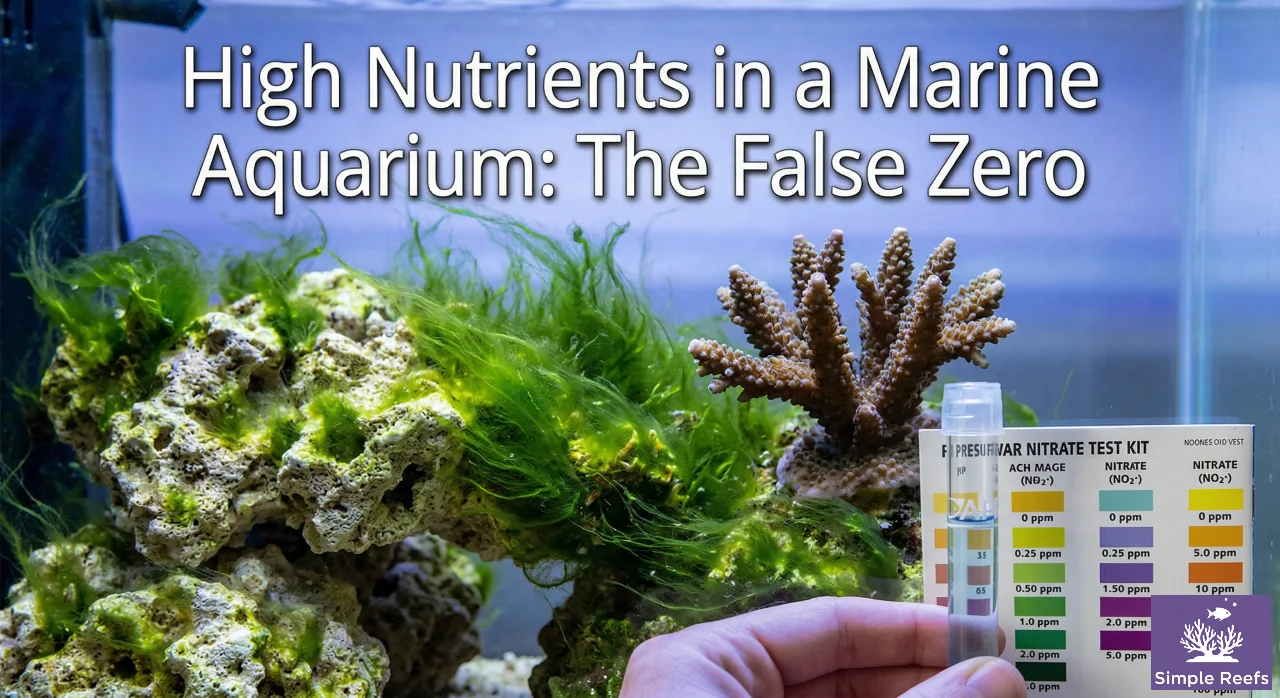
This is a very common situation for reefers to run into. You have hair algae all over the place but you test your water and it reads very low or even zero nitrates. Here’s the trick – don’t believe your test kit, your algae is making it lie to you! Lots of algae with no nitrates is a very common high nutrients issues.
It is incredibly unlikely that you have lots of algae but low levels of nitrates and phosphates. It just seems that way and there is a good reason for that. All of that hair algae that is in your display is actually the reason you have undetectable nitrates and phosphates.
The algae is actively consuming the nitrates and phosphates in the water and using them to grow. At this present moment in time, those compounds are bound up in the algae. If you were to remove all of that algae and give it a few days before testing your water again. Your nitrate and phosphate levels would be high again.

This is a really common mistake when it comes to marine aquarium ownership and water testing; it’s also a mistake I made myself as a beginner. I had hair algae and cyanobacteria everywhere but my results read undetectable levels. Luckily, I didn’t believe them.
Believe it or not, in an aquarium with algae eating fish, this is far less likely to happen. The fish will consume the algae before pooping it out and releasing the nutrients back into the water. Meaning the nitrates and phosphates will show up in tests.
You might be wondering: “If the algae is consuming the nutrients and acting like a natural filter, why is that a problem?“. Part of it is aesthetic – nobody wants to look at a glass box full of green fuzz. But more importantly, nuisance algae should be looked at like an aggressive weed.
If left unchecked, it will quickly smother your corals, block their light, and irritate their tissue. Plus, the moment you manually pull that algae out or it starts to die off, all those stored nutrients get dumped right back into your water.
⚠️ A Quick Note: The Danger of “True Zero”
While an explosion of green hair algae almost always points to hidden high nutrients, there is a dangerous flip side you need to be aware of. If your test kits are reading zero, and your tank is relatively clean but suddenly covered in a slimy, snotty, or rusty-looking film with trapped air bubbles, you might be dealing with a true zero-nutrient situation.
Aggressively stripping your water of all nitrates and phosphates starves out beneficial competing algae and bacteria. When the good guys starve, nasty opportunistic pests like Dinoflagellates (dinos) and Cyanobacteria (cyano) will quickly take over your display. Remember: the goal of reef keeping is nutrient management, not complete nutrient eradication!
How Do High Nutrients in a Marine Aquarium Happen?
High nutrients in a marine aquarium can happen quickly and easily. Just going about your regular routine – feeding your fish, adding placing nori in the tank, maybe being a little lacking in water changes – can result in nitrates and phosphates accumulating to a high point.
Even performing frequent water changes and doing basic maintenance can still lead you to encountering this specific problem. A couple of reasons high nutrients can crop up, out of the blue, are:
- Your RO (Reverse Osmosis) filters need changing
- Increased feeding
- A source of ammonia in your home (Cat litter tray, small animal cage, etc)
- Addition of extra fish or an overstocked aquarium
- Something has died in your aquarium
- Nutrient export, chaeto, reactor, turf scrubber, etc, isn’t functioning fully
- You have been unwell and unable to maintain the aquarium
- You have been working more and unable to maintain the aquarium
- Under estimated number of water changes
- Phosphates bound up in your rocks
Some of these can be completely unexpected and entirely invisible. Perhaps your RO/DI filter is old and you have nitrates in your source water?
Maybe you haven’t accounted for how much you are feeding when it comes to water change amount and frequency?
Perhaps your typical mode of nutrient export, macro algae, reactor, etc, isn’t functioning as well as it usually does. Maybe you have been unwell and unable to give your aquarium the attention it normally gets.

Perhaps something has died in your tank. Something like a snail can bury themselves away and rot in the sand, contributing unexpectedly to your nutrient profile. Have you added new residents to your aquarium and not accounted for the extra waste when calculating the size and frequency of water changes? Are you a little overstocked?
People have busy and, often, unpredictable lives and there are a ton of reasons why your marine aquarium’s nutrients might rise to annoying levels. It happens to the majority of owners and isn’t something to feel ashamed about. It’s just something that we need to work towards getting on top of.
⚠️ Warning: Unexpected Household Ammonia Sources
It is easy to forget that our aquariums actively “breathe” the air in our homes. Through surface water agitation and the massive volume of room air pulled in by protein skimmers, whatever is in your living space eventually makes its way into your reef. Because ammonia is highly water-soluble, airborne ammonia in your house can be absorbed by your tank, processed by your biological filter, and turned straight into algae-fueling nitrates.
Common household culprits include nearby cat litter boxes, puppy training pads, or even the frequent use of ammonia-based glass cleaners and aerosols near the aquarium.
A Personal Lesson: I actually learned this the hard way. A while back, we rescued and overwintered seven baby European hedgehogs. Even with constant, meticulous cleaning of their enclosures, the sheer amount of ambient ammonia they produced in the air was enough to completely disrupt the stability of a nearby nano tank. The aquarium rapidly absorbed that airborne waste, resulting in a massive, unexpected explosion of nutrients and algae.
If you are struggling with mysteriously high nutrients despite low feeding and strict maintenance, take a look around the room. Moving a pet’s litter area or simply opening a window to improve ventilation might be the missing piece of your nutrient puzzle.
The Next Step: Safely Lowering Your Aquarium Nutrients
Now that you understand where high nutrients come from, and why that perfect zero reading on your test kit might actually be a lie, it is time to get your water chemistry back under control.

We really need to remember the golden rule of reef keeping, here: nothing good happens fast in a marine aquarium. Rapidly stripping your water of nutrients can be just as dangerous as letting them run wild. We need to take it slow.
Fixing a nutrient issue requires a balanced, phased approach rather than a panic-induced overhaul. The most effective, long-term methods usually involve a combination of:
- Dilution: Performing strategic, calculated water changes to immediately remove suspended waste.
- Mechanical Export: Ensuring your protein skimmer is correctly sized and dialed in for a wetter skim.
- Natural Filtration: Setting up a refugium to grow macroalgae (like Chaetomorpha), which safely outcompetes the nuisance algae in your display.
- Chemical Media: Utilising tools like Granular Ferric Oxide (GFO) or carbon dosing to tackle stubborn, lingering phosphate and nitrate issues.
We are going to be putting together a full plan of action to deal with high nutrients in a marine aquarium so look out for that shortly. We’ll also be including some options that are a little more focused on budget setups.
Frequently Asked Questions
Why do my test kits read zero when my tank is full of algae?
This is a classic “false zero.” The nuisance algae in your display tank is consuming the nitrates and phosphates as quickly as they are produced, effectively hiding them from your test kits. If you remove the algae, the nutrient levels in the water will temporarily spike back up until a proper export method is in place.
Will high nutrients kill my cleanup crew?
Yes, chronic high nutrients are very dangerous to invertebrates. Elevated phosphates physically block calcification, preventing snails and shrimp from building shells or molting safely. Meanwhile, high nitrates cause severe cellular stress and osmoregulation issues, leading to lethargy and a significantly shortened lifespan.
Can room air really affect my aquarium’s nutrient levels?
Absolutely. Because marine aquariums have high gas exchange, especially through the massive amount of air pulled in by protein skimmers, airborne ammonia from cat litter boxes, pet enclosures, or cleaning sprays can be drawn directly into the water. Your biological filter then converts this ambient ammonia straight into algae-fueling nitrates.
Can lots of algae smother my coral?
Absolutely. Nuisance algae like green hair algae is highly aggressive and fast-growing. If left unchecked, it will physically grow over your corals, blocking out the vital light they need to survive. The algae also severely irritates the coral’s delicate tissue, forcing it to stay closed, which eventually starves and kills the coral.
Can high nutrients directly kill my coral?
Yes. While corals need trace amounts of nutrients to survive, prolonged high levels of nitrates and phosphates are toxic, particularly to delicate stony corals (SPS and LPS). High phosphates physically inhibit a stony coral’s ability to build its calcium carbonate skeleton. Excessive nutrients also cause corals to “brown out” (lose their vibrant colours), retract their polyps, and eventually suffer from rapid tissue necrosis (RTN) or bleaching.
Remember, if you are suffering from high nutrients as many of us do at one point or another, don’t panic. Don’t rush to over-correct the problem, take your time and do things slowly. Thanks for reading and happy reefing.