
The Importance of Test Kits To a Marine Aquarium
Welcome to Simple Reefs. We are a brand new website designed to take the stress and expense out of starting your very own marine aquarium. We’ve been talking about cycling a marine aquarium a lot, lately. That got me to thinking, do people realise the importance of test kits? With this in mind, I decided to put together this article on The Importance of Marine Aquarium Test Kits!
Table of Contents
A Careful Balancing Act
Take a second to think about what we are doing when we put together a marine aquarium. We are, in essence, taking a small piece of the ocean and encasing it in glass. Designing it ourselves and, more often than not, bringing together creatures from all over the world that all have slightly different requirements and wouldn’t typically co-exist.
None of the natural conditions that these creatures need to thrive are present in this glass box when we start. We are creating them from scratch, whether by mixing the salt correctly or by heating the water. There is no connection to the ocean and no method of exporting waste, we are doing it all ourselves.

It’s kind of extraordinary when you think about it! Putting the marine aquarium experience into perspective like this also draws attention to something else – the careful balancing act that keeps our coral, invertebrates, and fish happy and healthy. There are dozens of things that can go wrong and, most of the time, we don’t even realise it.
A Delicate Miniature Ecosystem
If you think of your aquarium like a miniature ecosystem you can start to focus in on all the perils that come along with it. After all, our aquariums are, essentially, prone to many of the same threats and risks as larger, open, ecosystems.
Pollution from waste, pollution from airborne toxins, pollution from decay, accumulation of unwanted compounds, accumulation of dangerous metals, the collapse of your biological filter. These are all potential hazards in your aquarium and the thing that’s really scary is most of these issues are invisible to the naked eye.
The Issues You Can’t See
The truth of the matter is that you are not going to be able to tell when many of these issues occur. Your only warning will come when it is already too late to do anything about it. Be it in the form of your invertebrates beginning to look tired and lifeless, your coral losing flesh, or your fish looking listless.
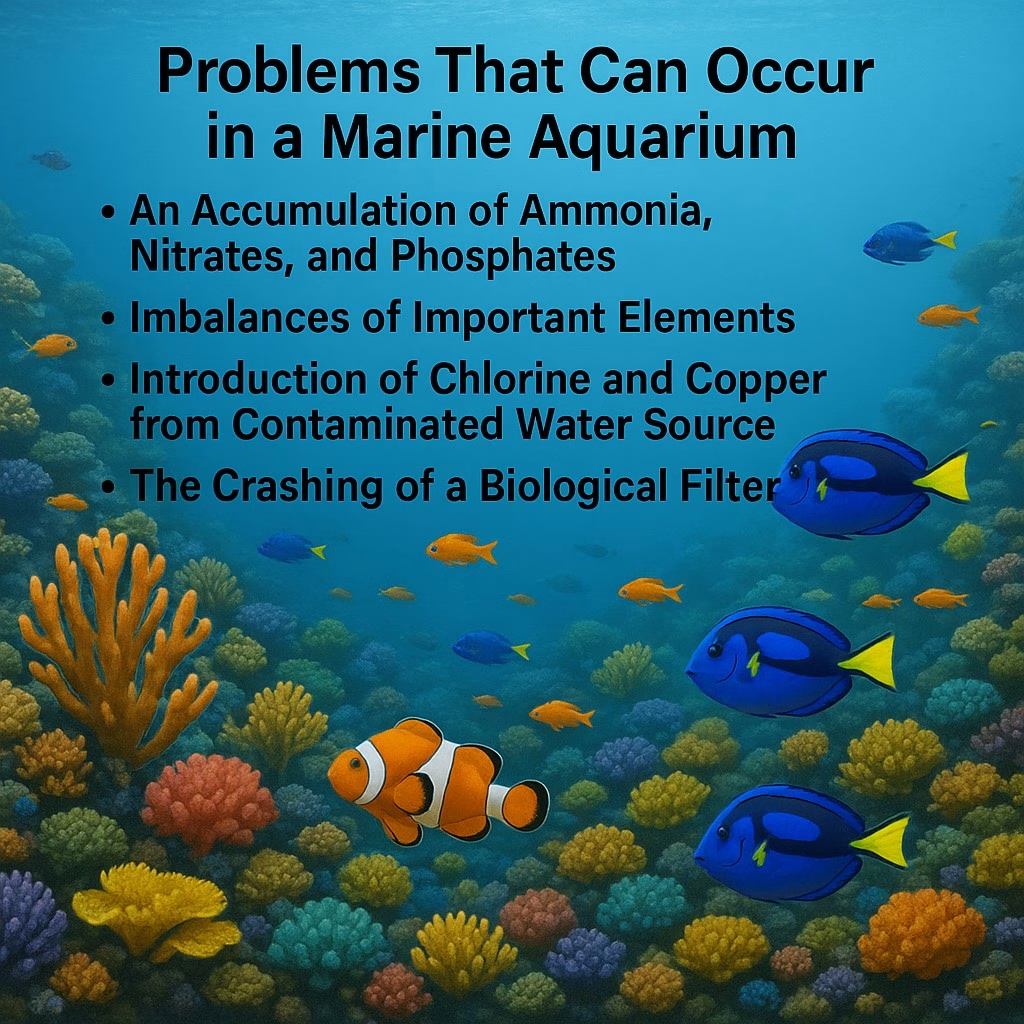
Let’s take a look at a couple of scenarios that can result in absolute disaster in a marine aquarium. I have actually experienced a couple of these myself so I am speaking from a place of experience.
- An accumulation of ammonia (this can come from the air, a rotting resident, or even your salt) overwhelming your established biological filter leading to a full cycle collapse.
- An accumulation of nitrates that begins to impact more sensitive coral and invertebrates.
- Copper from your water source accumulating in the water.
- Imbalances of important elements like Calcium, Magnesium, and Alkalinity.
- Accumulation of Phosphates from rotting food.
- Accumulation of Chlorine from a water source.
These are just some of the problems that can occur in a marine aquarium that are completely undetectable by the human eye until they become a series issue. The really concerning thing is that these things can all occur despite your careful husbandry. Allow me to explain a little more in depth.
Problems Can Occur Despite Best Practices
The two most common issues on that list are the accumulation of Phosphates and Nitrates. I mean, let’s be honest, those adorable (yet annoying) fish coming up to the front of the tank every time you walk past are hard to resist. It’s very easy to overfeed them which can result in a build up of both of these waste elements.
Phosphates, in particular, are a big problem because they bind up into the rocks and sand. Effectively getting trapped there. When you perform a water change you are bringing these elements down. The Phosphates that are trapped in the rocks will suddenly be released to bring the water back to the levels that it was at before you did the water change. Immensely frustrating!
These two seemingly minor elements can cause big problems. They fuel the spread of algae as algae consumes nitrates and phosphates to grow. They can provide available nutrients to problem things like Cyanobacteria. On top of that, removing the problem nutrients from the water too quickly can cause major issues like Dinoflagellates which thrive in low nutrient systems. It’s a difficult balancing act.
It Can Get Much Worse
But what about some of those other problems? Let’s take Ammonia as an example. Ammonia shouldn’t be a big problem, right? Your aquarium is well cycled and mature, what is the issue? Well, the issue comes when your aquarium is suddenly exposed to increased levels of ammonia.
Do you have a cat’s litter tray in the vicinity of the aquarium or near where you mix your saltwater? Do you have a rat or hamster cage in the same room as your aquarium? Ammonia can come from some surprising sources. Due to the fact that it evaporates from things like animal urine and is readily absorbed by water. Ammonia levels in your aquarium can climb out of nowhere.

I have even had ammonia levels shoot up from a contaminated source of aquarium salt by a certain British manufacturer that I won’t name. When ammonia climbs, your biological filter may struggled to deal with it. At the very least, nitrates will climb through the roof thanks to the ammonia being converted by the nitrifying bacteria in your tank.
That’s without mentioning problematic elements that can come from your water source. An old RO/DI filter that’s no longer doing its job could be allowing things like Copper and Chlorine into your water.
These might not cause problems immediately but as they accumulate they can become dangerous. The really scary thing is, you will never known it is happening. This is where the importance of test kits to a marine aquarium comes in.
What is a Marine Aquarium Test Kit?
Now that we have a little insight into just how things can go wrong without us being able to actually see the problem. Let’s take a look at the solution and how we can give ourselves an advantage when it comes to preventing and dealing with issues.

Marine Aquarium Test Kits are sort of like your aquarium trouble-shooters. The same way a mechanic can diagnose car problems using diagnostic tools, you can diagnose problems with your water using test kits. Not only will they tell you what the problem is, they will often put a number to how big of a problem it is.
Marine test kits come in a variety of forms. We have test kits that require you to take a sample of water and send it off to a laboratory for results. We have test kits that are read by a little device which gives you a digital number to reference; we have test strips which change colour when you put a drop of water on them; and we have kits that you perform in vials and then compare to a colour chart.
How Do Test Kits Work?
The most common types of test kits, and most affordable, are the latter and require you to take some of your tank water, place it in a vial, and add a series of regents to it. These reagents will chemically react with the elements in the water and the water will change colour. You then compare this colour to a chart to find the corresponding reading.
This corresponding reading will show you the concentration in the water of the element being tested. This will usually be in an easy to read parameter like PPM (Parts Per Million) or PPT (Parts Per Thousand).

A good example of this would be a nitrate test kit like the one I am showing in the image here. If there was no nitrate in the water, no chemical reaction would take place so the water would be clear. The presence of nitrates in the water causes a chemical reaction which changes the water’s colour to a subtle pink. This indicates the presences of around 12PPM nitrates.
This was a Salifert Test Kit and the process was simple. I took 1mm of my tank’s water using a syringe. I added 4 drops of Salifert’s reagent liquid to the water and then a flat spoonful of reagent powder to the mixture using the provided spoon.
The powder has to be packed into the spoon and then flatted out to make it level. You then, simply, swirl the mixture for 30 seconds until it is mixed and wait 3 minutes for the result. It’s easy and accurate, even compared to my digital Hanna checker. Some of the readings can be tough to differentiate, though.
The Importance of Test Kits To A Marine Aquarium
The importance of Marine Aquarium Test Kits can’t be understated. They are an absolutely vital tool in your fishkeeping kit and for a whole multitude of reasons.
- Essential for identifying the progress of your aquarium’s initial cycling period.
- Can inform you that problems are occurring before they do damage to the tank.
- Can help you maintain a stable environment for your aquarium’s residents.
- Can help you balance and adjust important elements needed for more advanced coral.
- Can help you identify problems with your source water.
- Can help you identify problems with your salt.
- Can help you prevent underdosing or overdosing of elements and additives.
A few of these things are very obvious, right? I mean, it is genuinely impossible to accurately identify whether, or not, your aquarium has cycled correctly without test kits (Check out our guide on how to cycle a new marine aquarium). You need, at the least, an ammonia test kit and a nitrate test kit. A nitrite test kit can be important if you choose to check those levels, too.
Some of these points are not so obvious, however, but can save you a whole lot of pain in the long run. If you have a solid collection of test kits and you make testing your water part of your weekly marine aquarium maintenance routine, you can prevent issues before they happen.
Test Kits Can Help Guide Solutions to Problems
Let’s be honest, when you notice a lot of algae growing or you see that your coral is looking a bit sad, you usually have little idea as to the cause. There can be so many different problems in a marine aquarium that tying something down to one reason, or another, can be really difficult.

This is particularly true if the only way you can fix these issues is by stabbing in the dark and hoping you stumble on the solution.
Is it an increase in ammonia? Have nitrate levels spiked? Does your water have copper in it? A decent array of marine aquarium test kits can help you find the problem immediately. With a test kit, you aren’t stabbing in the dark. You are shining a torch on the root cause of the problem and finding out exactly what is wrong.
This means your solution to the issue is more obvious and easier to focus on. You won’t be wasting money trying a bunch of different things to make the problem go away. You will be dealing with the cause of it directly.
Test Kits Can Help Maintain Stability
Test kits become even more important in more advanced reefs. This is where the usual collection of test kits that most marine aquarium owners should buy expands dramatically. Frequently testing your water for certain elements like Magnesium, Calcium, and Alkalinity is paramount to success when keeping more advanced stony coral.
Stony coral expect a certain amount of calcium in the water (they use it to build their skeletons), they prefer low nutrient levels, they need a stable PH level, and the presence of trace elements like Strontium and Magnesium. The only way you can provide all of these things is via the use of frequent testing. You have to continuously monitor, and then dose, the elements that need replacing as they are consumed by the coral.
Even a simple marine aquarium can benefit from the consistent monitoring of things like PH, Nitrate and Phosphate. The stability that comes from making sure these levels stay consistent is a huge benefit to any tank. More stability always equates to more growth and a happier reef. Even if you only keep soft coral. Frequent testing of you water allows you to give your tank what it needs, when it needs it.
Test Kits Can Save You Money
It sounds a bit counterintuitive, right? How can something that you have to spend money on save you money in the long run? Well, it is quite simple. When it comes to marine aquarium ownership, it is far cheaper to prevent a problem than it is to fix one.

I will refer back to my own issues from not testing that I mentioned earlier. I won’t relate the whole story, that’s coming up in a few days in a Mistakes and Mishap Monday’s article. Suffice to say, a bad batch of salt caused a huge ammonia spike in my tank which lead to an accumulation of nitrates. I, unfortunately, was neglecting to test frequently, at the time.
Fixing the problem cost me hundreds of pounds and a lot of time and effort. If I had been testing routinely, I would have seen the problem occurring before it became a huge issue. I could have prevented it which would have saved me a lot of money.
Test kits can act as early warning indicators of upcoming problems and help you prevent issues before they become costly and troublesome.
In Short
I hope this article has helped you to understand, a little better, the importance of test kits to a marine aquarium. Test kits aren’t just a useful tool in your marine aquarium kit, they are an absolute essential. Using marine aquarium test kits can be the difference between a comfortable and easy marine aquarium ownership journey and an absolute nightmare of a time.
Having that solid indicator of upcoming problems or just that peace of mind that your parameters are stable is invaluable. Test kits can help you identify problems, fix problems, and even prevent problems.
We have some more test kit related articles coming up this week. We are going to be talking about the importance of good quality, reliable, test kits and how to identify them, tomorrow. We are also going to be talking about the importance of testing your water routinely. Thanks for reading and spending your time with Simple Reefs.