
The Importance of Flow in a Marine Aquarium – 5 Reasons to Get The Waves Moving
Welcome to Simple Reefs. We are a brand new website designed to take the stress and expense out of starting your very own marine aquarium. One of the most overlooked topics when it comes to this hobby is the importance of flow in a marine aquarium. Today, we are going to be talking about exactly that.
Table of Contents
The Importance of Flow
Let’s be honest, when it comes to marine aquariums and reefs, hobbyists have a tendency to obsess over powerful lighting, precise water chemistry, and sophisticated filtration. One of the key things that often gets overlooked is the fourth pillar crucial for a thriving reef ecosystem: water flow. Hell, I am even guilty of this myself.
Now, we aren’t just talking about the little trickle that comes from your filter or return pump. Flow is about more than just moving water around. Flow is the tank’s circulatory and respiratory system; it helps to dictate the health of everything in your aquarium from the coral to the fish.
It creates a more oxygen rich environment, helps keep your fish active, feeds your coral, and even helps to keep the tank clean and algae free. Understanding and implementing proper water flow is one of the most beneficial steps you can take to transform a good aquarium into a great one.
Mimicking the Ocean’s Rhythms

It might sound like a bit of an oversimplification but, at its core, the goal of a marine aquarium is to replicate a slice of the ocean. All of the good stuff that exists in the sea, we want in our tanks. This goes for the beneficial bacteria, the clean-up crews, the elements in the water, and even the sand. There’s something that a lot of owners forget about when it comes to replicating this ocean environment, however.
The ocean is never still. It is a world of constant motion driven by tides, waves, and currents. These movements are absolutely fundamental to life on the reef. Coral and other sessile invertebrates have evolved over millennia to harness this energy.
The key is in that word right there – sessile. Coral are fixed in one place and cannot move to find food or escape their own waste. They rely entirely on the water itself to bring them life sustaining elements and carry away harmful detritus and by-products. We need to recreate that idea in our aquariums and that is where flow comes in.
The Critical Roles of Water Flow
The importance of flow can be broken down into several key functions, each vital for a stable and healthy system. While some of these are fairly obvious, others are slightly less apparent until you really think about it. Let’s take a look.
1. Gas Exchange: Coral, like all living animals, respire. They consume oxygen (O2) and release carbon dioxide (CO2). Now, us being mammals, we have a pretty specialised respiratory system. The sheer fact that we can pull air into our lungs to enable gas exchange is a massive cheat code because things like coral can not do this.
In fact, coral have no specialised respiratory structure at all, unlike many animals including fish. They are completely dependent on the oxygenated water being delivered straight to them to enable gas exchange. The only thing they can do to improve their chances is extending their polyps to increase the surface area usable for said gas exchange.
A thin, stagnant layer of water known as the diffusive boundary layer (DBL) can form around a coral’s tissue in low-flow conditions. This layer becomes depleted of oxygen and saturated with CO2. This effectively suffocates the coral. It would be like a human being in an air-tight bubble. You could only breathe for a short amount of time before that air trapped in there becomes depleted of oxygen, eventually causing you to suffocate.
Proper flow continuously breaks up this boundary layer, delivering fresh, oxygenated water and carrying away waste gases. Remember, the coral can’t move to complete this process itself. Think of it like popping that bubble and allowing yourself to breathe.
2. Nutrient Exchange: Similarly, flow delivers essential nutrients, including dissolved organic compounds for food, and the building blocks for skeletal growth like calcium (Ca2+) and carbonate (CO32−), directly to the coral’s polyps. Again, your coral can’t move so it needs, essentially, nature’s version of Door Dash to deliver straight to its door.

3. Waste Removal: As we have said many times on this website, a reef tank is a closed system where waste products can quickly accumulate. Fish waste, uneaten food, and other organic matter that we generally refer to as detritus will settle in low-flow areas of the tank. As this detritus decomposes, it releases nitrates (NO3−) and phosphates (PO43−). These are the primary fuels for nuisance algae outbreaks like hair algae and cyanobacteria.
Robust and rather chaotic flow keeps these particles suspended in the water column long enough for them to be exported by the mechanical filtration (filter socks, protein skimmers, hang-on-back filter, pick your poison). A well-designed flow pattern acts as a self-cleaning mechanism for your aquarium, preventing the build up of waste that can seriously degrade water quality.
4. Coral Health and Growth: Water movement directly stimulates coral tissue, encouraging it to grow stronger and more densely. Think of it, sort of, like how exercise builds muscle in humans. Push the coral around a bit and it will fight back, growing larger, thicker, and more robust in the process.
Flow also plays a vital role in coral immunity. Corals produce a protective mucus layer, which can trap debris and pathogens which you really don’t want. Adequate flow helps them shed this mucus layer, keeping their surfaces clean and reducing the risk of bacterial infections or tissue necrosis.
Remember, different coral have different needs. SPS (Small Polyp Stony) corals, like Acropora, often come from extremely high-energy reef crests and demand strong, turbulent flow. LPS (Large Polyp Stony) corals, such as Euphyllia (torch and hammer corals), prefer moderate, indirect flow that allows their large, fleshy polyps to sway gently without being damaged. Soft corals and mushrooms are generally best in lower-flow areas.
5. Fish Health and Behaviour: Flow isn’t just for corals. In fact, this might be the most underrated benefit of having decent flow in your marine aquarium. It encourages fish to swim actively, promoting better muscle development and overall health.
Remember, whenever we can replicate their natural environment we are creating a better home for our fish. In the wild, your tangs and angels would be forced to navigate currents to find food and shelter. If you can recreate this in your aquarium, it will reduce stress and boredom and can even lower levels of aggression.
So there’s 5 reasons to get the waves flowing in your marine aquarium. The question is, however, what constitutes quality flow? Well, let’s take a look.
Achieving Quality Flow: It’s Not Just About Speed
Creating good flow is more of an art than a science. The goal is not simply to create a whirlpool or to have your fish pinned against the side of the tank or fighting the pulling force of an oversized gyre.

You are aiming, more, to generate a varied and random current that replicates the real current that would be found in the ocean. That brings us onto some key differences when it comes to this subject and something you may notice in your own tank.
- Laminar Flow: Laminar flow is a direct, constant stream, like water from a hose. While you might be more familiar with this style of flow from freshwater aquariums, in marine fishkeeping, it is undesirable as it can blast one area while leaving others stagnant.
- Turbulent or Chaotic flow: This type of flow moves in multiple directions and changes intensity much like the waves or current in the sea. It ensures that all areas of the tank, from behind the rockwork to under coral to right down to the sand bed, receive adequate circulation.
- Dead Spots: Dead spots are spots of your aquarium that receive little or no flow. These will be noticeable because they will accumulate detritus and may even suffer from more significant algae growth or the appearance of cyanobacteria.
It’s not really enough to just buy a very cheap powerhead and point it at a part of your tank and hope for the best when it comes to more advanced coral. You can, likely, get away with this in basic tanks but more advanced reefs need more advanced solutions.
The idea is to reduce dead spots to virtually zero. There are specific pieces of equipment designed to do just this.
- Creating Quality Flow: Modern aquariums achieve quality, turbulent or chaotic flow with a combination of equipment:
- Return Pump: or Filter The pump in your sump that returns water to the display tank provides a baseline of flow. As does a hang-on-back filter outlet or the return line for a canister filter. This is more laminar flow but acts as your starting point.
- Powerheads & Wavemakers: These are the primary tools for creating flow within the tank. Basic powerheads and cheaper wavemakers will need some creative positioning to bounce the flow off of the back of the tank and off of the rocks. Modern DC-powered wavemakers are highly controllable and can be quite affordable, allowing hobbyists to program various patterns like pulses, surges, and random fluctuations that mimic natural ocean currents.
- Gyres: Gyres are a more advanced and expensive option designed for moderate to large aquariums. They excel at moving large volumes of water from one side of the tank to the other, creating a broad, almost wave like flow pattern that is excellent for eliminating dead spots. One gyre can do the work of multiple powerheads and a gyre placed at opposite ends of the tank can typically provide all the flow you will ever need.

We will be talking a lot more about gyres, wavemakers, and powerheads in the future. We will focus on bringing you some genuinely affordable options to save your bank balance as well as improve the health of your tank.
Finding the Balance: Signs of Good and Bad Flow
Quality flow is a delicate balancing act that you may find yourself working on for the entirety of your marine aquarium’s life. I know that I find myself adjusting and moving things around a few times a year. It’s, again, more of an art than a perfect science.
There are some significant clues, however, that you are getting things right. Paying close attention to these signs can help you perfect your tank’s water movement and flow.
- Signs of Too Little Flow: Detritus settling on rocks and sand; nuisance algae or cyanobacteria growing in “dead spots”; corals remaining closed or exhibiting poor polyp extension.
- Signs of Too Much Flow: Sand being blown around constantly in a sand storm, creating bare spots on the bottom; coral tissue being peeled back from the skeleton (“flapping”); fish struggling to swim in certain areas.
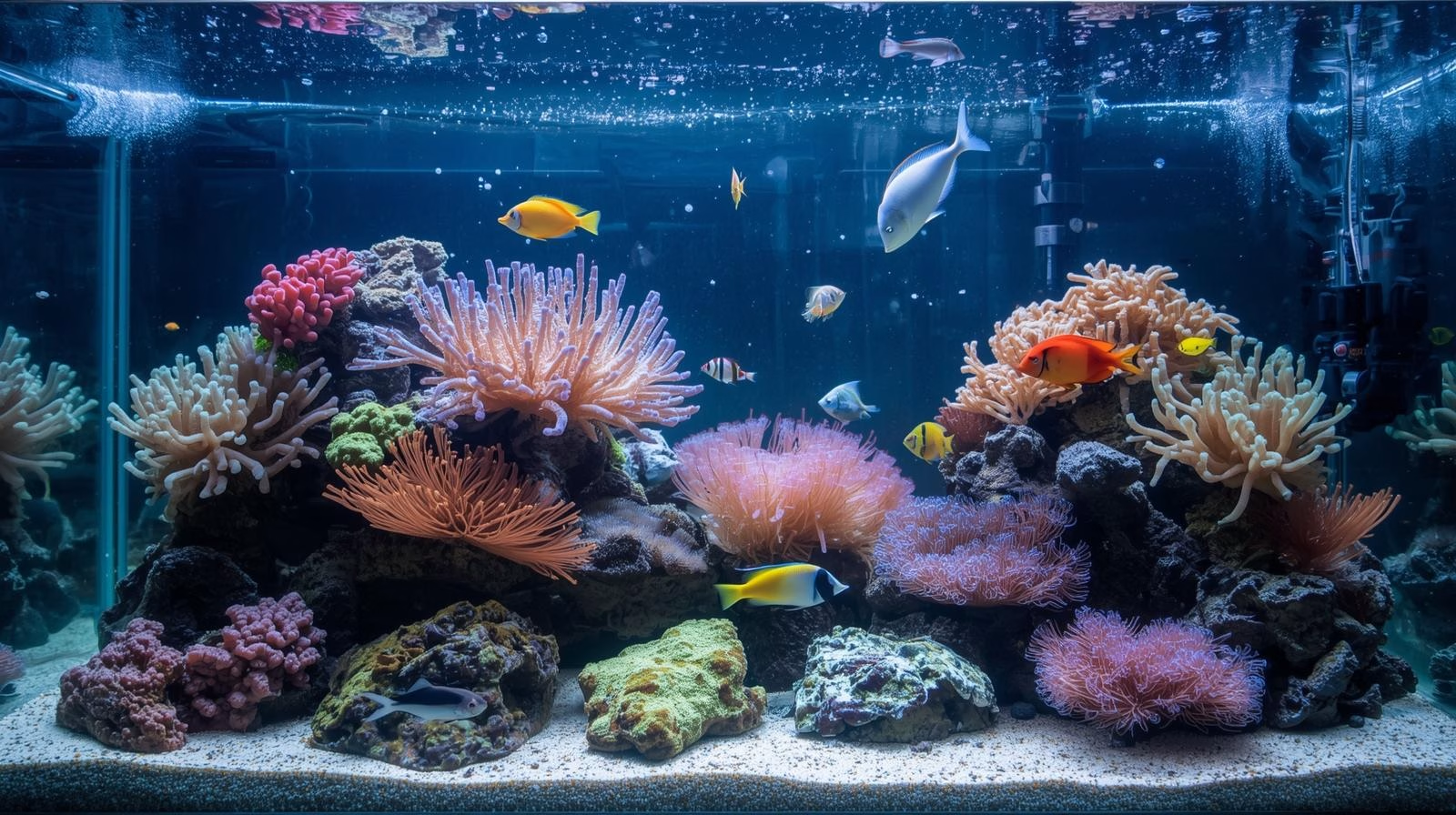
- Signs of Good Flow: A gentle, swaying motion in the polyps of soft and LPS corals; no visible accumulation of detritus; fish swimming actively throughout the entire water column.
It should be pretty obvious when you have found that sweet-spot for flow levels purely by these signs. Aim for that Goldilocks amount in the middle with some gentle swaying of coral, happy looking fish, and no accumulation of algae or detritus.
In Short
Flow is an often underrated part of marine aquarium ownership. It can be as simple as investing in a few powerheads cleverly positioned or purchasing a wavemaker. Quality, turbulent flow can provide much needed gas exchange and nutrients to your coral, help keep your tank’s surfaces waste free, and provide your fish with a more entertaining and natural environment. Thanks for reading and spending your time at Simple Reefs.