
Live Sand vs. Dry Sand: The Ultimate Guide for Budget Marine Aquariums
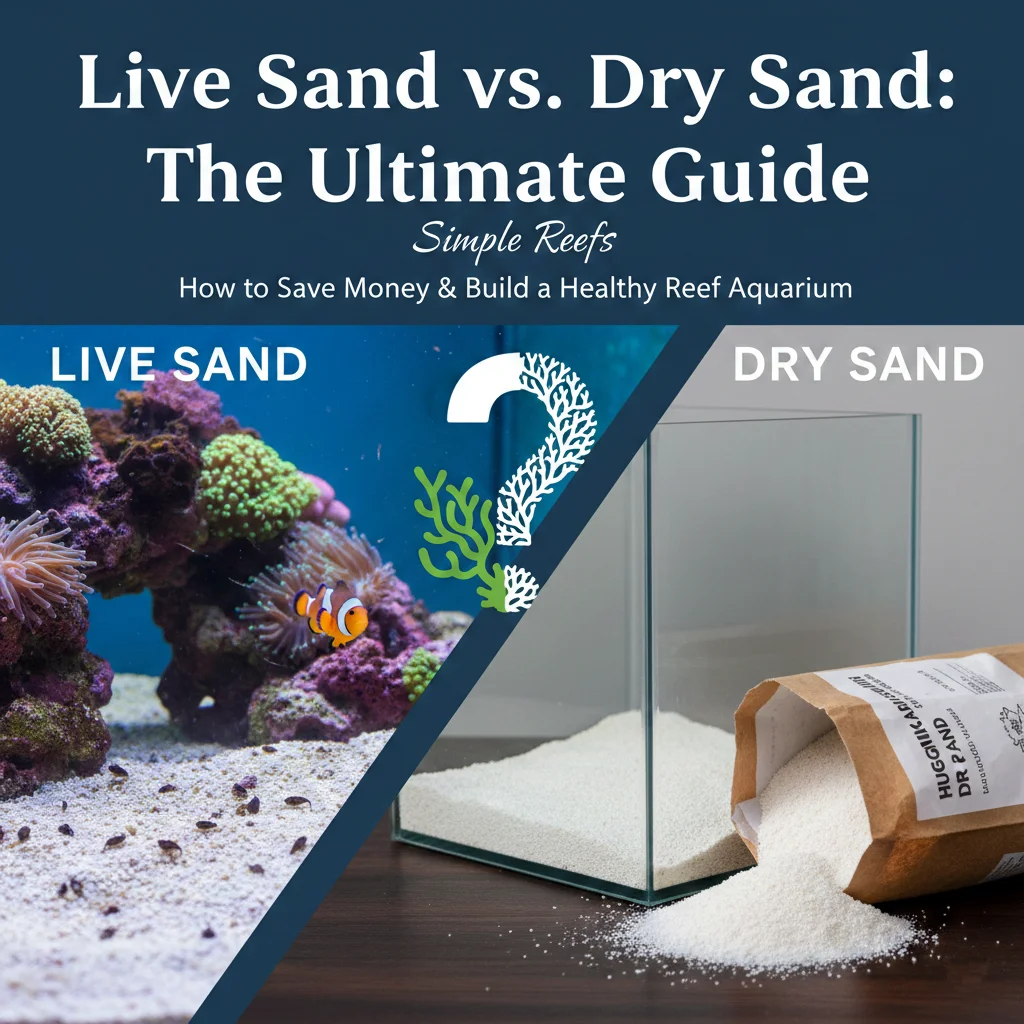
Welcome to Simple Reefs. We recently looked at Sand vs. Bare Bottom Reef Tank: Which is Best? If you have decided that you would like to include a sand bed in your new tank, we are here to save you some serious money. Today, we are looking at Live Sand vs. Dry Sand: How to Save Money on Your New Aquarium.
Table of Contents
The Great Sand Debate: In this guide, we strip away the jargon and break down the pros, cons, and costs of using Dry Sand versus Live Sand. We will show you exactly how these choices affect your wallet, your cycle, and the health of your future aquarium residents.
Key Takeaways
- Dry Sand is the budget king: It is completely dry, contains no life, and is far more affordable. It is a barren wasteland but has all the potential in the world to become live sand over time.
- Live Sand is packed with bacteria: Infused with millions of nitrifying bacteria, it provides a great jumping-off point but comes at a massive premium.
- The “Instant Cycle” is a myth: Despite bold claims on the bags, live sand is not a quick fix. You still need to cycle your tank patiently to ensure the safety of your fish.
Live Sand and Dry Sand
If you have decided that you want to properly recreate the aesthetic of an underwater reef, right in your living room. You have probably realised that a sand bed is the way to go.
That likely means you have started browsing the web, looking in online stores, and wondering what the hell the deal is with this whole “Live Sand” and “Dry Sand” debate.
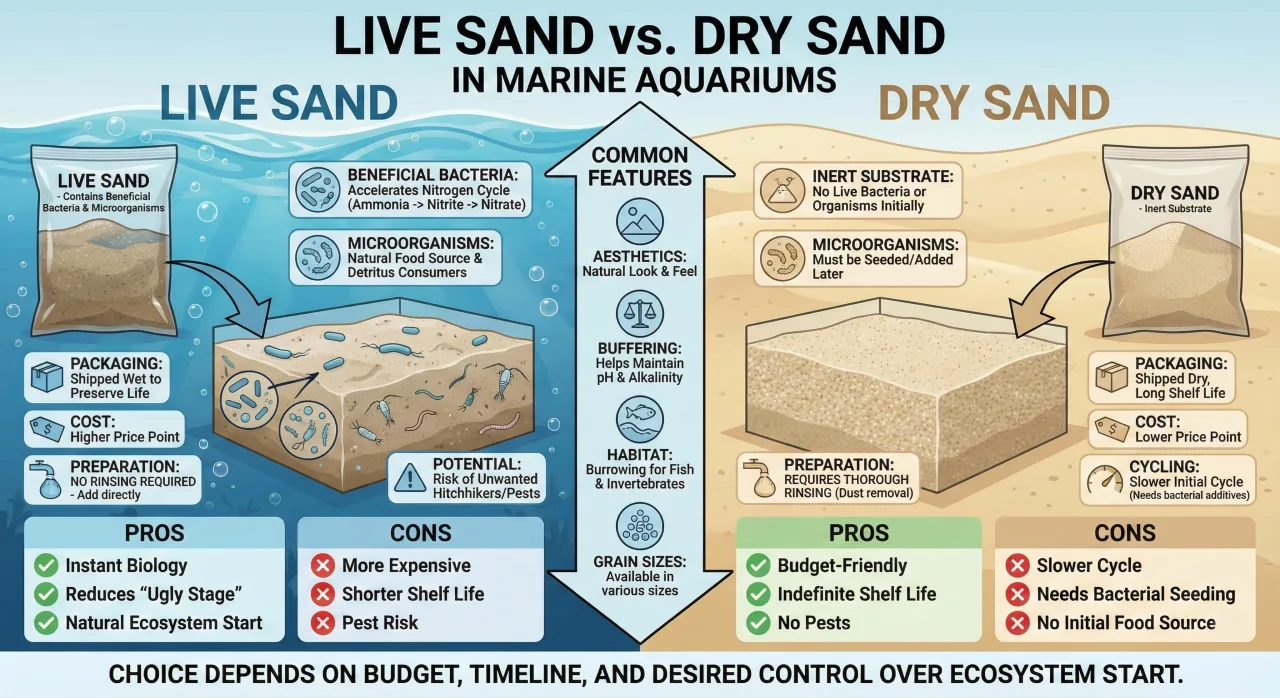
What are the differences between live sand and dry sand? Why does one cost so much more than the other? How do I save money if I want a sand bed in my marine aquarium?
It’s a genuine minefield and, like most things in this saltwater hobby, it can end up running into some serious money. This article is going to simplify this whole debate for you and tell you how you can include a sand bed in your marine aquarium without breaking the bank.
Quick Comparison: Live Sand vs. Dry Sand
The first point we need to cover is the actual difference between live sand and dry sand. The first thing you will notice is the price. Dry sand is much cheaper than live sand.
If you are standing in your local fish shop trying to decide what to buy, here is a quick breakdown of how these two types of sand stack up against each other.
| Sand Type | Cost | Bacteria Present? | Risk Level | Best For… |
|---|---|---|---|---|
| 🏖️ Live Sand | Very High (Over double the price) | Yes (Millions of nitrifying bacteria) | Low to Medium (False sense of security) | Those wanting a bacterial head start. |
| 🏜️ Dry Sand | Low (Very affordable) | No (Completely barren) | Zero (No biological die-off) | Beginners on a budget prioritising savings. |
Live and Dry: What Does it Mean?
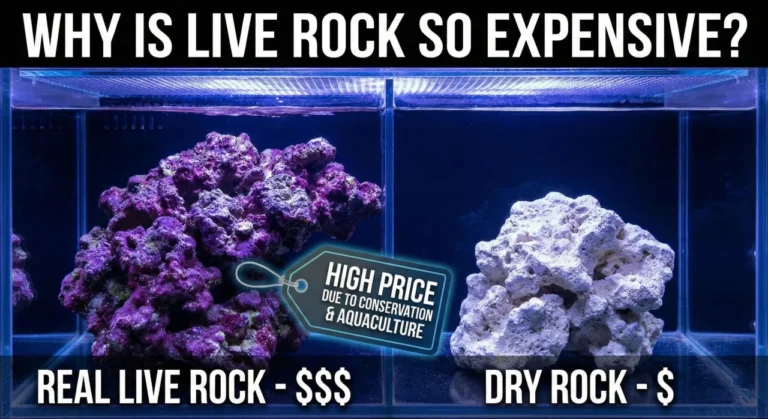
You will see the terms “live” and “dry” used a lot when referring to marine aquariums. For example, we have live sand and live rocks as well as dry sand and dry rocks. The terms, almost universally, pertain to whether or not the product in question is bio-active.
It’s easy to assume, when seeing the word “Live”, that the rocks or sand themselves are actually alive. This isn’t the case, of course. The term “Live” is a bit of a misnomer.
Live simply means that the surfaces of the rock or sand are covered in bacteria and perhaps playing host to a selection of micro-invertebrates, molluscs, algae, and lifeforms.
💡 What Does “Bio-active” Actually Mean?
You hear this term thrown around a lot in the marine hobby. When we say a sand bed or piece of rock is bio-active, we mean it hosts a living, breathing micro-ecosystem. We are not just talking about beneficial bacteria; a truly bio-active sand bed contains tiny crustaceans like copepods, micro-brittle stars, and tiny worms that work around the clock to break down fish waste and uneaten food. Think of it as an invisible, microscopic cleanup crew that keeps your water safe and stable.
Dry simply means the opposite. The rock or sand contains no living organisms, no bacteria, and no invertebrates. They may have played host to life in the past, but that life is now long dead with no chance of revival.
The term “dry” is a lot more literal as the sand and rocks actually come to you completely dry in a box or bag. Live sand or live rocks will arrive damp or in water. That’s why bags of live sand feel heavier – they contain water.
The Nitrogen Cycle: Why Bacteria Matters
Before we go deeper into the sand choices, we need to address the process of cycling an aquarium. This is very important because the lives of your future aquarium residents depend on it.
Cycling an aquarium is the process of transforming an aquarium from a barren wasteland into a mini-ecosystem teeming with bacteria. When fish eat, breathe, and poop, they produce a toxic compound known as ammonia. This ammonia, left to amass, will burn your fish’s gills, eventually killing them.

Before introducing fish to our tank, we need to complete a cycle. You can read a beginners guide on cycling a marine aquarium right here.
This cycle consists of forcing our aquarium to produce a specific type of bacteria which will consume the ammonia in the water, turning it into the slightly less harmful compound nitrite. Another type of bacteria then transforms the nitrite into an even less harmful compound known as nitrate, which we can then remove from the water by performing water changes.
This cycle takes time. We need to feed the tank with ammonia to make it happen, allowing the bacteria to feed and reproduce. We can speed this whole process up by introducing the bacteria at the start of our cycle. This is where live sand comes in.
What is Live Sand?
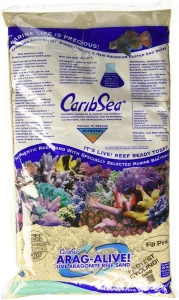
Live sand comes to you, in most cases, soaking wet and teeming with bacteria that’s ready and waiting to get started processing ammonia and reproducing.
Now, live sand is a bit of a catch all term. We could be referring to sand taken from a well-established marine aquarium. That sand is live because it will be packed with beneficial bacteria.
When it comes to commercial products however, live sand usually refers to a product made by companies like CaribSea and Nature’s Ocean. This sand is specially produced by these companies and comes already bioactive and bursting with nitrifying bacteria.
There’s lots of versatility here, too. These companies have you covered for most setups as their live sand comes in a number of different grades depending on preference: fine grain, thick grain, light colours, dark colours, etc.
💡 A Quick Note on Grain Size
When picking your sand, you will notice it comes in different grades or grain sizes. This choice actually matters just as much as picking live or dry!
- Sugar-Fine (0.1 to 1.0mm): Looks incredibly natural and is perfect for burrowing wrasses. However, it blows around very easily if you have high water flow, causing cloudy water and frustrating sandstorms.
- Medium Grade (1.0 to 2.0mm): The “sweet spot” for most beginners. It is heavy enough to stay put under your wavemakers but still soft and fine enough for gobies and snails to sift through comfortably.
- Crushed Coral (Coarse): Will not blow around at all, but it is notorious for trapping detritus and fish waste in the large gaps between grains. This can quickly turn into a nitrate factory and the sharp edges can injure sand-sifting fish.
The sand stays wet in the bag and, in theory, the bacteria should still be live when you open it. When added to your aquarium, this bacteria gets straight to work consuming ammonia. Providing a great kick-off point for your cycle and to set you up for a brighter future in marine aquarium ownership.
So we have established that live sand can help your cycle and contains millions of nitrifying bacteria. Now it’s time to address one of the product’s more dubious claims – can live sand instantly cycle a marine aquarium?
💡 Is Live Sand Bad for the Environment?
A common worry for new marine aquarists is the environmental impact of buying reef sand. You might picture massive machines tearing up beautiful living coral reefs to fill plastic bags for fish shops. Thankfully, this is rarely the case nowadays!
Modern live sand from major brands, such as CaribSea, is actually highly ethical. The aragonite sand is usually sustainably harvested from naturally renewing sources like the vast oolitic banks in the Bahamas where no living coral reefs exist. In other cases, it is safely quarried from ancient dry land sites. Once collected, it is taken to a facility and infused with laboratory-grown nitrifying bacteria. You can build your beautiful marine aquarium knowing you are not harming the real ocean.
Can Live Sand Really Instantly Cycle a Marine Aquarium?
Live sand can’t instantly cycle a marine aquarium, despite what it says on the front of the packaging. This is a dubious claim at best and dangerous at worst.
Many companies that produce live sand state that using live sand allows the addition of fish straight away. This should be approached with the utmost caution.

💡 Tip: Match Your Sand Grade to Your Livestock
Before you buy your sand, it is vital to think about the fish and invertebrates you plan to keep. Different marine creatures have very specific preferences when it comes to grain size!
- Fine Sand (0.1 to 1.0mm): This is an absolute must for burrowing wrasses (like the Yellow Coris or Leopard Wrasse), sand-sifting starfish, and Nassarius snails. Coarse sand can severely scratch their delicate bellies and scales as they dive into it every night.
- Medium Sand (1.0 to 2.0mm): If you want the classic Pistol Shrimp and Watchman Goby pairing, this is your best option. Sugar-fine sand simply collapses when they try to dig tunnels. Medium grains lock together nicely to hold the structure of their underground caves.
- Coarse Sand / Crushed Coral (2.0mm+): While great for preventing sandstorms in high-flow tanks, sharp crushed coral should be completely avoided if you plan on keeping bottom-dwelling fish. It can easily damage their mouths and gills when they try to sift it for food.
This is something I actually have experience with. I started my very first marine aquarium using dry rock and live sand. My logic was that I would place the live sand in my aquarium, add the dry rock while it was still dirty, fill it up, and allow the die-off on the rocks to feed the bacteria. I wouldn’t need to add bottled bacteria. But did it work?
Well, the entire living room stank, let’s put it that way. The crap on the rocks definitely began to rot. The cycle started and I measured ammonia levels every day.
It took over 6 weeks for the ammonia to disappear consistently. I can assume that the live sand definitely helped because the die-off on the rocks would have stalled a standard cycle, but it certainly isn’t an instant solution.
Sure, my error made it take longer than it should but similar experiences in smaller tanks where I cured the dry rock still resulted in cycles that took around two to four weeks.
⚠️ Warning: What Could Go Wrong?
Let’s say you add your live sand, wait for it to clear up, and add a fish in the first week. If you used dry rock that had hidden dead organics rotting away, that rotting will produce ammonia which will quickly overwhelm the bacteria present in the live sand. Your fish will slowly be poisoned to death by the ammonia as the tank simply won’t be able to process it all.
The best way to look at live sand is as a great jumping-off point. Treat the aquarium as if it has no bacteria in it already and go through the regular cycling process. Patience is always key!
The Pros and Cons of Live Sand
As with everything in the marine aquarium hobby, choosing live sand comes with a unique set of advantages and disadvantages. Here is a quick breakdown to help you decide if it is worth the extra money.
The Pros:
- A Bacterial Head Start: The obvious benefit. Millions of beneficial bacteria are already present in the bag, meaning your tank has a massive head start on the nitrogen cycle compared to starting with sterile dry sand.
- Convenience: Many premium brands include a small water clarifier packet (like CaribSea’s Bio-Magnet). This helps settle the dust quickly, and you generally do not need to rigorously wash the sand beforehand.
- Aesthetic Appeal: It looks fantastic straight out of the bag and comes in a huge variety of grades, types, and colours to suit your exact vision for your reef.
The Cons:
- The Price Tag: This is the biggest hurdle for Simple Reefs readers. Live sand can cost over double the price of equivalent dry sand, which takes a huge chunk out of your new aquarium budget.
- The Instant Cycle Myth: Trusting the bag’s claim that you can add fish immediately is highly risky. It gives beginners a false sense of security that often leads to fish loss from toxic ammonia spikes.
- Die-Off Risks: You have no idea how long that bag has been sitting on a shelf or what extreme temperatures it was exposed to in a delivery van. If the bacteria inside froze or overheated in transit, it will be dead. Adding dead bacteria to your tank introduces rotting organics, which will actually make your cycle take even longer.
- Shelf Life: Unlike dry sand, which will sit happily in a box in your garage for a decade, live sand has a strict expiration date. You always need to check the date on the bag before purchasing.
What Is Dry Sand?

Dry sand is exactly what it sounds like. It is sand that is completely dry, with no water remaining, no life living in it, no bacteria, no algae, no organisms, and nothing beneficial or negative in terms of what it can introduce into your aquarium.
Dry sand is a barren wasteland when it comes to biological life.
Whatever options you see with CaribSea live sand, you can also find with dry sand. It comes in white, pink, black, yellow, fine grain, large grain, or even in more granulated forms that look more like crushed coral.
The one thing they all have in common is that they are all free from dyes, bleaches, and impurities that will damage your underwater micro-ecosystem.
⚠️ Warning: Never Use Play Sand or Builder’s Sand
Since Simple Reefs is all about saving money, you might be tempted to head down to your local DIY store and buy a cheap bag of children’s play sand or patio sand. Please do not do this!
Non-aquarium sands are typically made of silica. In a marine tank, silica acts as rocket fuel for massive, uncontrollable outbreaks of brown diatoms and nuisance algae. Furthermore, play sand does not provide the crucial pH buffering benefits of marine aragonite and can contain heavy metals, rust, or toxic impurities that will quickly wipe out your entire reef. Always use aragonite sand specifically branded for marine aquariums.
Why Use Dry Sand?
The main reason to use dry sand is that it saves a massive amount of money. It’s impossible to overstate this. The difference in price between live sand and dry sand is ludicrous considering the amount of sand some tanks require.
In fact, you can purchase 25KG of dry sand at certain UK retailers for only £39.99. That is less than half the price of live sand. On the surface, this makes the decision seem like a no-brainer, right? Cheaper equals better. There is some nuance that we will look at in just a sec.
💡 Tip: How Much Sand Do I Actually Need?
Figuring out exactly how many bags to buy can be a bit of a headache. If you are aiming for that perfect beginner friendly 1 to 1.5 inch shallow sand bed, a very reliable rule of thumb is to aim for roughly 1 to 1.5 pounds of sand per gallon of display tank water. In UK measurements, that works out to about 1.2kg to 1.5kg of sand per 10 litres.
For example: If you are setting up a standard 4-foot (120cm) 200 litre aquarium, you will want roughly 24kg to 30kg of sand to get a nice, even spread across the bottom.
Bonus tip: Always buy one extra small bag. You will inevitably siphon up small amounts of sand during your weekly water changes and having a spare bag in the cupboard makes it incredibly easy to top up your sand bed a year down the line!
We Can Make Dry Sand Live
The hidden truth behind all of the dry sand vs live sand debate is the fact that we can actually turn dry sand into live sand for very little money.
We simply follow the exact same process that we detailed in our guide on how to turn dry rock and dry sand into live rock and live sand. It’s really that simple and can be done for the price of a £10 bottle of starter bacteria and some patience.
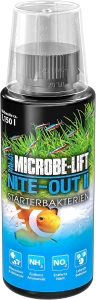
That way, you can be far more sure of when the tank is ready to add fish, you can be certain that there are no unwanted nasties in the sand, and you can be positive that none of the bacteria died in transit or storage.
With dry sand, you can be 100% sure that you are managing the cycling process in your own time and in your own way. This helps avoid any unwanted ammonia spikes.
Sure, if you only need one 10KG bag of sand, you might as well opt for live sand but when you need larger quantities, the decision to use dry sand and make it live is an obvious one. Especially where saving money is concerned.
💡Live sand may sustain tiny microfauna over time, helping break down waste naturally. Dry sand will gradually “come to life” if properly cycled, but early monitoring of ammonia and nitrites is essential.
Adding starter bacteria or a small amount of live sand can typically make dry sand bio-active within 2–4 weeks, depending on tank conditions. Follow our guide for the easiest method.
Dry Sand: The Cons
Naturally, there are cons to dry sand, as with anything in the marine aquarium hobby. Let’s take a look at those.
- You cannot instantly cycle with it: You will have to go through a full cycling process using bottled bacteria, some additional live sand, or live rock to make the sand live and create genuine biodiversity.
- A slightly uglier “Ugly Phase”: The lack of bacteria in the sand means that algae may take up some of that open real estate before bacteria has a chance to, making the uglies a bit more ugly.
- It is very dirty: The biggest con is that it is very dusty. If you just slap it straight into the tank, it will cloud the water up in a way that will make you regret not rinsing it. Thoroughly washing dry sand is an absolute must!
That last point is the most important. I’ve actually put together an entire guide on how to rinse dry sand the easy way so check that out to make sure you avoid the sandstorm.
In Short: Which Should You Choose?
This really depends on your budget, motivations, and preference. If you are looking to save money, dry sand is the perfect option for starting a new marine aquarium. We just need to make it live with a bottle of bacteria and a bit of time.
If you aren’t concerned about your budget and want a decent shortcut to a mature tank, live sand is fantastic.
Just remember that tons of stuff can go wrong in marine aquarium ownership, most of which can be avoided by something that is easy and free: patience. Don’t treat live sand as a quick fix, cycle your tank properly, and your fish will thank you. Thanks for reading!
Frequently Asked Questions
What is the difference between Live Sand and Dry Sand?
Live sand comes pre-loaded with millions of beneficial nitrifying bacteria and may sustain tiny microfauna over time, helping your tank maintain a healthy ecosystem. Dry sand is completely barren and contains no life, bacteria, or moisture out of the bag, but it is significantly more affordable and can be made “live” with patience and a bit of starter bacteria.
Can Live Sand instantly cycle a marine aquarium?
Despite the claims on the packaging, live sand rarely cycles a tank instantly. While it provides an excellent bacterial head start and speeds the process up, it is highly recommended to properly cycle and ghost-feed the tank for several weeks before adding fish to prevent deadly ammonia spikes.
Do I need to wash Dry Sand?
Yes, absolutely! Dry sand is incredibly dusty right out of the bag. If you do not rinse it thoroughly in tap water or RO water before adding it to your tank, it will cause a massive, cloudy sandstorm that will clog your filters and take days to clear. Follow our handy guide on how to rinse dry sand to make sure you avoid the mess.
Does sand grain size matter?
Yes! Sand grain size plays a big role in both aesthetics and aquarium health. Fine sand (0.1–1.0mm) is perfect for burrowing wrasses, sand-sifting starfish, and small snails, but it can easily blow around in high-flow tanks. Medium sand (1.0–2.0mm) is the most versatile for most setups and helps burrowers build stable tunnels. Coarse sand or crushed coral (2.0mm+) is great for preventing sandstorms but can injure bottom-dwelling fish and trap waste, so it’s better suited for tanks without delicate species.