

10 Marine Aquarium Upgrades You (Probably) Don’t Need Yet: Luxury Gear & Problem Solvers
Welcome to Simple Reefs. Today, we are taking a look at 10 Marine Aquarium Upgrades You (Probably) Don’t Need Yet: Luxury Gear & Problem Solvers. These are the luxury upgrades, niche problem-solvers, and high-end automation tools that you absolutely do not need to start your marine aquarium journey.
Table of Contents
Key Takeaways
- Completely Optional: The vast majority of successful budget reefs will never need automatic dosers, complex controllers, or media reactors.
- Problem Solvers: Items like UV Sterilisers and Aiptasia treatments are “break-glass-in-case-of-emergency” tools. Don’t buy them until you actually have the problem they fix.
- The Automation Trap: High-end automation saves time, but it introduces complex points of failure and costs thousands of pounds. Keep it simple to keep it cheap.
- DIY Saves Money: Many of the items on this list, from glass cleaners to algae scrubbers, can be made at home for pennies.
This article answers the ultimate question – “How far do you want to take your tank?” The items listed here are pure luxury or highly specific solutions. Every item is ranked on our “Simple Scale”, giving it a value for Importance, Cost, and Convenience to help you prioritise your budget.
Building a Budget Reef – The Luxuries and Maybes
This article forms the final part of our series on getting started with your very own slice of the ocean without breaking the bank. If you missed our previous guides, make sure you read up on the Absolute Must-Haves (the gear you need to get water in the tank) and the Smart Upgrades (the highly recommended quality-of-life gear).
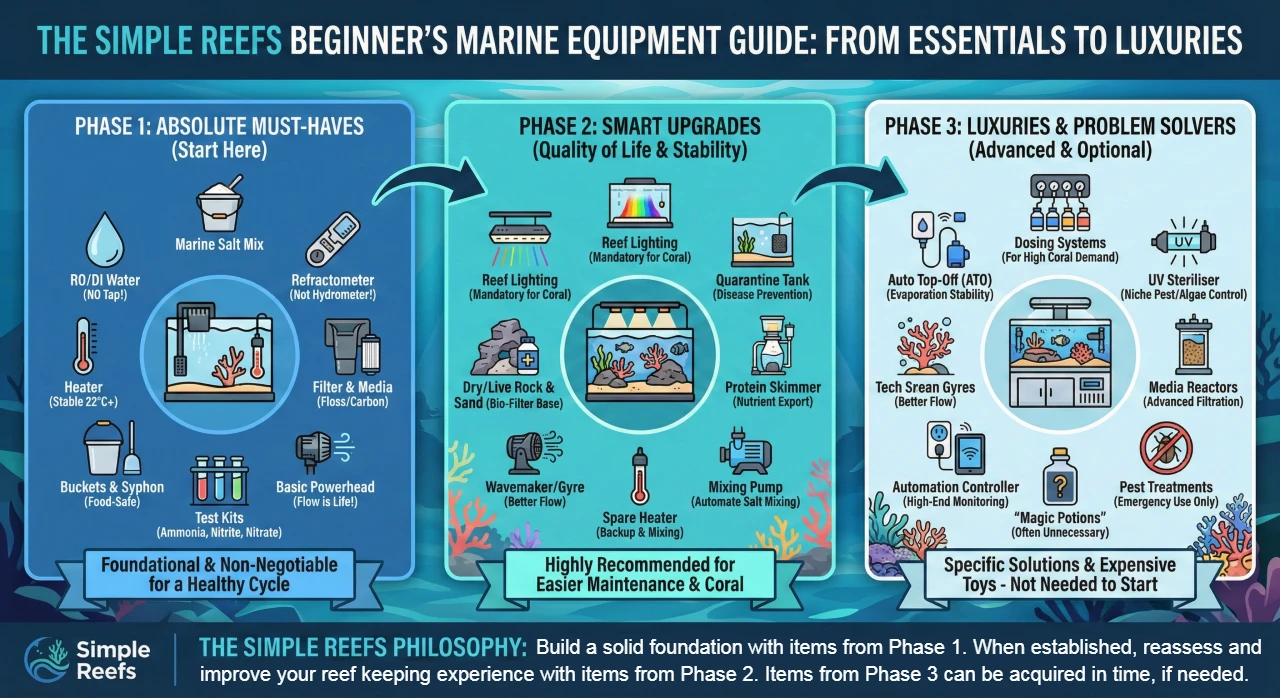
In this list, we are taking a look at all of the things that you (probably) don’t need yet. None of the gear here is essential. Everything can be skipped while still affording you the opportunity to experience success. Let’s dive in.
The Maybes: Quick Shopping List
| Upgrade Item | Why You Might Want It | Budget Recommendation |
|---|---|---|
| 🧽 Handy Maintenance Tools | Scrapers, basters, and coral feeders. | Cheap manual tools save time and hassle. |
| 🧼 Reef-Safe Cleaning Supplies | For safely cleaning glass and pumps. | DIY with white vinegar and citric acid. |
| 🦠 Pest Control (Dips/Aiptasia) | Kills hitchhiking parasites and pests. | Only needed if you are buying live coral. |
| 💧 Auto Top-Off (ATO) | Automatically replaces evaporated water. | The best “luxury” upgrade you can buy. |
| 🧪 Bottled Potions & Bacteria | Promises to clear algae or kickstart cycles. | Rarely needed. Stick to regular water changes. |
| 🚰 Element Dosing Systems | Maintains calcium/alkalinity for coral. | Only needed for tanks packed with stony coral. |
| ⚙️ Media Reactors | Advanced filtration to strip out nutrients. | Overkill for most small to medium setups. |
| 💡 UV Sterilisers | Zaps waterborne algae and parasites. | Only if battling specific plagues (like Dinos or Ich). |
| 🌿 Refugiums & Scrubbers | Uses macro-algae to outcompete nuisance algae. | Excellent natural filtration, but requires space. |
| 🤖 Aquarium Controllers | Complete tank automation (e.g., Neptune Apex). | Strictly for massive budgets and advanced reefs. |
Deep Dive: The Specialised Marine Aquarium Upgrades
1. Specialised Maintenance Tools

There are a ton of specialised maintenance tools for marine aquariums that cost a fortune. Many are branded, overdeveloped, and can be replaced by simple budget options.
Let’s be real, your lights are going to mean you are constantly battling a thin film of algae on your glass. You are going to want something to scrape that algae off, and you will probably want a way to blow detritus out of your rocks.
You can use an old credit card to scrape glass, they are incredibly effective. If you have a 3D printer, you can go one step further with loads of DIY options. A magnetic Algae Scraper (like a Flipper Float or Tunze Cleaning Magnet) allows you to clean without getting your hands wet. It also avoids you inadvertently introducing contaminants, that may be on your hands, into the tank water. They are pretty pricey, though.
Likewise, a humble £2 Turkey Baster is an unsung hero for blowing debris off rocks, while a specialised, extra-long Coral Feeder is brilliant for accurately squirting frozen food directly into the mouths of your fish and corals, again they are a more premium option.
There’s lots of maintenance tools that range from very little cost to a lot. Most are completely unnecessary but some will make your life a lot easier so choose carefully.
⚠️ Warning: Beware the Magnetic Sand Trap
Magnetic glass cleaners are incredibly convenient, but they carry a massive hidden risk. If you drag the internal magnet too close to the bottom of your tank, a single grain of sand or a tiny piece of crushed shell can easily get trapped in the rough scrubbing pad.
If you don’t notice it and keep sliding the magnet around, that tiny piece of grit will carve deep, permanent scratches right across your beautiful display glass. It will ruin the aesthetic of your tank, and you will see the scratches every time the lights turn on.
The Safe Alternative: Sometimes, the cheapest option is actually the best. Using an old plastic credit card or gift card to manually scrape the glass by hand is highly effective on tough film algae, completely free, and carries zero risk of trapping abrasive sand.
💰 Budget Tip: Skip the expensive branded aquarium tools. You can find extra-long plastic tweezers, pipettes, turkey basters, and basic glass scrapers on Amazon or at local hardware stores for a fraction of the cost of “aquarium-specific” brands.
- 📊 Importance 6/10: You don’t want horribly dirty glass or detritus buildup.
- 💰 Cost 2/10: Extremely cheap to pick up manual tools.
- ⏱️ Convenience 10/10: Makes weekly maintenance infinitely easier.
2. Reef-Safe Cleaning Supplies
Keeping a marine aquarium means lots of cleaning. You will be cleaning your external glass, your pumps, and your tools. There is something very important to think about here, however.
⚠️ Warning: The Windex Wipeout
You can’t just go to the store and buy some Windex or Windolene for your tank glass. These products contain ammonia and other chemicals that will wipe out whole aquariums if even a tiny bit of overspray enters the water. Always DIY your glass cleaner using pure RO/DI water and white vinegar. It costs pennies and is 100% reef safe.
Avoid the big-name brands. For cleaning crusty wavemakers and pumps, the stars of your cleaning show should be basic citric acid or white vinegar. Both are safe for aquarium use and will melt away stubborn calcium deposits.
If we need to sterlise items, plain peroxide with no additives will do the job. Just be sure to allow the item to thoroughly dry in the sun for at least 24 hours and rinse until the smell has completely gone.
💰 Budget Tip: Never buy liquid “equipment cleaner” from a fish store. Buy a 5kg tub of food-grade Citric Acid powder or a vat of white vinegar online. It costs almost nothing, lasts for years, and melts away calcaline algae and coralline buildup on your wavemakers just as effectively when mixed with warm water.
- 📊 Importance 8/10: Essential to avoid poisoning your tank.
- 💰 Cost 1/10: Vinegar and citric acid are incredibly cheap.
- ⏱️ Convenience 10/10: Easy to mix in bulk.
3. Pest Control (Coral Dips & Aiptasia Treatments)
If you are planning to add live coral to your tank, you need pest control. Coral Dip is designed to be safe for coral while killing the parasites (like flatworms and nudibranchs) that may be hitchhiking on your new frags.
Then there is Aiptasia. Aiptasia is a type of glass anemone that is classed as a pest and can quickly become the bane of your marine aquarium existence. They spread like wildfire and sting your coral.
Products like Joe’s Juice or F-Aiptasia are used to smother and kill them, but you should only buy these when you actually spot an outbreak.
⚠️ Warning: Dips Don’t Catch Everything
Coral dips are fantastic for killing mobile parasites like flatworms and nudibranchs, but they are completely ineffective against stubborn pests like Aiptasia or bubble algae. When stressed or dipped, a tiny Aiptasia anemone will retract deep into the microscopic crevices of a coral’s skeleton or frag plug, making it entirely invisible.
The Fix: Never glue a new coral directly onto your main rockwork right away. Even after a chemical dip, keep the coral in a quarantine tank, or isolated on a small frag rack on the glass of your display, for a week or two. Observe it closely. If an Aiptasia finally pops out of hiding, you can simply pull that single plug out and deal with it safely, rather than trying to fight a plague once it has spread all over your main reef.
💰 Budget Tip: Before shelling out £20+ on chemical Aiptasia killers that might not work and can alter your water chemistry, try adding a true Peppermint Shrimp to your tank. They are cheap, fun to watch, and often devour smaller Aiptasia naturally. They can nip coral, though.
- 📊 Importance 9/10 (If Keeping Coral): Hitchhikers are inevitable.
- 💰 Cost 3/10: Dips and treatments are relatively affordable but aiptasia treatment can be expensive.
- ⏱️ Convenience 8/10: Saves your tank from being overrun by pests.
4. Automatic Top-Off (ATO) System
Keeping a tank full of warm water in your home will lead to inevitable evaporation. I estimate that my 425-litre tank loses 3+ litres of water per day! That’s a hell of a lot.
When saltwater evaporates, the salt is left behind. If left without topping up with fresh water, your salinity will spike, shocking your inhabitants. Sure, you can do this manually by diligently checking your water levels every day, check out our guide on just that. But automating that process is one of the most common luxury upgrades on a marine aquarium.

An Automatic Top-Off (ATO) system uses a sensor to detect when the water level drops, triggering a tiny pump to add fresh RO/DI water from a reservoir. It is, without a doubt, the greatest luxury upgrade you can buy for tank stability.
💰 Budget Tip: If a £100 optical ATO is too pricey, you can easily build a gravity-fed ATO using a £10 plastic float valve plumbed into a simple food-safe plastic container sitting above your sump. Simple mechanics, zero electricity, and completely reliable. Second hand is a good option, too. My ATO was £30 on eBay and works a treat.
- 📊 Importance 7/10: You can top-up manually, but stability is key.
- 💰 Cost 5/10: Reliable optical ATOs can be found for £50-£100.
- ⏱️ Convenience 10/10: Completely automates a daily chore.
5. “Magic Potions” & Bottled Bacteria
This part of marine aquarium ownership is an absolute minefield. Companies sell myriad tinctures and potions that claim to miraculously reduce nitrates, eliminate Cyanobacteria, or kickstart your cycle.
The reality is, many do nothing at all, others are unnecessary, and a few are, even, quite dangerous. Things like Dr Tim’s Re-Fresh, Seachem Pristine, Waste Away, Replenish, Microbacter Clean etc etc have their applications but none of these things are immediate fixes to problems.
⚠️ Warning: The Snake Oil Trap
The reality is, many of these bottles do nothing at all, and a few are quite dangerous. Products that claim to deal with a problem “once and for all” can cause explosions of other problems. Products designed to fight cyanobacteria, for example, can annihilate your bacterial profile causing explosions of hair algae. Never dose a chemical to solve a problem that a simple series of 20% water changes could fix.
💰 Budget Tip: The ultimate budget hack for water chemistry issues isn’t a £30 bottle of “sludge destroyer” – it’s a water change. Remember, dilution is the solution to pollution, and saltwater is much cheaper than snake oil.
- 📊 Importance 2/10: Mostly unnecessary, often harmful.
- 💰 Cost 8/10: Buying constant “fixes” drains your wallet quickly.
- ⏱️ Convenience 2/10: Often masking a problem rather than fixing it.
6. Element Dosing Systems
When you have an aquarium full of stony coral, they will rapidly deplete the Calcium, Alkalinity, and Magnesium levels present in your saltwater to build their skeletons. This, naturally, means that you need to add more.
This is where we really start getting into the reeds of Reef ownership and this is, also, where things can start getting really expensive. We can make the assumption that, if you are keeping your reef quite simple, we won’t ever need to worry about any of this stuff.
For small aquariums, frequent water changes are usually enough to replenish these elements. However, for advanced reefs, you can use an Automatic Dosing System with either all in one dosing solutions like All For Reef or individual additives based on your tank’s specific requirements.
💡 Tip: The Magic of “All-For-Reef”
If your stony corals are starting to consume more elements than your weekly water changes can replenish, you don’t immediately need to buy a complex 4-head electronic dosing pump and four separate jugs of chemicals.
For small to moderately stocked mixed reefs, a product like Tropic Marin’s All-For-Reef is an absolute game-changer. It is a highly concentrated, all-in-one solution that delivers balanced Calcium, Alkalinity, Magnesium, and essential trace elements entirely from a single bottle. You can easily dose it manually with a simple syringe each morning, making it the ultimate, stress-free stepping stone into the world of keeping advanced corals.
These programmable pumps deliver perfectly measured amounts of a liquid supplement at set times of the day. Some come with extravagant features like Wi-Fi control and apps while others are very basic.
💰 Budget Tip: You do not need a £200 electronic dosing pump if you are on a tight budget. You can manually dose your daily calcium and alkalinity using cheap plastic syringes from the pharmacy, taking only 30 seconds out of your morning routine. Set an alarm and do it after your coffee.
- 📊 Importance 1/10 (Fish Only) | 9/10 (Stony Coral Tanks): Depends on your tank.
- 💰 Cost 8/10: Dosing pumps and regular chemicals get expensive fast.
- ⏱️ Convenience 10/10: Automates daily manual dosing removing another chore.
7. Media Reactors
A reactor is a simple tube used to facilitate a reaction between your water and a chemical compound.

Water is forced down through the tube and back up through a filter medium (like Carbon or GFO) before exiting back into your aquarium with the impurities removed.
Reactors can become quite a complex topic. Especially where reactors used to grow beneficial bacteria are concerned. How fast the water travels through the reactor, how much the medium inside the reactor moves, and how much medium should be used, all complicate this subject greatly.
If you have a massive phosphate problem, a reactor is highly efficient. However, if you are running a simple marine aquarium, you will likely never need one. We’ll be going more in depth on this subject in the future.
💰 Budget Tip: Save yourself £80+ on a dedicated reactor and pump. Simply pour your carbon or GFO into a cheap mesh filter bag and drop it into a high-flow area of your sump or Hang-On-Back filter. It is about 90% as effective for 5% of the cost.
- 📊 Importance 4/10: Most basic tanks won’t need these.
- 💰 Cost 6/10: The reactor is cheap, but replacing the media adds up.
- ⏱️ Convenience 5/10: Highly effective, but reactors need regular cleaning.
8. UV Sterilisers
A UV Steriliser contains a bulb that emits Ultra Violet light. Water is forced through a tube where it is exposed to the light, mutating the DNA and killing unwanted algae cells, free-floating parasites, and waterborne nasties.
A UV light can help manage parasites like Marine Ich or plagues like Dinoflagellates. I’ve used a UV along with a blackout to cure Dinos in one of my own aquariums. They can also be used to treat green water and reduce algae outbreaks.
However, they require specific flow rates and yearly bulb replacements. Think of it as specialised medical equipment rather than a daily necessity. If you are keeping things simple, you will never need one.

💰 Budget Tip: UV Sterilisers require new bulbs every 6 to 12 months to remain effective. Instead of buying “aquarium branded” replacement bulbs, check the exact wattage and pin layout – you can often buy identical bulbs from pond or hardware stores for half the price. I purchased two replacement bulbs for my steriliser for only £12 on Amazon.
- 📊 Importance 5/10: A lifesaver in an emergency, limited use otherwise.
- 💰 Cost 7/10: Good units and replacement bulbs are costly.
- ⏱️ Convenience 8/10: Very handy for clearing up green water or parasites.
9. Refugiums and Algae Scrubbers
All of that ugly nuisance algae in your display tank feeds off light and nutrients (nitrates/phosphates) from fish waste. So, what if we deliberately grow a beneficial algae (Macro-Algae) in a hidden part of our tank to consume those nutrients before the ugly algae gets a chance to?
That is the premise of a Refugium or an Algae Scrubber. They use dedicated grow-lights in your sump to cultivate algae that you harvest and throw away, permanently exporting nutrients. They are amazing, natural filtration methods, but completely optional for small budget tanks.
I actually built my own algae scrubber for my 425 litre aquarium out of some PVC piping and things I had lying around my house so it can be done affordably. I’ll be covering it further in a future article.
💰 Budget Tip: You can build a highly effective DIY algae scrubber for less than £20 using some PVC pipe, a sheet of rough plastic knitting canvas from a craft store, and a cheap red/blue LED grow light bulb from Amazon.
- 📊 Importance 5/10: Most budget tanks can opt for water changes instead.
- 💰 Cost 6/10: Commercial scrubbers are expensive, but DIY is very cheap.
- ⏱️ Convenience 7/10: Great natural filtration, but requires harvesting.
10. High-End Automation (Controllers & Water Changers)
This is where you get into the silly money of reef ownership. Systems like the Neptune Apex act as the “smart home” brain of your aquarium.
They monitor temperature and pH, and can automate wavemakers, dosers, and even Automatic Water Changers (systems plumbed into your drains to do water changes for you).
These systems start at close to £300 for just the basic brain, eventually running into the thousands. They are incredibly cool, but if you are here on Simple Reefs building a budget setup, this is the exact opposite of what you need.
💡 Note: Who Actually Needs Full Automation?
If you are running a standard beginner tank with a few fish and hardy soft corals, an £800 aquarium controller is like buying a Ferrari just to drive to the end of your driveway. Full automation is truly designed for:
- Ultra High-End SPS Reefs: Tanks packed with incredibly sensitive, expensive stony corals (like Acropora) that can literally die overnight if the Alkalinity, pH, or temperature swings even a fraction of a degree.
- Massive Systems: 200+ gallon aquariums where manual dosing, top-offs, and water changes become physically exhausting daily chores.
- Frequent Travellers: Hobbyists who are constantly away for work and need a way to monitor their tank remotely to alert a tank-sitter the second a heater fails or a pump stops working.
The crazy thing is, I have heard of people’s tanks wiping because automation systems failed catastrophically, dumping extra additives into the tank, increasing the temperature and all sorts. The potential for technical failure is very concerning.
💰 Budget Tip: Instead of spending £800+ on a full aquarium controller system, you can buy a 4-pack of Wi-Fi smart plugs for £20. You can control them from your phone, set daily lighting and refugium schedules, and turn off your return pump remotely during feeding time.
- 📊 Importance 1/10: Purely a luxury for massive, complex reefs.
- 💰 Cost 10/10: Wildly expensive.
- ⏱️ Convenience 8/10: Automates everything, but introduces complex tech failures.
Frequently Asked Questions: Aquarium Maybes
Do I need an aquarium controller like an Apex?
No. While they are fantastic for monitoring tank parameters while you are on holiday, a simple £10 thermometer and a basic plug timer for your lights will achieve the exact same daily result for a fraction of the cost.
Are bottled bacteria and “magic potions” worth the money?
Rarely. A good bottle of nitrifying bacteria can help kickstart a brand new cycle, but “sludge destroyers” and “algae fixers” are often a waste of money. The best solution to pollution is always dilution (a good old-fashioned water change).
Should I buy a UV steriliser just in case?
No, save your money. Unless you are actively battling a severe outbreak of waterborne parasites (like Ich) or a stubborn bloom of green water or dinoflagellates, a UV steriliser will just sit there consuming electricity and requiring expensive bulb changes.
The Bottom Line
If an item is on this list, you have our full permission to completely ignore it while you are starting out. Focus on your Must-Haves, establish a stable tank, and only return to this list of marine aquarium upgrades when your budget allows or a specific problem arises. Thanks for spending your time at Simple Reefs.