

Which Test Kits Should You Buy for Your Marine Aquarium?
Welcome to Simple Reefs. We are a brand new website designed to take the stress and expense out of starting your very own marine aquarium. Yesterday, we talked all about the importance of test kits to a marine aquarium. Today, we are going to look at which test kits you should buy for your marine aquarium.
Table of Contents
Which Test Kits Should You Buy?
When it comes to marine aquarium ownership and starting out, everything can be a little bit daunting. This can be especially true when it comes to which test kits you should buy. There are a massive abundance of test kits available for all different kinds of scenarios.
We can test for Nitrite, Nitrate, Ammonia, PH, Alkalinity, Copper, Magnesium, Calcium, Strontium, Iron, Chlorine, and all sorts of other things. Not all of them are going to be applicable to the average user, right?
Well, that’s correct, not all of them are going to be applicable to the average user. This is particularly true where people who are brand new to the hobby are concerned. It’s safe to say that we can put together a base-line, fresh to the hobby, enthusiastic-but-cautious, starter pack so let’s take a look at that first.
I would hasten to add, if you missed our article discussing the importance of test kits to a marine aquarium, I would suggest checking that out. Particularly if you are in any doubt whatsoever about why you should be testing your water a lot.
The Absolute Test Kit Essentials Starter Pack
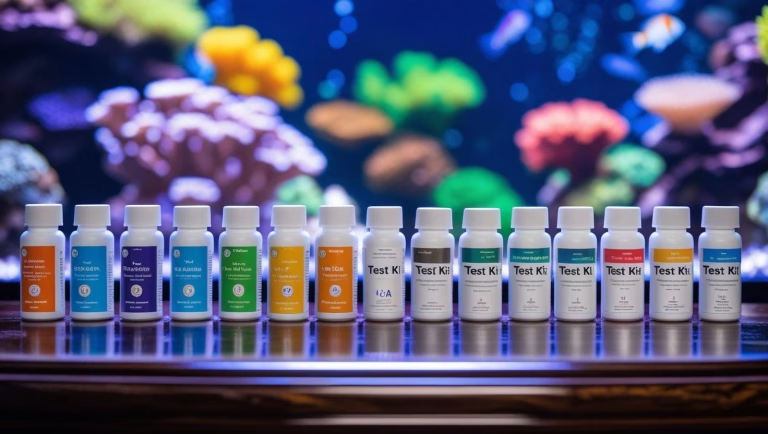
We are going to need a few test kits, for sure. There’s absolutely no question about it as we can’t even truly say that our cycle is complete without a few tests to confirm it. With this in mind, let’s take a look at the Absolute Essentials Starter Pack:

A Refractometer: You are going to need something to test the salinity of your water. This is very important, you will use it every time you mix up water and once a week to check how the salinity of your actual aquarium water is doing. Salinity of your mixed water should match that of your tank water.
These can be purchased for as little as £10 and are vital. You should grab some calibrating fluid, as well, as this will allow you to make sure your refractometer stays accurate. I would highly suggest that you avoid hydrometers as these are frequently inaccurate.
Ammonia (NH3/NH4+): Absolutely essential. You can’t skip this and if you haven’t included one with all of your starter equipment you need to order one quickly. Ammonia is incredibly toxic to your fish even in small amounts. When you cycle your tank for the first time (Check out our article on cycling a new marine aquarium) you need to be able to measure ammonia.
Ammonia levels should be virtually non-existent in a mature tank but they can rise. If a fish is rotting in the water or there is a crash in your biological filter, you might have a problem. An ammonia test kit will tell you if this happens and you can act on that information.
Nitrite (NO2−) Test Kit: Nitrite forms as the second stage in the nitrogen cycle that we have talked about a lot on this website. A nitrite test kit allows you to check whether the levels of nitrite are dropping during your cycling process. Nitrite levels in a mature aquarium should be about zero so you may find you never need this kit. Increased nitrite can indicate a problem with your cycle, though. Some people choose to skip testing for nitrites as it is, supposedly, less toxic to marine fish. A test kit is still handy to have.
Nitrate (NO3−) Test Kit: Nitrate is the compound produced by Nitrobacter bacteria when it converts Nitrite. Nitrate is the last compound produced by the nitrogen cycle when the ammonia has been converted to nitrite. A Nitrate test kit helps confirm that your nitrogen cycle is complete and your tank is fully cycled and ready for new residents.
Nitrate levels are something you will want to monitor indefinitely. While some amount of nitrate in the water is beneficial as it will be consumed by coral. High levels of nitrates will fuel algae growth and have been shown to slow down the growth rate of coral. Frequent testing can indicate if you are performing frequent and large enough water changes or whether you nitrate export methods (refugium, algae turf scrubber) are working efficiently.
pH Test Kit: A pH test kit measures the acidity or alkalinity of your water. You really want to be shooting for a pH level of between 8.0 and 8.4 for a healthy marine aquarium. A pH test kit will help you keep those levels in check. Stability is key, here, as fluctuating levels can stress your tank’s occupants. Low levels may indicate that you have high levels of carbon dioxide in your tank’s water or that you need to use a buffering solution.
With all of these test kits, you should have full coverage for most scenarios. If you never progress beyond fish-only or a basic reef, you might never need anything more than this. But what if we are looking to get a little more advanced?
The Stony Coral Test Kit Essentials
Let’s be honest, you have probably wandered into your local fish shop and seen those hypnotic, glowing, constantly moving, LPS coral and fallen in love, right? I know that I did. I originally didn’t want coral at all. That all changed with some pink passion Zoas which, obviously, set the ball rolling. It wasn’t long before I was tempted by gorgeous LPS coral like Torches and Hammers.

If this happens to you, you are probably going to want to expand your test kit collection. The reason for that is because there are a few elements that stony coral will be consistently consuming to build their skeletons. We call these the “Big Three” and they are the foundation elements. You will need to be testing for these and replenishing them as the coral deplete them.
Calcium (Ca2+) Test Kit: Calcium is a fundamental building block of your stony coral’s skeleton. If there isn’t enough calcium in the water, the coral simply can’t build it’s skeleton and won’t grow. It’s quite simple really. You test for calcium levels and if they are below a certain point (typically between 380 – 450PPM) you add more calcium to the water.
Alkalinity (dKH) Test Kit: When it comes to reefs featuring stony coral, there might not be a more important parameter than Alkalinity. Alkalinity is the backbone of the reef as it provides the carbonate ions that stony coral need for calcification. Without sufficient carbonate hardness, your coral wouldn’t be able to grow. Alkalinity also acts as a buffer for the water which prevents wild pH swings which would upset your residents.
Desirable alkalinity levels actually vary quite a bit and the range that would be considered normal is fairly large, between 8 – 12dKH. The key is stability. You don’t want wild alkalinity swings, you want to keep it very stable. An Alkalinity test helps you to find out the dKH level of your aquarium and keep it there.
Magnesium (Mg2+) Test Kit: Magnesium is Calcium’s best friend as it helps prevent it from precipitating out of a solution before it can be used. It, also, is used by coral to actually enable the uptake of the calcium into their skeletons. Believe it or not, human’s need magnesium to help with the uptake of calcium for strengthening our bones, too. It works the same in coral. Less magnesium will mean less calcium is absorbed by the coral and the result will be less coral growth.
Magnesium is an often neglected element but when it is out of whack, it can throw your entire tank out of whack. Monitoring Magnesium frequently and adjusting where needed can help with coral growth and the stability of both calcium and alkalinity levels.
For the vast majority of reefs, these test kits, along with the first group, will give you near full coverage of everything you need. You will be able to make sure your water is stable and there is a nice balance of all the fundamental, foundational, elements need for coral growth.
Test Kits for Finding Problems
These test kits are more geared towards finding problems with your aquarium. They aren’t essential but they are very useful when you are looking for issues or solutions.

Phosphate (PO43− ) Test Kit: Phosphate levels can be a real pain in the bum. Phosphate is a waste biproduct of fish food and it can fuel the growth of nuisance algae. Much like with high levels of nitrate, high levels of phosphate can make your tank look very ugly indeed. A phosphate test kit can tell you the concentration in your water.
The only problem with this is that phosphate can bind up in the rocks and sand. It will then release from the surface when phosphate is removed from the water, effectively equalising the level back to what it originally was. This can be frustrating to fix but that is a topic for another article.
Copper Test Kits: Copper is a particularly nasty element when it comes to marine aquariums. Creatures like shrimp and coral are not big fans of it and it can even kill with only slight concentrations. Copper can be present in tap water so can accumulate as a result of using a poorly maintained RO/DI filter. It can even come from things like magnets rusting into the water. Naturally, is is used in the treatment of fish to remove parasites which can be a big problem with second hand equipment.
Copper can become bound up in rocks or the sealant of your aquarium. If you suspect copper is killing your shrimp, coral, or snails, a copper test kit is essential. A copper test kit would be handy to use if you have recently purchased a tank and are not sure if it has been used to medicate fish with copper. Obviously, you will need a copper test kit if you are medicating quarantined fish, as well.
Silicate Test Kits: If you are noticing a lot of brown dusty algae all over the place, you may have a silicate problem which is fuelling the growth of diatoms. Again, this can come from your source water if you have a poorly maintained RO/DI filter. It can also come from new rocks or sand that have been added to your tank. A silicate test kit can help you confirm the presence of silica so you can do something about it.
Chlorine Test Kits: Chlorine is another nasty element that you may need to test for. Chlorine is added to tap water so can accumulate if you have a poorly maintained RO/DI filter. This can cause damage to your livestock. Chlorine test kits typically come in strip form but can be a useful addition to your tool kit.
These are the main test kits that should cover you for most issues that can occur. If I think of more, I will be sure to update this article and add them. Hopefully you won’t need these.
Test Kits For The Advanced Hobbyist
Okay, these first test kits are for the absolute obsessive people who need every single element to be in perfect balance. I am not going to list them individually because anyone looking to buy these will know what they need.

Trace Elements (Strontium, Boron, Iodine, Potassium, Iron): As your reef gets bigger and more advanced, your coral are going to begin consuming literally everything in the water. This includes all the trace elements that are restored partially with water changes but not in a way that would be sufficient for complex tanks. These trace elements are things like Boron, Iodine, Iron, Potassium, Strontium, and a whole bunch of different things.
Trace elements are typically replenished by dosing them either in a pre-mixed form or a bespoke mix chosen by the hobbyist. While there are tests available commercially for some of the trace elements like Iodine, you are going to need something more advanced for many of them.
There are companies where you send a water sample and they will test for everything. They will then send you back a sheet of your readings which you can cross reference. You can then adjust your dosing schedule to suit your current levels. Obviously, this is very advanced and way beyond the requirements of most tanks.
Trace element test kits are, pretty much, the top end of marine aquarium testing. It’s safe to assume that you shouldn’t need to worry about these too much until you have a tank filled with high demand coral.
In Short
The vast majority of marine aquarium hobbyists should be able to get by with just the essentials starter pack. We only really need to be testing for a few certain elements on a regular basis. When you start to get a bit more advanced, you should think about purchasing test kits for the foundation elements.
Naturally, all of this testing will be for nothing if the test kits are of a poor quality. Tomorrow, we are going to be looking at the importance of high quality test kits and how you can tell whether a test kit is worth spending your money on. Thanks for reading and spending your time at Simple Reefs.