
The Ultimate Protein Skimmer Beginner’s Guide: Pros & Cons, How Do They Work, Do You Need One
Welcome to Simple Reefs. Today, we are bringing you the ultimate beginner’s guide to protein skimmers. We are answering everything you need to know: what they are, how they work, their pros and cons, and whether you actually need to buy one.
Table of Contents
The Protein Skimmer Guide: In this complete guide, we are going to break down exactly what a protein skimmer is and how it works to keep your marine aquarium clean. We will look at the simple science behind removing fish waste, explore the biggest benefits and frustrating downsides, and finally answer the ultimate budget question: do you actually need to buy one for your tank?
Key Takeaways
- What It Does: A protein skimmer removes dissolved organic waste (like fats and proteins) from your water before it can rot and turn into toxic ammonia.
- The Benefits: Skimmers reduce the need for frequent water changes, increase oxygen levels, and help keep your water crystal clear.
- The Downsides: They can strip the water of nutrients too effectively, require regular maintenance, and have a steep learning curve to dial in correctly.
- Is It Essential?: While highly recommended for larger tanks with heavy fish loads, many nano aquariums and low bio-load setups can thrive without one simply by keeping up with regular water changes.
What is a Protein Skimmer?
A protein skimmer is, essentially, a specific type of filtration system for your marine aquarium designed to help make the water cleaner and safer for your fish and coral.
When we refer to filtration systems, we basically mean a piece of equipment, a method, or a device which can remove something undesirable from the water. Either via mechanical means, chemical means, or biological means.

There are, in fact, many different types of filter when it comes to aquariums, not just mechanical filters that use a media to trap detritus. For example, the bacteria in your aquarium acts as a biological filter, removing toxic compounds from the water.
A protein skimmer is a type of filter used to remove fats, proteins, oils, toxins, and other types of unwanted molecules from your water.
What is a Protein Skimmer Used For?
Quite simply, a protein skimmer is used to remove dissolved organic matter (DOM) from your aquarium’s water column.
This is where it can start to seem a little complicated but it’s actually a lot more simple than you may think. When we say dissolved organic matter (DOM), what we really mean are the proteins, fats, oils, and amino acids that come from food and poo.
💡 Tip: What Exactly is Dissolved Organic Matter (DOM)?
You will see the acronym DOM thrown around constantly in the saltwater hobby. It stands for Dissolved Organic Matter, but what is it actually? Think of it as an invisible soup of waste that is suspended in your tank water.
When you feed your aquarium, microscopic particles of that food dissolve straight into the water. Add in fish poop, oils from your hands, and the naturally shedding slime coats from your corals and fish. All of these things break down into invisible proteins, fats, and amino acids.
Because this waste is completely dissolved into the water column, you cannot catch it with a standard mechanical filter sponge or a filter sock. If left alone, this invisible waste will simply rot and produce ammonia which will then be turned into nitrates as the final stage of the nitrogen cycle.
These nitrates, though not particularly toxic, can accumulate and cause outbreaks of nuisance algae. They can also lead to your coral becoming very unhappy.
If we were to just allow these dissolved organics to rot in the water, our water column would begin to accumulate a lot of nitrates.
When it comes to nitrates, we have two options – remove or prevent. Now, I am sure you remember the old adage – an ounce of prevention is worth a pound of cure. Well, this is where a protein skimmer comes in.

The best way to prevent these organics from rotting and becoming nitrates is by removing them before they have a chance to completely break down and turn into ammonia. A protein skimmer allows us to do just that – it removes dissolved fats, proteins, oils, and amino acids from the water.
💡 Quick Refresher: The Nitrogen Cycle
When Dissolved Organic Matter is left to rot in your aquarium, it kicks off the nitrogen cycle. First, that rotting waste breaks down into highly toxic ammonia. The beneficial bacteria living inside your porous reef rock then consume that ammonia and convert it into nitrite, and finally into nitrate.
While nitrate is much safer for your fish and corals, a heavy buildup of it will quickly fuel explosive nuisance algae growth. A protein skimmer acts as the ultimate preventative measure. By physically pulling out the raw organic waste before it has a chance to rot, you stop that ammonia from ever being created in the first place!
How Does a Protein Skimmer Work?
A protein skimmer works by trapping and removing the dissolved organic matter in your aquarium’s water through a process known as foam fractionation.

Protein skimmers pull your tank’s water into a reaction chamber where thousands of tiny bubbles are created by injecting air into the water. These bubbles then trap tiny molecules, oils, fats, amino acids, and other dissolved organics (DOM).
As the bubbles rise, they carry the trapped molecules and dissolved organics up with them, eventually overflowing into a cup where they are collected together in a disgusting smelling, brown or green liquid known as skimmate that you are going to really want to throw down your toilet and not in your sink… Thank me later!
Think of it like a bubble-powered trash elevator: bubbles grab dissolved waste and lift it up into the collection cup where it’s thrown out for the trash man (you) to dump somewhere else.
Now here’s where the science comes in and it can start to seem a little bit complicated. It’s actually more simple than you may realise, though. Let’s take a look.
💡 The Science: Foam Fractionation Explained
Inside the reaction chamber of your skimmer, a pump chops water and air into thousands of micro bubbles. Basically, the rule here is the more bubbles the better.
The key to effective skimming is bubble size and quantity. Smaller bubbles create more total surface area and stay stable longer. The longer our bubbles last and the more stable they are, the more they can interact with the dissolved matter in our water.

This is where the magic happens and it all relies on electrical polarity. Dissolved organic waste is made up of molecules that dislike water and will cling to air (“hydrophobic” and “amphipathic”). What does that mean?
- Hydrophobic molecules avoid water and quickly attach to air bubbles.
- Amphipathic molecules have one end that likes water and one end that avoids it, which also makes them stick to bubbles.
Because all of these waste molecules have at least one side that hates water, those molecules will rush to grab onto the dry air inside our tiny bubbles and shove their heads in there. Once they dive into those bubbles with their tails sticking out into the water, they are trapped.
With the waste firmly attached, the bubbles rise up the narrow neck of the skimmer. As they reach the top, they push into the collection cup and collapse, leaving behind that thick, awful smelling liquid we call skimmate.
Why does the clean water stay behind? Water molecules are highly attracted to each other rather than the air. Because they prefer to stick together, they will not attach to the rising bubbles, ensuring that only the organic waste is carried away. Think about shaking a bottle of pure, fresh water. The bubbles you create burst almost instantly because there is no waste to give them structure. In your skimmer, it is the actual organic waste that gives the foam its strength!
A Natural Process: I grew up on the coast so I always think this is a perfect example of how this process occurs naturally. If you have ever taken a walk along the beach and noticed thick, yellowish foam washing up on the shore, you have witnessed this exact same process in nature. The ocean uses the crashing waves to churn up dissolved organic matter, creating natural sea foam. A protein skimmer simply shrinks this natural oceanic cleansing process down and puts it inside a plastic tube!
Are All Protein Skimmers The Same?
Not at all – there are actually a number of different types and styles of protein skimmer. After all, the basic principle is always the same but there are a number of ways to achieve the desired result.
- In Sump Skimmers: These are the most common type for larger marine aquariums. They sit completely hidden inside the glass filtration sump beneath your display tank and offer the absolute most power and efficiency.
- Hang on Back Skimmers: If you do not have a sump underneath your tank, these are a lifesaver. They hang securely over the back glass of your aquarium, pulling water up, skimming the waste out, and returning the clean water directly to your display.
- Internal Nano Skimmers: These are designed specifically for smaller setups and All in One aquariums like the Fluval Sea series. They drop directly into the hidden rear filtration chambers or sit neatly in the corner of your display tank.
- External Skimmers: These are usually reserved for massive setups, commercial tanks, or professional breeders. They sit entirely outside of the aquarium and sump, requiring dedicated plumbing pipes to feed water into them.

While newer protein skimmers sit in your sump and use needle impellers to churn water, valves to fine tune the air to water ratio, and silencing valves to keep it quiet, it wasn’t always this way.
Older protein skimmers simply used a plastic chamber with a piece of cedar wood at the bottom connected to an air hose. Pumping air through the wood creates tiny bubbles and they rise into the chamber in exactly the same way as more modern protein skimmers.
In fact, you can still buy these types of protein skimmers online for under £10 and they actually work fine. Sure, they aren’t as efficient and can’t be tuned in the same way but they do remove dissolved organic matter from the water.
Nowadays, we aren’t even restricted to needing a sump to house a protein skimmer. I used a hang on back protein skimmer for a long time and they are just as effective. We even have cheap hang on back protein skimmers made especially for nano aquariums.
The Technology Powering Your Skimmer
While the goal is always exactly the same, the way a skimmer creates those waste removing bubbles can vary wildly. Here is a quick look at the technology you will likely find inside them.

- Needle Wheel Impellers: This is the standard technology that you will see in most modern skimmers. The pump uses a spinning wheel covered in tiny pins or needles. As water and air enter the pump together, this wheel rapidly chops them up into thousands of incredibly fine micro bubbles.
- Venturi Valves: This is a clever piece of plumbing that forces water through a narrow pinch point. As the water speeds up to get through the gap, it creates a vacuum that actively sucks air into the water stream, perfectly mixing the two before they hit the pump.
- Bubble Plates: When the pump blasts that mix of water and bubbles into the main chamber, it creates a lot of chaotic turbulence. A bubble plate is a simple plastic disc with holes drilled into it that sits just above the pump. It calms the turbulent water flow and forces the bubbles to rise smoothly up the neck. You see this technology a lot in cheaper skimmers but it still works great.
- Direct Current Pumps: Many premium skimmers now use smart controllable pumps. These allow you to precisely change the speed of the motor with a push button controller, giving you ultimate control over how much foam your skimmer produces while keeping the noise to an absolute minimum.
- Limewood Air Skimmers: This is the traditional, highly budget friendly method we talked about above. A basic external air pump pushes air through a block of porous limewood at the bottom of a plastic tube. The wood acts like a diffuser, creating very fine bubbles. They are incredibly cheap to buy but do require you to replace the wood block frequently as it rots in the saltwater.
The Benefits of a Protein Skimmer
If you head onto popular reefing forums, the members there can be quite unflinching on their opinion regarding the importance of a protein skimmer and that’s understandable. So what are these benefits that make a protein skimmer feel like a necessity? Let’s take a look.

- The removal of waste, helping prevent the increase of nitrates and phosphates.
- A cleaner, clearer water column with more light penetration thanks to fewer oils and particles.
- Increased aeration of the water resulting in more dissolved oxygen for your tank’s residents.
- Reduction of carbon dioxide, improving the stability of your pH.
- Removal of tannins that make your water yellow.
- Reduces the growth of unwanted nuisance algae.
- A buffer for unexpected nutrient spikes.
- Reduced maintenance in the form of fewer water changes.
- Potential reduction of odour from your aquarium.
- A potential early warning sign of tank issues.
Protein Skimmers Remove Waste
The removal of waste is the big thing here. Less nitrates mean fewer water changes, after all. So a protein skimmer can help us go longer between costly water changes, effectively saving us money too.
Less nutrients in our water also mean less food for algae. Because those things that are rotting are now sitting safely in our skimmer’s collection cup, they cannot become something that will feed unwanted things like hair and bubble algae.
Clearer water means a better aesthetic presentation for your aquarium and more penetration for your aquarium lights. Everything will look brighter and the water won’t look as turbid. The light will not have to fight through so much crud to get to the bottom of the aquarium.
More Oxygen and pH Stability
Another great benefit is that a protein skimmer forces a whole bunch of oxygen into your aquarium’s water in the form of tiny bubbles. These bubbles create a greater surface area for gas exchange. Allowing carbon dioxide to accumulate at the surface and evaporate. Meaning your carbon dioxide levels, which rise through your fish respiring, will drop and your oxygen levels will increase.
This will, in turn, help to stabilise your aquarium’s pH level. A trait which is very handy when you own a lot of coral. It also benefits your fish, keeping them healthier and technically allowing you to accommodate a slightly increased collection of residents.
A Helpful Buffer and Warning Sign

Another underrated benefit of having a protein skimmer is that it can provide a handy buffer for your aquarium in times of crisis. What I mean by that is that the protein skimmer will help remove a lot of the waste produced if a creature in your aquarium mysteriously dies.
If a large snail decides to bury itself away and die in the sand, a protein skimmer will pull out a massive amount of the resulting rot before it can cause an ammonia spike.
It can also act as an early warning sign. Pollutants that find their way into the water will often cause a skimmer to run extremely wet as the bubbles are unable to be formed properly. Resulting in the cup overflowing in a short space of time.
If your perfectly tuned skimmer suddenly starts overflowing for no obvious reason, you may just have a problem in your aquarium that needs investigating.
The Downsides of a Protein Skimmer
I would say, in my opinion, the downsides of owning a protein skimmer are far outweighed by the benefits. However, nothing in this hobby is ever universally great without any compromises. So what are those downsides? Let’s take a look.
- Water can become overly clean and stripped of nutrients.
- Can introduce airborne external pollutants into the water.
- Can reduce levels of plankton and beneficial bacteria.
- Can remove desirable medications from the water.
- Requires regular maintenance and cleaning.
- Potentially expensive to purchase and run.
- Takes up space and can be difficult to accommodate in small tanks.
- Can be noisy, especially in living areas.
The Danger of Stripping the Water
As we mentioned, protein skimmers are very good at what they do. A little too good, in fact; particularly if you have one that is oversized for your aquarium and stock levels.

Imagine you have an aquarium with a bunch of coral and only one or two small fish. You aren’t feeding a lot and there isn’t much waste being introduced into the water column.
If your protein skimmer does what it does best and strips your water down to completely undetectable levels of nutrients, you can quickly encounter serious issues.
Your coral need nutrients and could slowly starve. You may also be hit with dinoflagellates as a result of your system being nutrient deficient.
⚠️ Warning: The Danger of Zero Nutrients
It is incredibly common for beginners to chase absolute perfection by trying to get their nitrate and phosphate levels down to absolute zero. A powerful protein skimmer can easily achieve this, but doing so will often trigger a complete biological disaster in your tank.
When you strip the water completely bare, your beneficial algae and bacteria starve to death. This leaves the door wide open for microscopic pests to take over. The most notorious of these are Dinoflagellates (often simply called Dinos). They look like a thick, brown, snotty web covered in trapped air bubbles that will rapidly smother your rocks and kill your coral.
To keep Dinos and other toxic nasties at bay, your aquarium actually needs a small amount of dirt in the water. Always aim to keep a very low, but detectable, level of both nitrates and phosphates to maintain a healthy and balanced ecosystem.
Airborne Pollutants and Medications
A protein skimmer absolutely has to take in a lot of air from the environment to do its job. Remember, it is injecting this air into the water to create those tiny bubbles.
This means that any potential pollutants in the room with your aquarium will end up in your water. Be it air fresheners, cleaning products, VOCs from paints, deodorant, or oils from cooking.
You have to remember to turn your protein skimmer off whenever there is a chance of airborne pollutants in your house.
The same logic applies to dosing your tank with medications, helpful things like Copepods, and bacteria. The general idea is that you turn your skimmer off for a number of hours when adding these things, otherwise the skimmer will just pull them straight back out of the water.
The Learning Curve and Maintenance
Each protein skimmer is a little different and learning how to use one can be a bit of a painful experience.
Simple things like finding the correct depth of water for your skimmer can be a huge pain. Finding the perfect balance of air and water is down right tricky, and dialling it in can take a week of careful, tiny adjustments. I’ve spent many a night cursing my protein skimmer because it just won’t behave.
Protein skimmers also need maintenance. It is not just good enough to empty the smelly cup. You want to be removing your protein skimmer from your aquarium once a month and giving it a good clean.
Dirt builds up fast inside the neck and on the impeller, severely impacting how effective the skimmer will be. They can grow algae inside the reaction chamber if you have a light in the sump and this can cause problems. I have even had algae block up the entire air intake.
💡 Tip: The Secret to Dialling In Your Skimmer
Finding the perfect balance of air and water is known as dialling in your skimmer, and it requires a huge amount of patience. When you first unbox a brand new skimmer, it will have a thin layer of manufacturing oils on the plastic. This causes the bubbles to pop instantly, meaning the skimmer needs a break in period of about one to two weeks before it will start producing foam properly.
Once the skimmer has settled, the golden rule is to make incredibly tiny adjustments. Turn the air or water valve just a fraction of a millimetre and then walk away for 24 hours. It takes a full day for the foam column to react and stabilise.
You are aiming for the foam to break and collapse just below the rim of the collection cup. If you want a wet skim (a light tea colour that fills the cup quickly), run the water level slightly higher. If you prefer a dry skim (a thick dark sludge that takes weeks to fill), drop the water level slightly lower.
Do I Actually Need a Protein Skimmer?
The simple truth of the matter is that some tanks will benefit from a protein skimmer, others simply don’t need one.

We’ve talked about the how, we’ve talked about the why, we’ve talked about the pros, and we have gone over the cons. This leaves one big question. Do you actually need a protein skimmer?
That really depends on what type of aquarium you are planning to set up. Remember when we talked about our 5 year plan for how we want out marine aquarium to look?
If you were to head onto certain community forums and ask this question, you would receive a whole bunch of people telling you that a protein skimmer is completely essential.
The truth is, however, that goes against the actual experiences of people who have been in the hobby for decades.
| Aquarium Setup | Skimmer Needed? | Notes |
|---|---|---|
| Nano Aquarium (Under 60 Litres) | No | Frequent weekly water changes are usually more than enough to keep the water perfectly clean. |
| Coral Only Aquarium | No | Very low waste production means a skimmer might actually strip the water and starve your coral. |
| Mixed Reef (Coral and Fish) | Highly Recommended | Provides the perfect balance to handle fish waste while keeping corals happy and water crystal clear. |
| Predator Aquarium (Triggers, Puffers) | Absolutely Yes | Large, messy eaters produce massive amounts of waste that must be removed from the water immediately. |
| Heavy Nutrient Export (Large Refugium) | Optional | A large amount of growing macro algae will often handle the waste removal completely on its own. |
Which Aquariums Do Not Need a Protein Skimmer?
There is a selection of marine aquariums that do not strictly need a protein skimmer to thrive:
- Small Nano aquariums with few fish
- Coral only tanks with 2 or less small fish
- Pico aquariums that are absolutely tiny
- Aquariums with substantial nutrient export like algae turf scrubbers and big refugiums

Let’s take one of the most popular beginner tanks, the Fluval Evo 13.5, as an example. While Fluval does sell a specific mini skimmer for this tank, a huge portion of the community chooses to skip it entirely.
Instead, they use the rear chambers to hold filter wool, bio media, or even turn it into a tiny refugium growing macro algae. The same goes for many types of smaller nano tanks. There’s a good reason why.
Nano Aquariums Have a Big Benefit
The truth of the matter is that nano aquariums have one perk that acts as both a benefit and a downside. They have a very small water volume, meaning that problems can occur rapidly, but they can also be fixed rapidly via simple water changes.

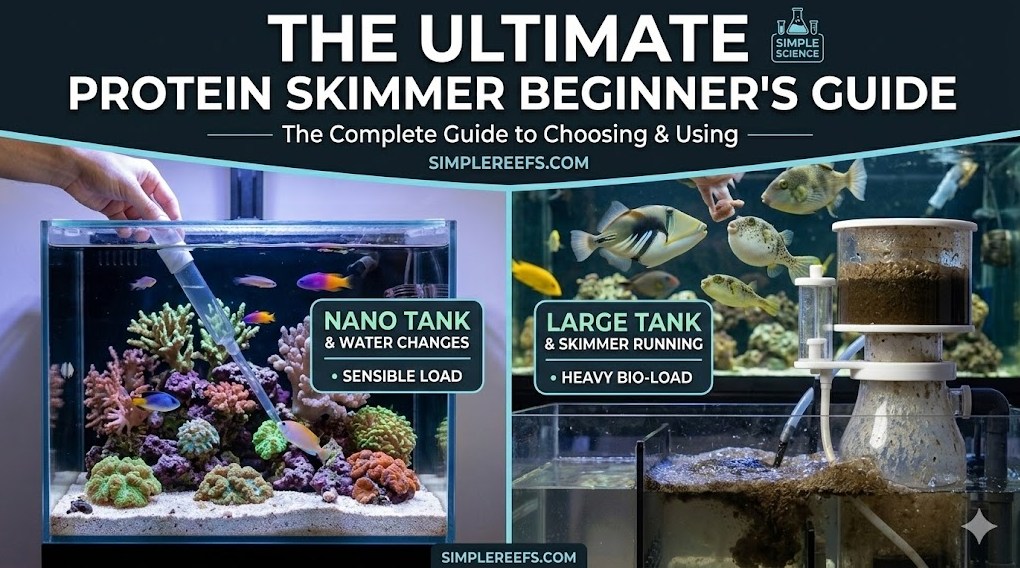
In a small nano aquarium, it is totally reasonable to forgo the addition of a protein skimmer and just be more diligent with water changes. If you changed 25% of the water in a nano aquarium once a week, I doubt you would ever have any real need for a protein skimmer, as long as your bio-load is kept sensible.
If you skip a protein skimmer on a nano aquarium, just be sure to point your return pump’s outlet at the surface of the water to heavily agitate it. This will help compensate for the lack of oxygen introduction that the skimmer usually provides.
What About Bigger Aquariums?
This is where it gets a bit more complex. In most cases, you will want a protein skimmer in a large tank. Changing large amounts of water to mitigate nutrient buildup is far more costly and far less practical. A protein skimmer means you will have to perform less water changes.
There are situations where this may not be the case. If you are running a coral table, for example, you could opt to go without a protein skimmer. Don’t get me wrong, I recognise that this is a controversial statement and I can hear those rigid hobbyists getting angry but it is true.
Again, being diligent with water changes should be enough to stay on top of it. As long as you are only feeding your coral very small amounts of food, that is. Some people don’t feed their coral at all. In that case, you definitely won’t need a skimmer. Water changes will perfectly suffice and they will help replace missing depleted elements like calcium in the process.
I would say that invertebrate specific tanks, in some cases, won’t need a protein skimmer. Plenty of aquariums house only a pistol shrimp and a goby. Water changes should, again, suffice. The same goes for tanks with certain shrimp. There just isn’t that much call for waste removal when the feeding will, typically, be quite light.
In Short
The truth of the matter is that most standard aquariums will massively benefit from the inclusion of a protein skimmer. They cut down on the need for huge water changes, stabilise your water’s pH, add vital oxygen, and keep everything much cleaner.
However, if you have a nano aquarium or a coral focused tank with very few fish, diligent weekly water changes will absolutely suffice. A skimmer is an incredible tool, but if you are trying to keep things simple and budget friendly on a small tank, it is one piece of equipment you can often safely skip or leave for later.
If you have decided that a protein skimmer is the way to go for your tank, why not check out our ultimate protein skimmer buyer’s guide so you know what to look for when purchasing? Thanks, as always, for reading and spending your time at Simple Reefs.
Frequently Asked Questions
What is a protein skimmer used for?
A protein skimmer physically removes dissolved organic matter, such as fats, proteins, and fish waste, from the aquarium water before it has a chance to rot and produce toxic ammonia.
How does a protein skimmer work?
Protein skimmers use a water pump to create thousands of micro air bubbles. Dissolved waste molecules attach themselves to these bubbles and rise into a collection cup, leaving clean water behind.
Do I really need a protein skimmer for a marine aquarium?
While highly recommended for larger tanks or aquariums with messy fish, many smaller nano setups and coral focused tanks can thrive without a skimmer by relying on frequent weekly water changes.
Can a protein skimmer remove too many nutrients?
Yes. An oversized skimmer running on a tank with a very low amount of fish waste can strip the water of all nitrates and phosphates. This can starve your coral and lead to outbreaks of nuisance pests like Dinoflagellates.
Why is my new protein skimmer not making foam?
Brand new skimmers have a thin layer of manufacturing oil on the plastic that causes bubbles to pop instantly. It typically takes a break in period of one to two weeks before a new skimmer begins producing thick foam.
Should I leave my protein skimmer on all the time?
Generally, yes. Leaving it on keeps your water highly oxygenated and your pH stable. However, you should temporarily turn it off when feeding liquid coral foods, adding beneficial bacteria, or dosing medications so the skimmer does not immediately pull them right out of the water.