
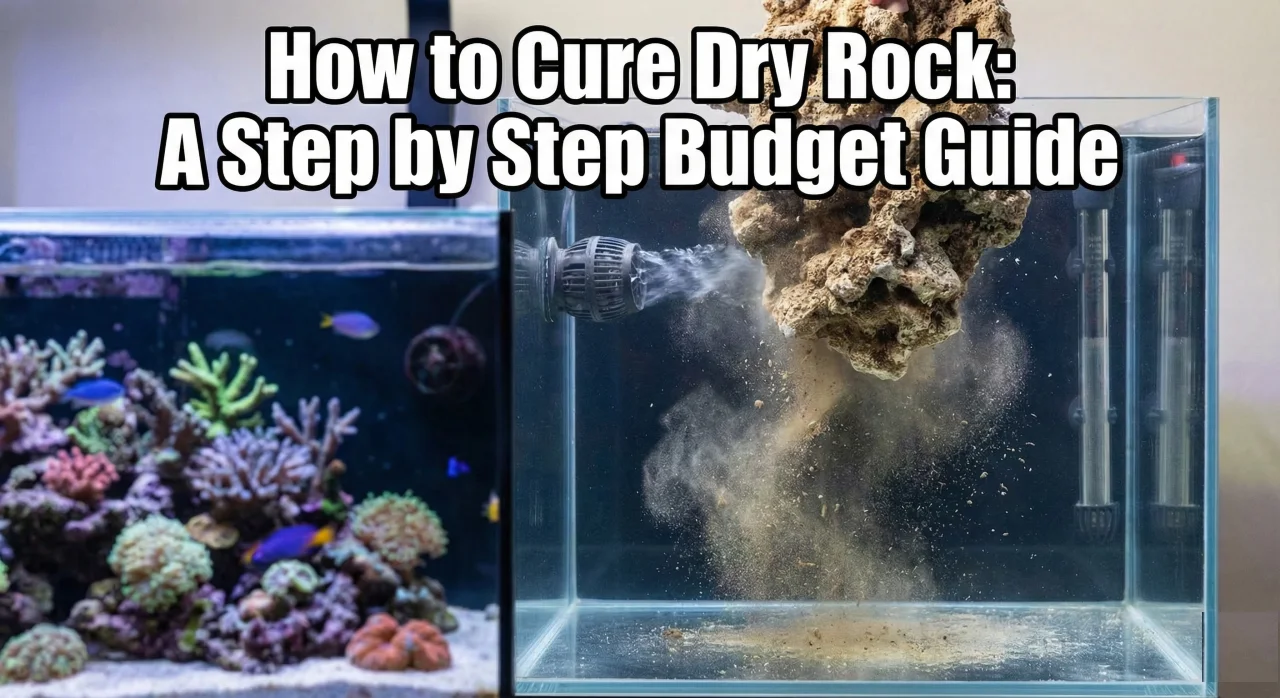
How To Cure Dry Rock: A Step By Step Budget Guide
Welcome to Simple Reefs. If you are staring at a box of dusty reef rock and wondering what to do next, you are in the right place. In this step by step budget guide, we are going to answer a very simple question. Do you actually need to cure dry rock?
Table of Contents
If the answer is yes, we are going to show you exactly how to clean and fully cure your dry rock safely, ensuring it is perfectly prepped before it goes anywhere near your marine aquarium. Let’s go!
The Dry Rock Curing Process: In this guide, we are going to break down exactly how to prepare your dry rock safely. We will look at how to identify if your rock actually needs curing, the budget friendly equipment you need, and the three different methods you can use to rid your rock of dead organics so it is safe for your marine aquarium.
Key Takeaways
- Rotting Organics Are Dangerous: Dry rock from the ocean or an old aquarium is covered in dead flora and fauna. If not removed, these will rot in your tank and create a toxic ammonia spike.
- Not All Rock Needs Curing: Specialist man made rocks like Life Rock or mined limestone can go straight into your tank after a quick rinse.
- Safety First: The fastest curing methods involve strong acids or bleach. You must wear protective gear and perform these steps in a well ventilated space to avoid serious injury.
- Cycling vs Curing: These are two completely different processes. We cure the rock to clean it of dead organics, and then we cycle the rock later to grow beneficial bacteria.
Do You Need to Cure Dry Rock? (And What Curing Actually Means)
Curing is a process that involves preparing your rock to be added to your aquarium. It could be loosely compared to hardening a material so it becomes usable, much like curing polymer clay. The same way we cure clay to make it usable, we cure rocks to make them usable in our aquariums.
The reason we do this is because rocks that have been used in an aquarium, or come from the ocean, will be covered in various different types of flora and fauna. Be it algae, invertebrates, bacteria, molluscs, sponges, or even coral.
When the rock is removed from the water, these organics begin to quickly die off. When the rock is added to saltwater again, these dead organisms will begin to rot. That rotting will cause the production of a toxic compound known as ammonia. This ammonia can then damage, and kill, the residents of our aquarium.
The curing process allows all of this die off and rotting to occur in a controlled environment. Be it a bucket or another aquarium with no residents. That way, the ammonia won’t harm anything and we can remove it from the rocks safely.
We Aren’t Cycling The Rock Yet
It is incredibly common to see the terms “curing” and “cycling” used interchangeably in the marine fishkeeping hobby, but they are two completely different things. This lack of clarity is exactly why so many beginners end up making mistakes that cost them both time and money. Simple Reefs is here to fix that.
To put it simply: curing is the act of cleaning the rock. We are stripping away all the dead, rotting organics so the rock is safe to use.
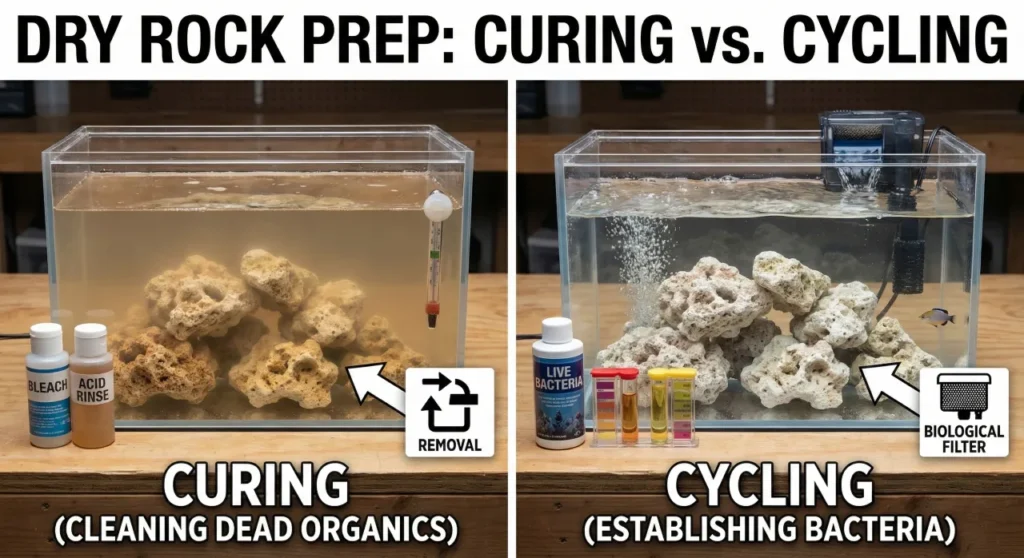
Cycling comes later. Cycling is the process of deliberately growing beneficial bacteria on that clean surface to ultimately turn your dry rock into live rock. You will struggle to successfully cycle dirty rock quickly, so we must always cure it first.
Which Dry Rock Needs Curing?
This is an issue that confuses people and for good reason. After all, shouldn’t dry rock be safe to use straight away? It has been out of the water for a long time, after all.
The reason we may need to cure Dry Rock is because dead organics may still be found on the rock in spite of it looking clean and white. Those cracks and crevices may be hiding all kinds of dead coral, molluscs, sponges, bacteria and other unwanted things.
As soon as we add the rock to our aquarium, they will begin to rot and create ammonia. This can slow your cycling process dramatically so we cure it to avoid that hassle. Take a look at this quick checklist to see whether your dry rock needs curing.
💡 Quick Tip: The Dry Rock Checklist – How to Tell If Dry Rock Needs Curing
Whether dry rock needs curing depends entirely on where it came from. Use this quick checklist to decide before adding it to your aquarium:
- Mined Rock (e.g. terrestrial limestone) – No curing required
- Life Rock or other speciality painted Dry Rock – No curing required
- Instructions on leaflet say safe for immediate use – No curing required
- Man made rock – No curing required
- Dry rock from the ocean – Curing required
- Dry rock from another person’s aquarium – Curing required
- Dry rock from unknown origin but brown or yellow in colour – Curing required
- Dry rock from unknown origin, bright white but obvious dead things – Curing required
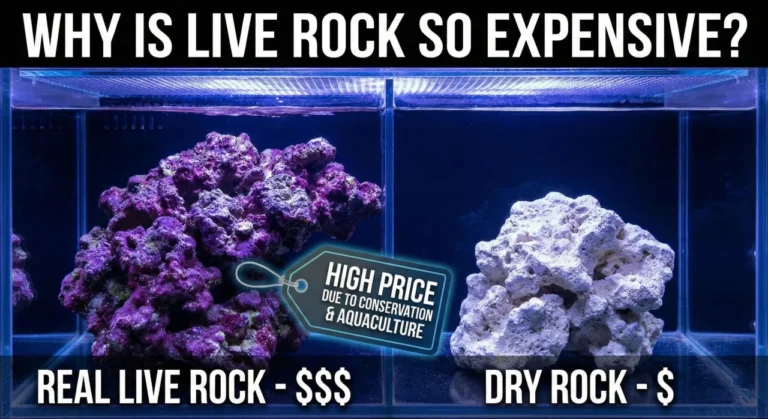
Take a look at the rock. If there is residual pink or purple algae on there, we should cure it. If you have wet Live Rock instead of dry rock, do not follow this guide.
The Budget Friendly Shopping List
Naturally, this is Simple Reefs, and we are all about saving you money. With this in mind, our guide is written with a view to cutting costs. You will need different items depending on how fast you want to cure your rock.
| Item | Approx. Cost | Notes |
|---|---|---|
| 25L food safe bucket | £10 | Cheap brewing bucket works fine. Rubbermaid Brutes are good but pricey. |
| 100W heater & Wavemaker | £25 combined | Essential for the slower curing methods to keep water moving and warm. |
| RO/DI fresh water | £1-£2 / 5 litres | Buy from fish shops or deionised water from car sections at B&M/Halfords. |
| Ammonia test kit | £12 | Crucial for testing when the curing process is complete. |
| Scrubbing brush & PPE | £5 | Medium bristle brush, rubber gloves, goggles, and a respirator/mask. |
| Citric Acid Powder | £5 – £10 | Optional. Used for an initial acid soak to strip organics. |
| White Vinegar or Bleach | £2 – £10 | Required for the quicker curing methods. Must contain NO dyes or perfumes. |
| Seachem Prime | £8 | Essential dechlorinator if you choose the bleach method. |
Step 1: Let’s Give The Rock A Clean
Don’t go throwing that rock straight into your tank. First of all, you are going to want to give it a clean. It will definitely have dust on it and there is, more than likely, a bunch of nasty, dead organisms on there that you can’t see.
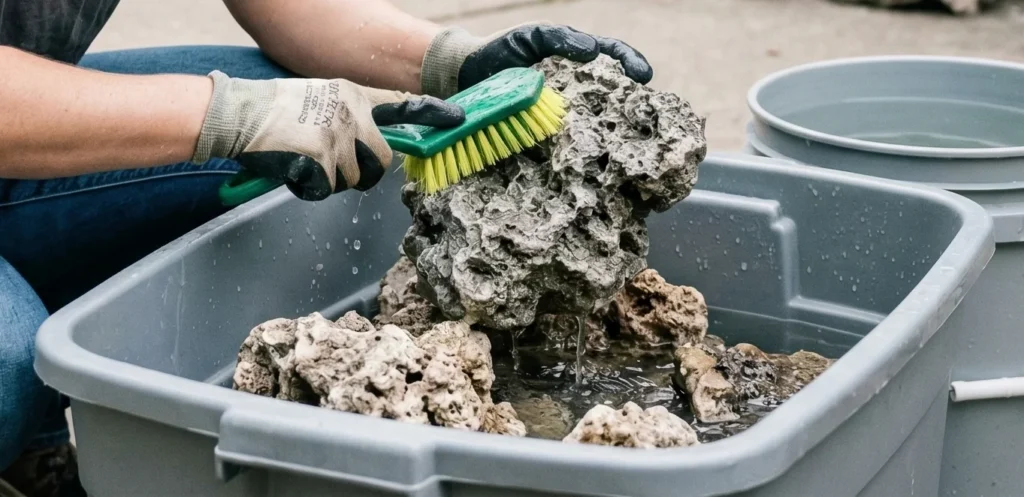
Cleaning is fairly simple. You can use a medium bristle scrubbing brush. Get deep into the nooks and crannies, removing anything that wants to come off of the rock. Don’t be afraid to grab a pick or a blunt knife and scrape away.
Try to get the rock as clean as possible. Doing this now will save you a lot of mess in your aquarium and make your curing, and subsequent cycling, process much quicker.
A quick note if you are using Carib Sea’s Life Rock or any similarly painted dry rock. Don’t scrub it or use caustic chemicals. Simply rinse it with some freshwater to get the dust off and you are ready to go.
Step 2: An Optional Acid Soak (Not Necessary for Most Rock)
Before we begin the actual curing process, we have the option to soak the rock in acid for a day or so. This step is not at all necessary and is actually far from recommended. Any time you can avoid working with corrosive substances, you should avoid it.
The process may speed the next steps up considerably but should only be considered for particularly nasty, evidently dirty rocks. Before we proceed however, please take note of this important warning:
⚠️ Warning: Do Not Acid Soak Painted or Man Made Rock
If you spent extra money on premium, painted dry rock like CaribSea Life Rock, Real Reef Rock, or specialised reef ceramics, absolutely do not put them in an acid bath!
The citric acid will completely strip away the beautiful purple and pink artificial coralline coatings you paid for. It can also severely degrade the structural integrity of man made ceramic rocks, causing them to crumble. These types of rock are manufactured to be completely free of dead organics anyway, so they only ever need a quick rinse in fresh water to remove transit dust.
The idea behind using a gentle acid is to help break down stubborn organic material on the rock.
This can speed up the process a little and also make your rocks significantly cleaner. We may even, potentially, release some of the bound up phosphates that will later be leeched into our aquarium water.
To do this, we are going to use citric acid powder. The reason we choose citric acid is because it is affordable and very safe compared to more harsh forms. We don’t want to be playing around with something dangerous now, do we? It is also readily available in powder form in the UK, USA, and many other places.
It should be noted that the acid will soften our rock. Aragonite rock, the most commonly found type in marine aquariums, isn’t a big fan of acid and we will lose some of the surface area. Hence why we only soak the rock for a day or so.
Any longer and we are doing serious damage that we really don’t need. Expect slightly lighter, more porous rock afterwards.
⚠️ Warning: Safety First With Acid
Only undertake this task if you can do it outside. Fumes from acid can burn your lungs and eyes. Leave the bucket in a shed or a covered area away from animals like birds. Keep the bucket well out of the way of children and pets.
Citric acid can burn. Wear suitable personal protection like a respirator or mask, rubber gloves, and safety goggles. All of these things can be picked up very cheap in places like B&M and Poundland.
Simply fill a bucket with water and add citric acid powder based on the amount of water contained in the bucket. I would suggest about a 3% ratio of citric acid powder to water. So, for example, 30g of citric acid powder to 1 litre of water. Mix it up thoroughly then add your rocks.
Wear goggles as I guarantee there will be some splashing and sod’s law says it will be your eyes that get the brunt of it. Expect to see some fizzing when you add the rocks as the acid begins to attack the organics. Give it around 24 hours, take the rocks out and give them a very good rinse before moving onto the next step.
💡 Note: Optional and Not Essential
The citric acid soak is completely optional. It can help speed up the breakdown of organics slightly, but most dry rock will cure just fine using the safe bucket method or vinegar/bleach options. Don’t feel pressured to include this step, I sure as hell don’t do this. It’s mostly for enthusiasts who enjoy tinkering or want to experiment with a slightly faster process.
Step 3: Let’s Start Curing Our Dry Rock
We now have a choice to make. We can do this process the safe but slow way, the slightly quicker safe way, and the risky but quick way. Let’s take a look at those options. Be warned, each comes with some downsides and at least one of them requires a decent level of care.
Grab your food safe bucket and fill it with fresh, RODI (Reverse Osmosis, Deionised) water. We use RODI water because it won’t add anything nasty to the rocks like phosphates or silicates.
💡 Smell Check: What Is Normal?
During the curing process, it is completely normal for the water to smell earthy, much like low tide or wet seaweed. This is simply the dead organics breaking down and leaving your rock.
If the smell gets overwhelming or starts to stink out your house, simply perform a large water change. A bad smell means the process is working, and diluting the water is the best way to keep it manageable.
Here’s a quick comparison to help you decide:
| Curing Method | Estimated Timeline | Primary Ingredients | Safety Level |
|---|---|---|---|
| Method A: Safe & Slow | 1 to 3 Weeks | RO/DI Water | High: Completely natural, no harsh chemicals, perfectly safe for indoor use. |
| Method B: Vinegar Soak | 1 to 2 Weeks | RO/DI Water & Pure White Vinegar | High: Very safe, mild acid breaks down organics faster, safe for indoor use. |
| Method C: Bleach Cure | 1 Week + Drying Time | RO/DI Water, Unscented Bleach, Dechlorinator | Low: Fast and aggressive, highly toxic fumes, must be done outdoors with PPE. |
Method A: The Safe But Slow Way
This is the safest way to do this but it may take awhile. Put an aquarium heater in the bucket and set it to 26 degrees Celsius (79 degrees Fahrenheit). Add a powerhead or wavemaker to move the water around and then add your dry rock.
Place the lid over the top of the bucket, leaving a gap to stop light getting in but to allow oxygen circulation and the gases produced by the curing process to escape.
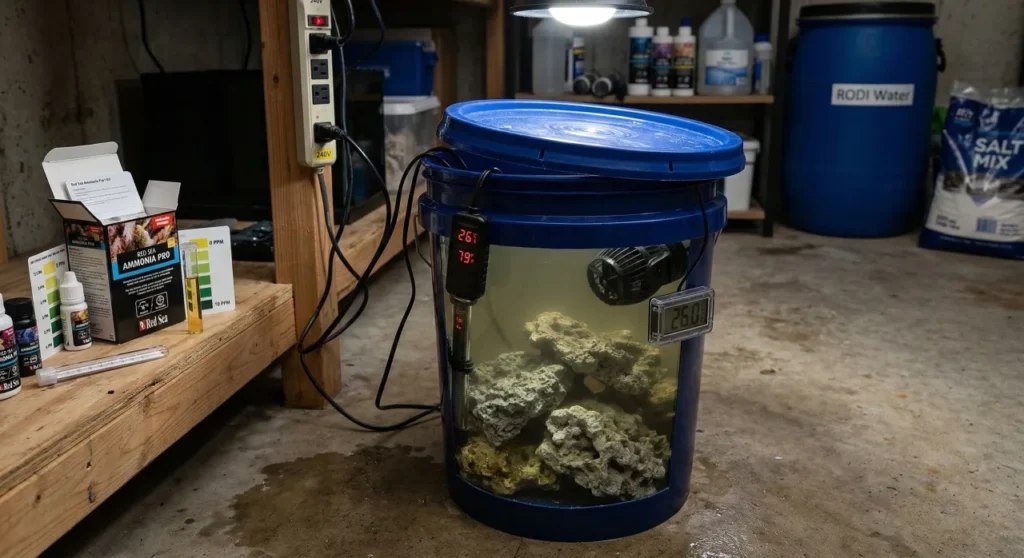
Now it is just a matter of waiting. We need to give it time for all of the organics to die off. This could take a week or it could take three. The water is likely to begin to smell and change colour. When the smell gets annoying, change the freshwater out for new and carry on.
When you stop noticing the smell of rotting, wait a day, then test for ammonia. If your ammonia test comes back at 0PPM, your curing is done.
Average Time To Cure: 1-3 Weeks depending on organic content of rock.
Method B: The Slightly Quicker Safe Way
This process is almost identical to the process above. We are simply going to add some pure white vinegar to the water. Place your water into the bucket and then add vinegar. Things like Windex are not suitable. Mix it up good and then add the rock into the bucket with the heater and powerhead.
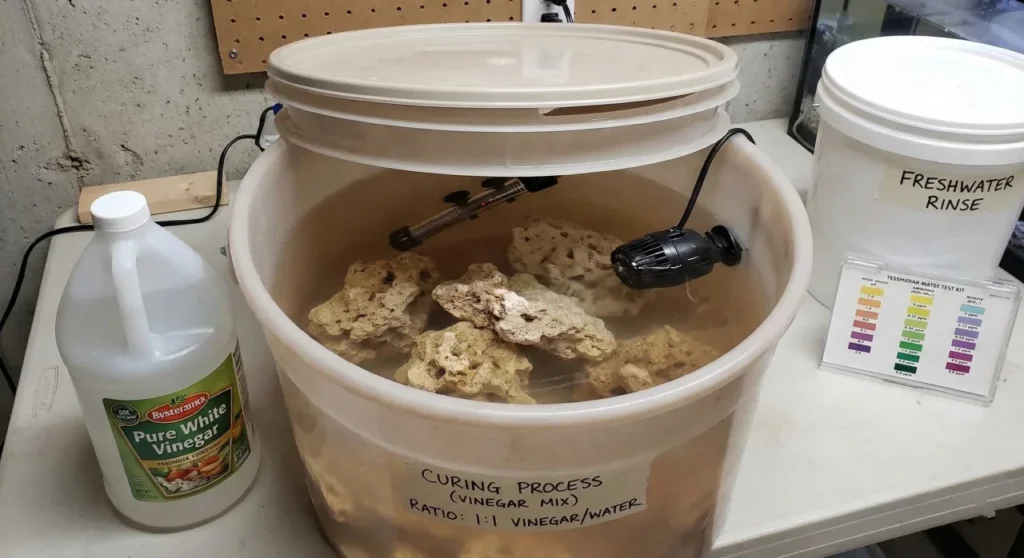
You want to be looking at a ratio of 0.85 to 1 part vinegar to one part water. For example, if you are using 15 litres of water you will want around 13 to 15 litres of vinegar. Place the lid over the top with a gap, and wait. The acid in the vinegar should help dissolve the organics on the rock, allowing us to shorten this process considerably.
When you stop noticing the smell of rotting, change the water and vinegar mix out for fresh water alone. Leave the rocks in the water for a day, then test for ammonia. If your ammonia test comes back at 0PPM, your curing is done.
Average Time To Cure: 1-2 Weeks depending on organic content of rock.
Method C: The Fast But Risky Way
This is probably the most common method of curing dry rock but it is also a bit more risky. We are going to take regular, household, thin bleach with no dyes or additives, and dilute it with freshwater.
Most UK thin bleaches are 4 to 5% sodium hypochlorite. Avoid thickened or splashless versions. I like to grab the thinnest, most basic bleach from Tesco. If the bleach is thick, coloured, or scented, it is no good.
⚠️ Warning: Bleach Is Highly Toxic
Only undertake this task if you can do it outside. Fumes from bleach can burn your lungs and eyes. Inhalation can even be fatal. NEVER do this indoors. Leave the bucket in a shed or a covered area away from animals. Wear suitable personal protection like a respirator or mask, rubber gloves, and safety goggles. Put some old clothes on, as well. Bleach can do a number on fabrics.
Take your bucket and fill it with water and then add your bleach. The ratio you are looking for is 1 litre of bleach to about 10 litres of fresh water. We don’t need a heater but you can add a wavemaker if you like to blow debris off the rocks.
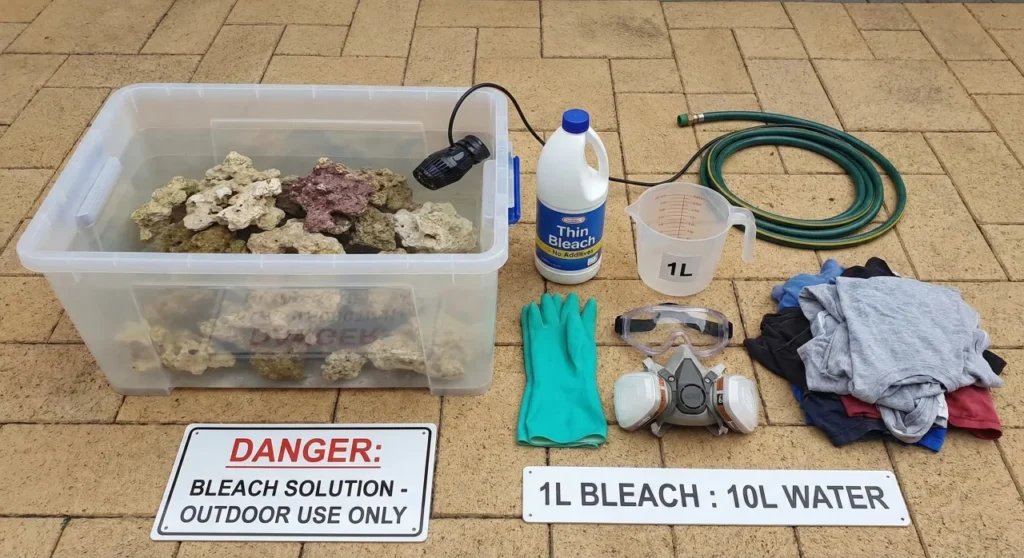
Leave the rocks in the bleach and water solution for 1 week. Bleach doesn’t dissolve the organics but it does oxidise them. The result is the same, nice clean dry rock.
When the week is up, grab your gloves, mask, and goggles and remove the rocks from the water. You now need to diligently rinse the rocks and run a lot of water over them to make sure they are safe. We don’t want any bleach smell left over whatsoever so keep on rinsing.
Average Time To Cure: 1 Week plus time for the rock to dry out.
Step 4: The Final Rinse and Drying (Bleach Method)
If you used the bleach method, I like to throw in an extra precautionary step here. Give your bucket a really good clean and rinse. Fill it up with RODI fresh water and add some dechlorinating fluid, as per the instructions. Seachem Prime is a fantastic option here.
Soak the rocks for 24 hours in the dechlorinating fluid. This will deactivate the chlorine from the bleach.
We then need to let our rocks dry. This is particularly important if you didn’t follow the additional step of using dechlorinating fluid. The rocks need to be bone dry so that the chlorine can evaporate in a process known as “Gassing Off”. Give the rocks a couple of days. When they are bone dry, they are safe to add to your aquarium.
The Final Step and a Note About Algae
The next step is to transform the dry rock into live rock. The curing process will have removed all of the dead organics from the rocks and made them safe to place in the aquarium whether or not you have residents.
It is worth noting that our Dry Rocks may cause algae blooms in our aquarium and potential phosphate related problems. Phosphates can become bound up in the rock. We may also see the release of what is known as Silicates.

These silicates will cause algae blooms known as Diatoms. Diatoms look like brown dust and will cover the sand and rocks, lasting from a few weeks to a few months.
We can add a few products that will soak up all of those silicates and will also remove phosphates too. That will help reduce algae blooms and provide a better future for our aquarium.
💡 Tip: Beating Bound Up Phosphates
Old dry rock, especially rock taken from a previous aquarium, acts like a sponge for phosphates. Even after the dead organics are scrubbed away, the rock can continue leaching these hidden phosphates into your water. If ignored, this will eventually fuel a massive hair algae outbreak in your display tank.
To prevent this, test your curing bucket water for phosphates alongside your ammonia tests. If you get a high phosphate reading, simply place a mesh filter bag filled with a phosphate remover like ROWAphos or GFO (Granular Ferric Oxide) into the bucket right in front of your wavemaker. This will strip much of the bound up phosphate out of the rock before it ever reaches your pristine aquarium!
Can Curing Dry Rock Stall Your Cycle?
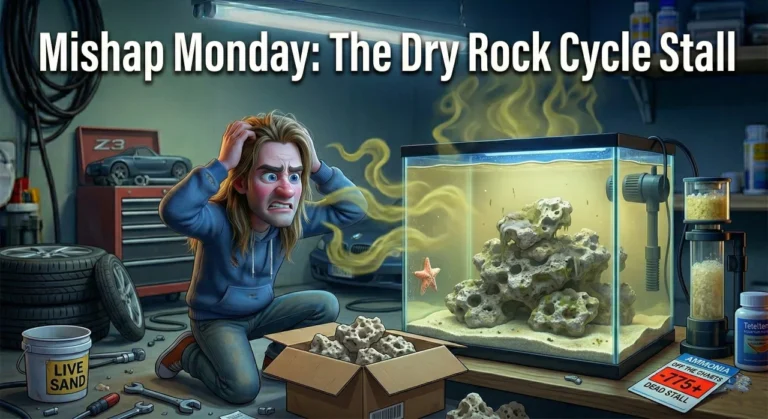
Yes. It absolutely can. If dry rock still contains a large amount of hidden organic material, that die-off can produce prolonged ammonia spikes once the rock is placed into water. Even if you think you are “cycling”, you may actually just be dealing with ongoing decay.
This happened to me. I used bright white rock that looked perfectly clean and I was completely convinced didn’t need anything other than a quick clean. Within days, the smell coming from the tank told a very different story. One unhappy fiancée and a completely stunk out house later and I realised my mistake.

Here is what can happen:
- Heavy trapped organics continue breaking down.
- Ammonia keeps being produced.
- Beneficial bacteria struggle to stabilise because the source of waste is inconsistent.
- The cycle appears “stuck” or endlessly resetting.
In extreme cases, this can delay your cycle significantly and make you question whether you did something wrong. Often, you didn’t. You just didn’t remove enough decaying material before starting the cycling process.
This is why thorough curing matters. It removes the unpredictable variable. When you finally begin cycling, you are working with clean, stable rock instead of a slow release ammonia factory.
If you want to read exactly how this played out in my tank and how I fixed it, I’ve written a full breakdown here: Mishap Monday: The Dry Rock Cycle Stall.
💡 Note: Can I Cure Dry Rock in My New Aquarium?
- Yes, but with caution: You can cure dry rock directly in an empty tank, but it carries risks.
- Ammonia spikes: Dead organics can release high ammonia. Levels above 4 to 5 ppm can stall bacterial growth and delay your cycle.
- Monitor closely: Test your water frequently. Perform large water changes if ammonia rises too high.
- Learn more: For a deeper look at how organic die-off can stall your cycle, check out our full guide here.
If I Were Starting Again…
If I were setting up a reef tank from scratch and working with unknown dry rock, I would choose Method A: The Safe But Slow Way every single time.
It costs almost nothing, carries virtually no risk, and gives you complete peace of mind. It also avoids horrible chemical smells and potential burns. You are simply allowing nature to do its thing in a controlled bucket instead of inside your display tank. No harsh chemicals. No chance of weakening the rock. No stress about chlorine residue.
Yes, it may take a week or two longer, but in reef keeping, nothing good happens fast. Patience ends up being its own type of investment that can save you serious money.
The faster methods absolutely work. Many experienced reefers use bleach without issue. But if you are new, the safest path is often the smartest one. Let the organics break down naturally, change the water when it smells, test for ammonia, and move on when it reads zero.
It’s a simple and predictable method with low drama and that is exactly how your reef journey should begin. 🪸 Thanks for reading! Why not read our guide on Cycling Your New Marine Aquarium to get started on making your tank ready for its first inhabitants?
Frequently Asked Questions
Can I skip curing if my dry rock looks perfectly white and clean?
Only if it is a specialist man made rock like Life Rock or mined terrestrial rock. If it came from the ocean or an old aquarium, it will have dead organics hidden deep inside the pores that will rot and cause an ammonia spike, no matter how clean it looks on the outside.
How long does it take to fully cure dry rock?
It typically takes between one and three weeks. The exact timeframe depends entirely on the curing method you choose and how much dead organic material was trapped inside the porous rock.
Does dry rock need a heater while curing?
Yes, if you are using the natural water or vinegar method. Keeping the water around 26 degrees Celsius encourages bacteria to break down the organics much faster. If you are using the bleach method, a heater is not required.
Do I need to buy a protein skimmer for the curing bucket?
No. While some people use skimmers to pull out organic waste during the process, it is an expensive and unnecessary step for a budget friendly setup. Regular water changes and manual scrubbing are more than enough.
Can I just use tap water to cure my dry rock?
It is highly recommended that you use RO/DI water instead. Tap water contains heavy metals, chlorine, and silicates. These will soak into the highly porous dry rock and leach out into your display tank later, causing massive nuisance algae blooms.