
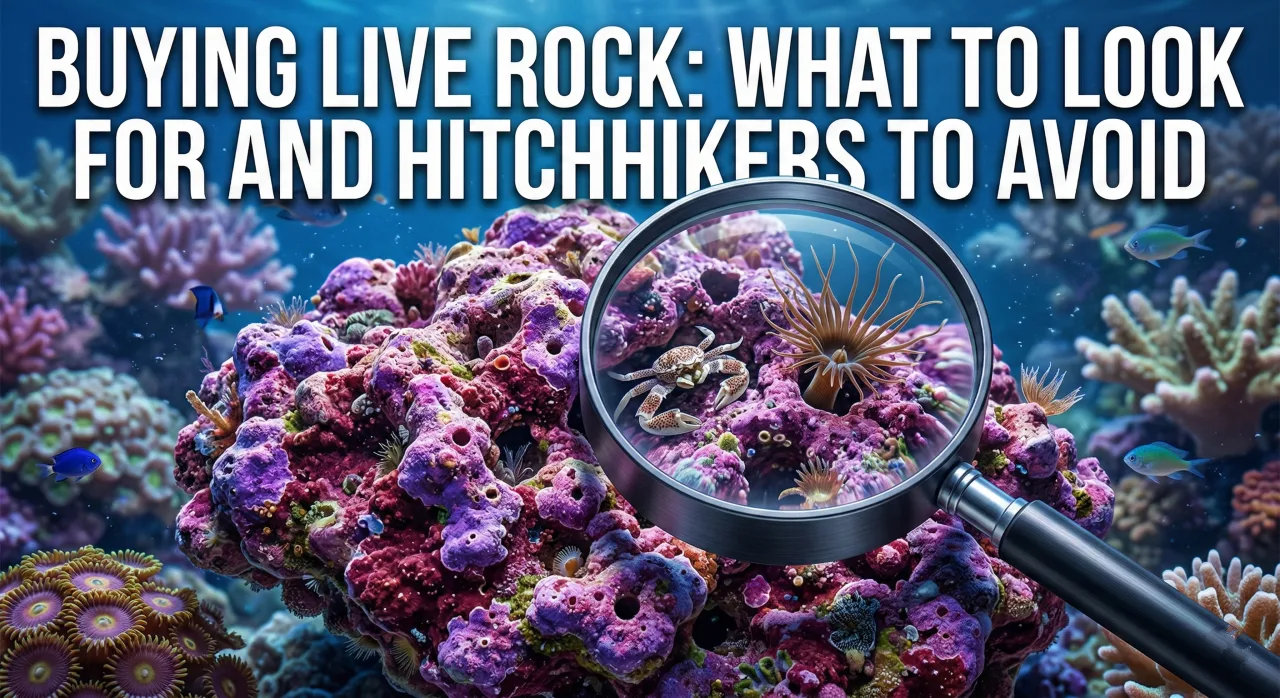
Buying Live Rock: What to Look For, Hitchhikers to Avoid, and When to Cure It
Welcome back to Simple Reefs. Today we are taking a closer look at the foundation of your marine aquarium: the rockwork. We are going to walk you through exactly how to choose the best pieces of live rock, what to avoid, and what to do when you get them home. Let’s dive into Buying Live Rock: What to Look For, Hitchhikers to Avoid, and When to Cure It.
Table of Contents
The Rock Foundation: In this guide, we are going to break down everything you need to know about live rock. We will look at how to identify healthy pieces, the hitchhikers you must avoid, and the next steps when you get it home.
Key Takeaways
- Avoid White Rock: Healthy, aged live rock should never be bright white. Look for yellow, brown, and purple colours.
- Die-Off is Dangerous: When rock is shipped, the living organisms on it begin to die. This “die-off” creates toxic ammonia that must be processed before the rock enters your tank.
- Patience is Required: Curing rock can take anywhere from a few days to several weeks. You must wait until ammonia tests read zero before adding the rock to an established reef.
Back to Basics: What Actually is Live Rock?
Before we look at what to look for when buying live rock, we need to answer a very common beginner question – What is live rock? Well, despite the name, the rock itself is not actually alive.
It is usually made of calcium carbonate, essentially the skeletons of ancient coral reefs that have broken down over thousands of years.
What makes the rock “live” is the massive, thriving ecosystem of organisms living on the surface and deep within its porous structure.

A good piece of live rock is home to millions of beneficial nitrifying bacteria, colourful coralline algae, tiny filter-feeding feather dusters, and microscopic crustaceans like copepods.
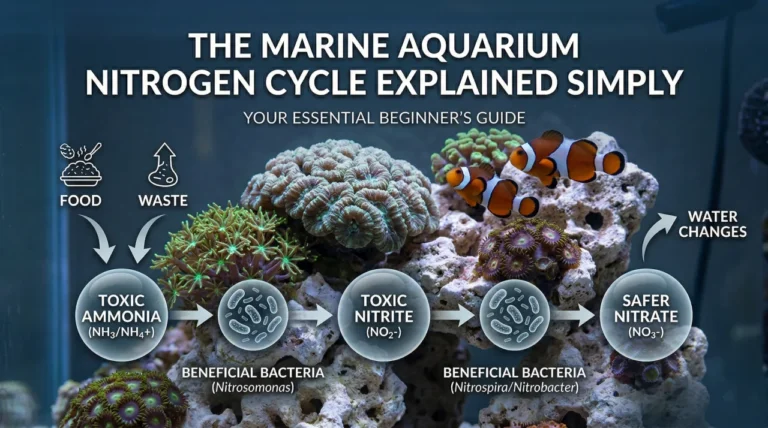
In a marine aquarium, this rock acts as the biological heart of your tank. It is the lungs and the kidneys of your reef, processing toxic fish waste (ammonia) and turning it into safer compounds.
Without a healthy bacterial filter living in your rocks, your tank simply cannot support marine life.
Do I Need To Purchase Live Rock?
The next big question that I am sure most beginners (including myself when I started) have is whether you actually need to start your marine aquarium by purchasing live rock?
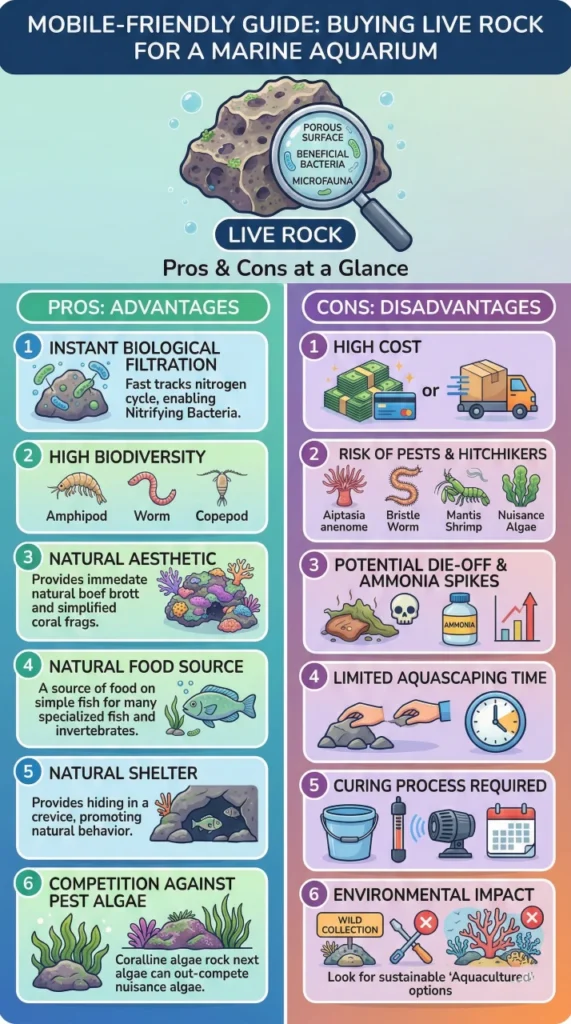
Well, the answer to that is a resounding no. You don’t need to start by purchasing live rock and, in a lot of cases, this is the least sensible thing you can do. While it is a fantastic start for your biological filtration, live rock comes with some very specific problems:
- The Astronomical Cost: Live rock is sold by the kilo, and in much of the world, it is incredibly expensive. Filling even a medium sized tank entirely with mature live rock can easily cost hundreds of pounds.
- The Pest Lottery: Every single piece of live rock you buy is a gamble. By purchasing 20kg of it, you drastically increase your chances of importing Aiptasia anemones, coral eating flatworms, or a rogue Mantis shrimp into your display.
- The Aquascaping Rush: Live rock must stay wet to keep the bacteria and organisms alive. You simply cannot spend three hours carefully cementing and gluing a gravity defying rock structure on your living room floor.
- The Monumental Die-Off: Curing one or two pieces of live rock in a bucket is a manageable task. Trying to cure an entire tank’s worth of shipped live rock will result in massive ammonia spikes and a house that smells strongly of a fish market.
The smart alternative to purchasing live rock is to, instead, start your marine aquarium with dry rock and turn that dry rock into live rock. We have a guide for that so why not give it a click and save yourself some money?
Dry rock is far more affordable, there is no pest risk, and you can take your time building your aquascape with no risk of die off. Naturally, it comes with its own set of downsides but they are minimal.
If, however, you decided to opt for live rock or simply need a single piece to help with the cycling of your new aquarium, we are here to help you pick the perfect rock. We are then going to show you how to cure that live rock to make it safe to place in your aquarium.
⚠️ Warning: Never Drop Uncured Live Rock Directly into an Established Tank
If you already have fish, corals, or invertebrates living in your aquarium, adding a brand new piece of live rock straight from the shop or the post is incredibly dangerous.
- The Ammonia Bomb: During transport, organisms on the rock inevitably die. If you place this rock straight into your tank, that decaying matter an cause an immediate ammonia spike. This can easily wipe out your entire aquarium very rapidly.
- The Pest Invasion: Adding rock directly means you are bypassing any quarantine process. You could be introducing Aiptasia anemones, coral eating flatworms, or predatory crabs straight into your pristine display without noticing them until it is too late.
The Only Exception: The only time it is safe to add uncured live rock directly to your display tank is if the aquarium is brand new, completely empty of livestock, and you are using the rock to start your initial nitrogen cycle. There are some exceptions when it comes to live rock from your local fish shop but we are going to talk about that in a little.
The Curing Process: Luckily, we can make this live rock safe using a process called ‘curing’. This involves allowing the organics on the rock to die off and rot in a safe environment. Keep reading for a handy guide on curing live rock.
Picking The Perfect Live Rock
We have a few regional specific nuances when it comes to the purchasing of live rock. For example, in North America, most of your live rock is cultured in specific farms, often in the ocean. In the UK, it’s a little different.
The live rock you purchase in the UK is far more likely to have been “aqua-cultured” inside of aquariums within this country. This means the retailer started with dry rock and transformed it into live rock over a period of time.
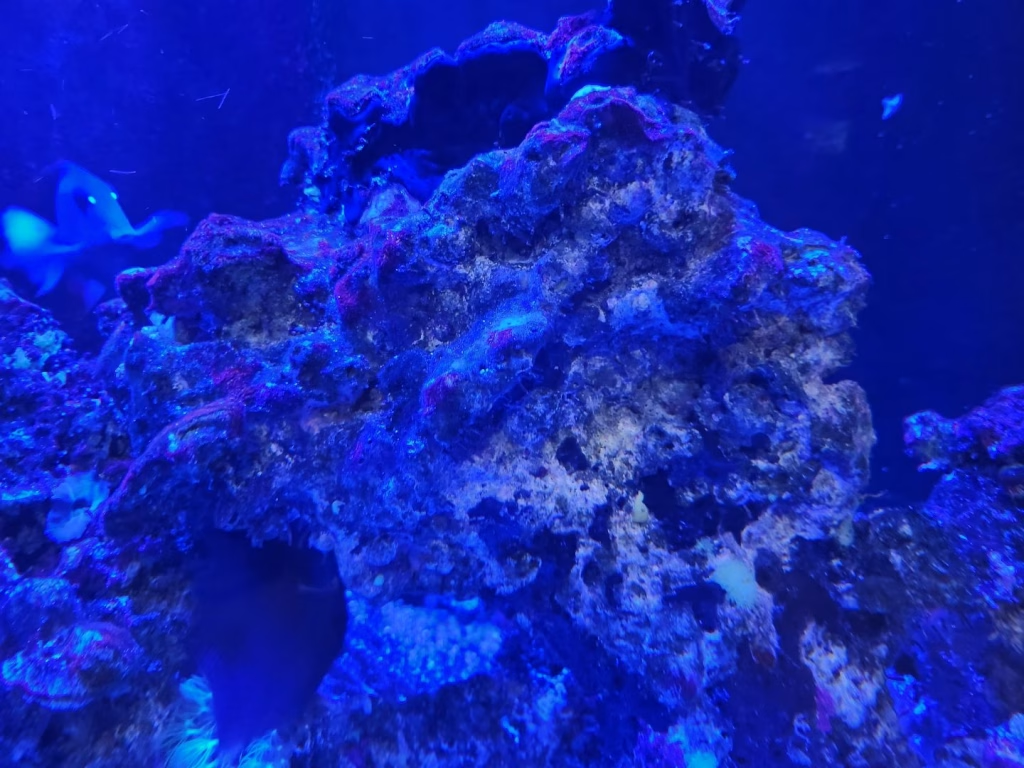
Most of the time, this will be done by fish shops themselves or larger distributors like Rock ‘n’ Critters. This process is the reason why live rock is so expensive. It is a time intensive task and takes up a lot of space and energy.
Transforming a piece of dry rock into live rock takes a long time. This can lead to an unfortunate situation where certain fish shops or sellers try to pass off very immature rock as healthy, seasoned live rock.
If we want to guarantee that we are getting a quality, mature product, we need to know what we are looking for. Here’s what you need to keep your eye out for.
💡 The Long Game: Turning Dry Rock into Live Rock
If you opted for affordable dry rock, you might be wondering how it actually becomes “live”. The process is known as seeding. By placing sterile dry rock into a saltwater environment alongside a small piece of existing live rock, a scoop of live sand, or some bottled marine bacteria, the biological life slowly spreads and colonises the new rock.
How long does it take? To establish a basic bacterial filter capable of safely processing fish waste, it usually takes between four and eight weeks. However, for that dry rock to truly mature into authentic live rock, complete with purple coralline algae, sponges, and a diverse population of microfauna, you are looking at a timeframe of six to twelve months. It requires patience, but it will save you a massive amount of money!
What Colour Should Live Rock Be?
If buying in a local fish shop, you should be able to get up close and personal with their live rock selection. Most owners will be happy for you to examine the rock thoroughly before buying.
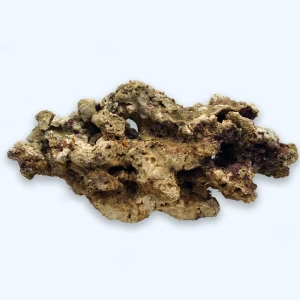
The main thing you want to be sure of is that the piece of live rock is well cultured. This means it needs to have spent a lot of time in an established aquarium, giving it the chance to develop a diverse selection of bacteria and invertebrates.
Do not buy anything that looks even close to white or light yellow. That rock has likely only been in the water for a few weeks. It will be completely useless biologically or, even worse, detrimental to your aquarium if it has managed to acquire pests without the benefits of mature bacteria.
We are looking for rock that has some serious age to it. That means it is more of a browny-yellow colour. A few sponges on the surface are a good sign of age, as are miniature bivalves and feather dusters. If you can see spots of purple, red, or pink encrusting coralline algae, that is a massive bonus.
Hitchhikers and Algae to Avoid
Take a good look at the rock and examine it for pests. There are a whole range of different micro-creatures that can come hitchhiking on live rock. Many will be very beneficial, but some can become real problems later down the line.
| The Hitchhiker | What It Looks Like | Why You Should Avoid It |
|---|---|---|
| Aiptasia & Majano | Small, pale brown or translucent anemones. Aiptasia have long, stringy tentacles, while Majano have shorter, stubbier tentacles. | Pest anemones that sting your coral and fish, spreading like wildfire. |
| Mantis Shrimp | A brightly coloured or mottled brown crustacean with large, highly complex eyes on stalks and folded front claws like a praying mantis. | Ruthlessly efficient killers with tremendous eyesight that will eat your fish, shrimp, crabs, and snails. |
| Gorilla Crab | A small, hairy, brown or grey crab. The ultimate giveaway is that the very tips of its claws are black or dark brown. | Unlike reef safe hermits, these are opportunistic predators. They will happily kill sleeping fish, eat snails, and tear corals apart. |
| Bobbit Worm (Eunice Worm) | A long, segmented worm with a metallic sheen, five distinct antennae on its head, and large, bear trap like jaws. | Terrifying nocturnal ambush predators that grow incredibly large. They will actively hunt your fish and drag them deep into the rockwork. |
| Asterina Starfish | A tiny, white or pale pink starfish, usually no bigger than a fingernail. They often look deformed, with missing or uneven legs. | While many are harmless, they reproduce rapidly by splitting in half and can reach plague proportions. Some types also eat expensive Zoanthid corals. |
| Bubble Algae | Hard, shiny, dark green spheres or bubbles attached tightly to the rock surface, often growing in clusters. | Looks like green clustered marbles. It will absolutely explode if you have a nutrient issue and cover your tank. |
| Dinoflagellates | A stringy, snot like, brown slime coating the rocks and sand, very often with tiny air bubbles trapped within the slimy strings. | A thick brown slime. They come in different types, spread quickly, suffocate coral, and are horribly difficult to remove. |
| Vermetid Snails | Small, hard, calcareous tubes sticking out of the rock, resembling a tiny piece of twisted pipe. They cast out fine, spider like webs. | Perhaps not as bad as some owners suggest. They can irritate nearby corals with their long mucus webs. |
If you see brown slime, bubble algae, or Aiptasia on any of the rocks in the retailer’s display tank, leave the rock in the shop and walk away as fast as possible.
There are very few safe ways to add rocks or coral to your tank and not spread these issues to your own display. Even if the price is tempted, the risk simply isn’t worth it.
When you have your perfect piece of live rock, it’s time to decide whether, or not, we need to cure the rock.
💡 Tip: Beneficial Hitchhikers to Look Out For
While we spend a lot of time worrying about pests, live rock can also bring some fantastic free additions to your cleanup crew. If you spot any of these little guys when inspecting a piece of rock, consider it a massive bonus:
- Common Bristleworms: Beginners are often terrified of these, but they are brilliant detritus eaters. They look like pink or orange segmented worms covered in thousands of tiny white bristles. They live in the rock crevices and eat leftover food your snails cannot reach. Just do not touch them with your bare hands, as the bristles sting!
- Micro Brittle Stars: These tiny starfish have long, striped legs that you will often see poking out of crevices during feeding time. They are brilliant detritus scavengers that will keep your rockwork clean and will never harm your corals.
- Stomatella Snails: Looking a bit like a slug with a flattened, fingernail like shell on its back, these are phenomenal algae eaters. They are largely nocturnal and will happily reproduce naturally in your marine aquarium.
- Feather Dusters: Small, tube dwelling worms that cast out a delicate, feather like crown to filter feed from the water column. They are completely harmless, indicate good water quality, and are fascinating to watch.
- Copepods and Amphipods: These look like tiny white fleas scurrying across the surface of the rock. They are the ultimate sign of a healthy ecosystem and provide a fantastic, continuous free food source for your fish.
What is “Die-Off” and Do I Need to Cure My Rock?
When we remove live rock from the water to transport it, the salt water dwelling organisms are suddenly placed into a lethal situation. The second that rock is removed from the water, the clock starts ticking.
Sponges die first, then the invertebrates, and finally the surface bacteria. When these organics die and are placed into your aquarium, they begin to rot.

This rotting process produces ammonia. If this happens in your display tank, it will overwhelm your biological filter and cause an accumulation of dangerous toxins. This process is known as “die-off”.
Needless to say, brand new tanks will not be able to handle this die off. While it can actually aid in cycling a new marine aquarium, it can also lead to a cycle stalling and taking much longer to complete.
The amount of ammonia produced will be far too much for the small population of bacteria to process. That amount of ammonia can even cause well established tanks to struggle and experience a mini-cycle, or worse. To completely avoid this, we can cure the live rock.
So, What Does Curing Live Rock Mean?
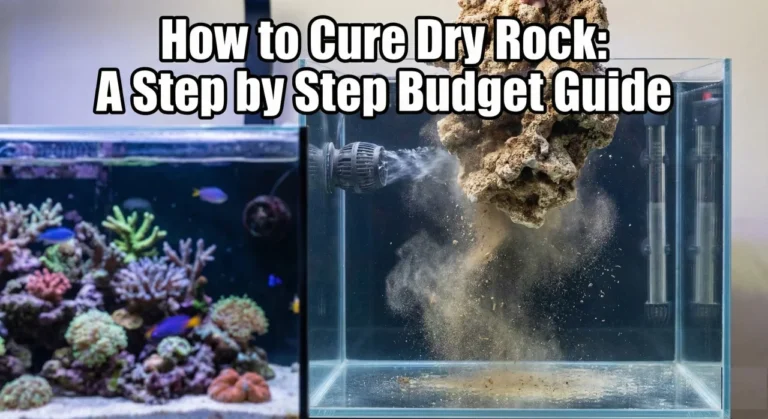
Curing live rock simply means we are making the rock safe for use in our aquariums. The idea is simple: we take that live rock and isolate it in its own body of saltwater so that the die off can occur in a controlled environment, not in our tanks.
We place the rock into a bucket with heated saltwater and a wavemaker. The dead organics rot away in this contained environment rather than in our aquarium.
We then change the dirty water in the bucket regularly. We let everything that is going to die finish dying in a safe way, while allowing the surviving bacteria to adapt.
💡 Do I Always Need to Cure Live Rock?
This is the big question, right? The answer is, not always but in most cases, yes. Here is a quick breakdown of when you need to get the bucket out:
- Bought from a Local Fish Shop: It depends. Check out our tip box below for some more information.
- Bought Online (Pre-Cured): “Pre-cured” just means the retailer cured it when they received it. It will still suffer die-off during shipping to your house. You should almost always cure or quarantine rock bought online.
- Brand New Empty Tank: If your tank has absolutely no fish or corals in it yet, you can often skip the bucket and cure the rock directly inside your new display tank! The ammonia will actually help cycle your new setup. Prepare for the possibility of a slightly longer cycle and test for ammonia frequently. Check out our guide on cycling a new marine aquarium and take a look at the information box below.
🔄 The Nuance of Cycling with Uncured Live Rock
You might be thinking that since a brand new tank needs ammonia to cycle anyway, you can just throw in heavily die-off affected live rock and let nature take its course. While the bacteria on the rock will process the waste eventually, there is a major catch to this method.
A small amount of die-off is fantastic for feeding your new biological filter. However, a massive amount of die-off can actually stall your cycle completely. Here is why:
- The Toxic Cascade: If the rotting organics produce an ammonia spike that goes off the charts, the water becomes so toxic that it starts killing the surviving beneficial bacteria, coralline algae, and desirable hitchhikers. This creates even more dead matter, leading to a vicious, rotting cycle.
- The Solution: Even in a brand new, fishless tank, you must test your water frequently. If your ammonia levels skyrocket (anything above 4.0ppm), you still need to perform water changes to dilute the toxicity. You want to keep the ammonia at a manageable level so the bacteria can catch up and multiply without being poisoned by their own environment.
In Short: Remember, even though you have added live rock to your new tank and people claim it is instant cycling, you need to test frequently for ammonia. Don’t add fish until you consistently see zero ammonia on your test kit.
🪸 Adding Live Rock Straight from a Local Fish Shop
This is probably the most common scenario for a lot of hobbyists, and the answer is: it depends.
If the rock has been kept fully submerged in a well-maintained shop system and you transport it home quickly in a sealed, wet bag, it is often safe to place directly into a mature, established tank. Most healthy reef systems can absorb a small amount of minor die-off without issue.
However, there are still risks to consider:
- Hidden Die-Off: Sponges and delicate organisms may have been exposed to air during handling, causing ammonia spikes once placed in your tank.
- Tank Maturity: Newer or heavily stocked systems have less margin for error.
- Hitchhikers: Curing does not eliminate pests such as aiptasia, crabs, or mantis shrimp. Observation or quarantine is the only real defence here. Even after quaranting a piece of live rock, it took one asterina star well hidden to end up with a plague in my main aquarium.
One important factor to consider is how long the shop has had the rock. If it has only just arrived from a wholesaler, it may still be experiencing die-off from shipping. In this case, curing at home is strongly recommended.
If you want to eliminate uncertainty, place the rock in a heated, circulated container for 24–72 hours and test for ammonia before adding it to your display.
In short: Direct addition is often fine in stable systems, but a short curing period reduces risk.
Lets Move On To Curing Your Live Rock
You should have a good idea now of whether or not you actually need to cure your live rock. If the answer is yes then you are in luck. We have a full, comprehensive beginners guide to curing live rock that will help you get started.
We spare no detail but still keep things simple so click the link to head on over and check it out. Thanks for reading and happy reefing!
Frequently Asked Questions
Do I need to cure my live rock?
If you purchased the rock from an online retailer and it was shipped to your house, yes. The shipping process causes die-off that will create an ammonia spike. If you bought it from a local fish shop and drove it straight home in water, you can often place it directly into your tank but a few days of quarantine or curing is the safest way to approach the situation.
How long does curing live rock take?
It can take anywhere from a few days to over a month. The timeline depends entirely on how much organic matter died during transport. You must rely on your ammonia test kits rather than a calendar to know when the rock is ready.
Can I cure live rock in my main aquarium?
Yes, but only if the aquarium is brand new and contains absolutely zero fish, corals, or invertebrates. The ammonia produced by the curing rock is highly toxic to livestock, but it works perfectly to jump-start the nitrogen cycle in an empty tank.
What is live rock die-off?
Die-off refers to the sponges, algae, and microscopic creatures that die when live rock is removed from the ocean or an established tank. As these organisms decay, they release ammonia into the water.