
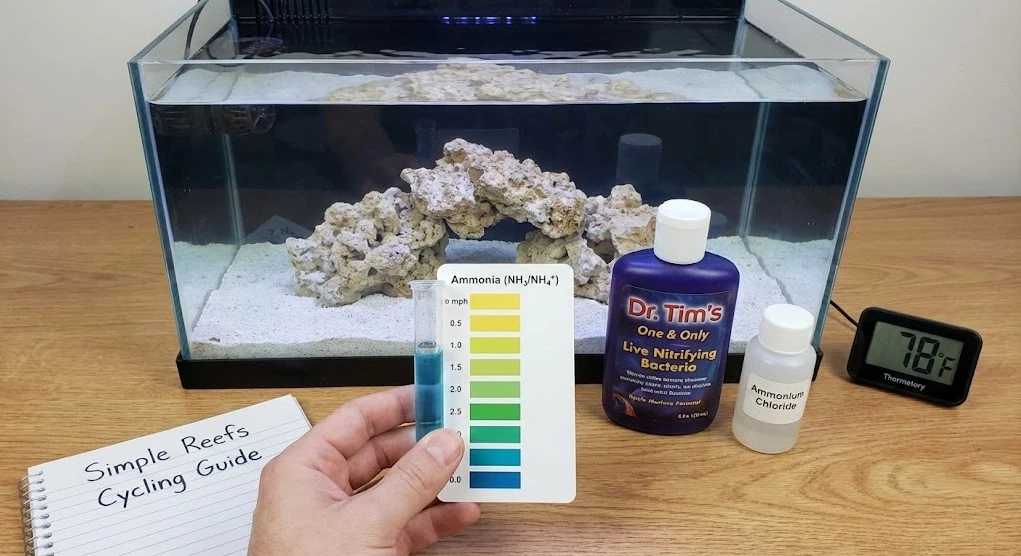
How To Cycle a New Marine Aquarium Safely, Quickly, and On a Budget
Welcome to Simple Reefs. If you are new to the world of marine aquariums, you are probably eager to get your first fish and cleanup crew added to your tank. Before you do that, you need to get it ready for them. We are here to help with this guide on How To Cycle a New Marine Aquarium Safely, Quickly, and On a Budget.
Table of Contents
Key Takeaways
- The Cycle is your Filter: Cycling a tank means growing a massive colony of beneficial bacteria on your rocks and sand to process toxic fish waste.
- Patience is Mandatory: A typical marine cycle takes anywhere from 3 to 6 weeks. Rushing this process will result in dead livestock.
- Testing is Everything: You cannot guess if your tank is cycled by looking at it. You must use reliable liquid test kits to track Ammonia, Nitrite, and Nitrate.
This article answers the ultimate beginner question: “Is my tank safe for fish yet?” We strip away the complicated chemistry jargon and give you a straightforward, week-by-week testing timeline so you know exactly what your water test kits are telling you, and when it is finally time to add your first Clownfish.
Making Your Marine Aquarium Safe For Fish – Cycling
If this is your first saltwater tank, you’re probably staring at a beautiful, empty glass box and wondering, “When can I finally add fish?”.
Contrary to what you might think, you can’t just throw the fish in the water and hope for the best. Before you head to the fish store, there’s a crucial step: cycling your marine aquarium.
In this guide, we’ll explain the nitrogen cycle and how to track your ammonia and nitrate levels. We’ll also provide a simple week-by-week timeline so you know when your tank is ready for its first residents.
This is a general, fishless-cycle approach – no living creatures are harmed in the process. That’s the most ethical way to go about this so let’s take a look.
What Exactly is “The Cycle”? (The Nitrogen Cycle)
When you add fish to an aquarium, they eat, breathe, and poop. These are unavoidable parts of the whole “being alive” thing, right? The problem is, each of these processes creates waste.
That waste, along with any uneaten food, eventually rots in the water. When organic matter rots, it creates a highly toxic chemical compound called Ammonia (NH₃).

Ammonia is incredibly lethal to marine life. It burns their gills, damages their organs, and will kill them very quickly. That’s where cycling your aquarium comes in.
“Cycling” your tank is the process of growing specific types of beneficial bacteria that eat this toxic ammonia and convert it into safer compounds. This is known as the Nitrogen Cycle.
| Stage | The Chemical | The Danger Level | The Bacteria That Eats It |
|---|---|---|---|
| Step 1 | Ammonia (NH₃) | ☠️ Highly Lethal | Nitrosomonas bacteria consumes Ammonia and turns it into Nitrite. |
| Step 2 | Nitrite (NO₂) | ⚠️ Moderately Toxic | Nitrobacter bacteria consumes Nitrite and turns it into Nitrate. |
| Step 3 | Nitrate (NO₃) | ✅ Relatively Safe | Safely removed by you doing routine water changes! |
Can I Just Add Fish Straight Away?
Absolutely not!
If you add fish to a brand new aquarium before you have grown this bacteria (a process called “fish-in cycling”), the fish will be swimming in their own toxic waste.
Because there is no bacteria to eat the ammonia, the levels will rapidly spike. There are still a lot of advocates for this method of cycling an aquarium but, to put it bluntly, it simply isn’t fair to the creature.

Our impatience shouldn’t cause us to encourage a process that creates tremendous suffering in a living animal. There are safe ways to do this that minimise the risk and that’s what we are going to show you here.
⚠️ Warning: The Cruelty of Fish-In Cycling
Ammonia poisoning is an agonising way for a fish to die. It chemically burns their respiratory system and eyes. Even if the fish survives the initial spike, they often suffer permanent organ damage that drastically shortens their lifespan. In the modern marine hobby, fish-in cycling is considered highly unethical. Always complete a “fishless cycle” before adding livestock.
How to Start Your Cycle
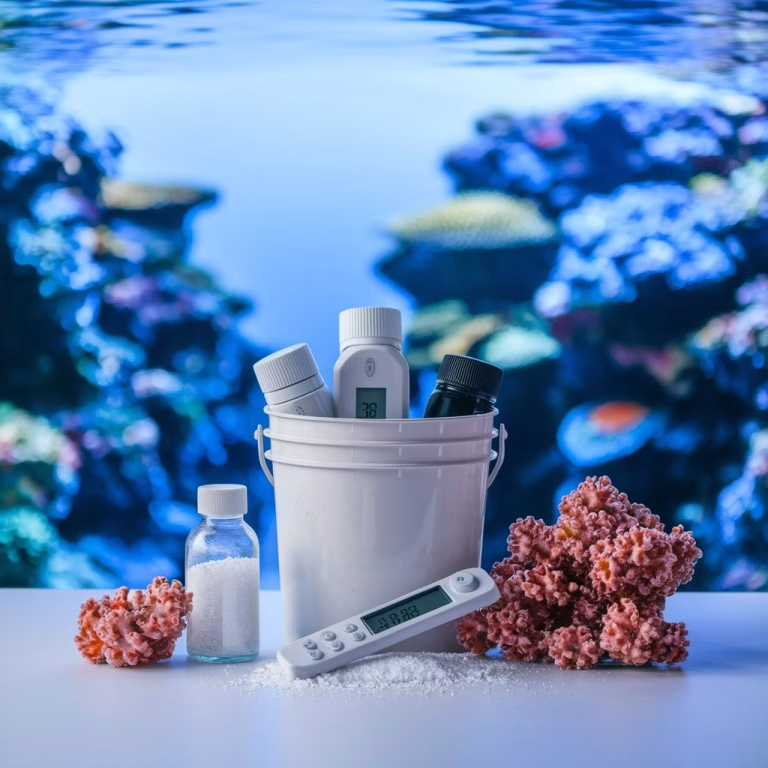
To start your cycle, you need two things: Beneficial Bacteria (the workers) and an Ammonia Source (their food). All of these things can be picked up at either a local fish shop, Amazon, or even in supermarkets.

Beneficial Bacteria Sources
- Bottled Marine Bacteria – e.g. FritzZyme TurboStart 900, Dr. Tim’s One & Only, MicroBacter Start. Instant start for your tank.
- Live Rock / Live Sand – Transfers existing bacterial colonies from an established tank.
- Seeded Filter Media – Media from a mature tank placed in your filter.
Ammonia Sources
- Pure Liquid Ammonia – Ammonia always has to be pure ammonia with no dyes or fragrance. Add small, measured doses to feed bacteria.
- Raw Shrimp / Fish Food – Slowly rots in the tank, releasing ammonia.
- Commercial Ammonia Products – Specifically labeled for aquarium cycling. Dr Tim’s Ammonium Chloride is made specifically for this job and has a handy dropped as well as instructions for your specific tank volume.
| Feature | 🦠 Beneficial Bacteria (The “Workers”) | 🥩 Ammonia Source (The “Food”) |
|---|---|---|
| Their Role | Consume toxic waste (ammonia/nitrite) and convert it into safer compounds (nitrate). | Provide a steady food source so the newly added bacteria can multiply and spread. |
| Best Options | Bottled marine bacteria (Dr. Tim’s, FritzZyme), Live Sand, or established Live Rock. | Pure Liquid Ammonia (Ammonium Chloride) or “Ghost Feeding” (fish flakes). |
| When to Add | Added once on Day 1 to “seed” the sterile rocks and sand. | Added on Day 1 and continuously/daily throughout the entire cycle. |
| What if you skip it? | Ammonia will build up forever. The tank will remain toxic and never cycle. | The bacteria will quickly starve to death. Your cycle will completely stall. |
💡 Note: If using bottled bacteria like Dr Tim’s One & Only, strict daily dosing of ammonia is less critical. Follow the bottle instructions carefully to avoid overfeeding.
What we are doing here is taking the beneficial bacteria source and introducing it into our aquarium that currently has no beneficial bacteria. We are then feeding that beneficial bacteria with a source of ammonia because that’s what it loves to eat.
When the bacteria gets nice and fat, it will “reproduce” and begin spreading onto the surfaces of your tank – the rocks, the sand, the filter, etc.
💡 The Science Bit: How Bacteria Actually “Grows”
We often talk about bacteria “reproducing,” but they don’t reproduce like animals do. Instead, they multiply by splitting completely in half – a process called binary fission.
One bacteria cell eats ammonia, gets fat, and divides into two. Those two eat and divide into four, then eight, then sixteen, and so on. This is exactly why your aquarium cycle seems to do absolutely nothing for the first two weeks, and then suddenly finishes in a matter of days. It is an exponential numbers game, and waiting for those first few splits just takes a lot of time!
The simple science here is that the more bacteria we have covering our surfaces, the more ammonia can be consumed.
Fish produce a lot of ammonia so we need a lot of bacteria to consume it so that the water is safe for the creatures we are introducing.
Once we have one of each of these items, we can move onto the next step which is getting our tank up and running so that we can add the beneficial bacteria and ammonia source and get this thing rolling.
Fill Your Tank and Turn Everything On
First of all, we need to make sure our tank is up and running:
- Tank filled with saltwater at the appropriate salinity (1.024 – 1.026 SG / 33–35 PPT).
- Rocks and sand added, if you have them.
- Filters primed, filled with filtration media, and turned on.
- Powerheads or wavemakers running.
- Water heated to the appropriate temperature (77–79°F / 25–26°C).
We want to keep our lights off to prevent unwanted algae growth during the cycling process. We also want to keep any protein skimmers or UV sterilisers off. Skimmers will actually remove the organic waste that we need in the tank to feed the beneficial bacteria.
Add The Source of Beneficial Bacteria
Once you are all setup, you are going to want to add your beneficial bacteria source (Live rock/Live Sand/Bottled Bacteria) to the aquarium.
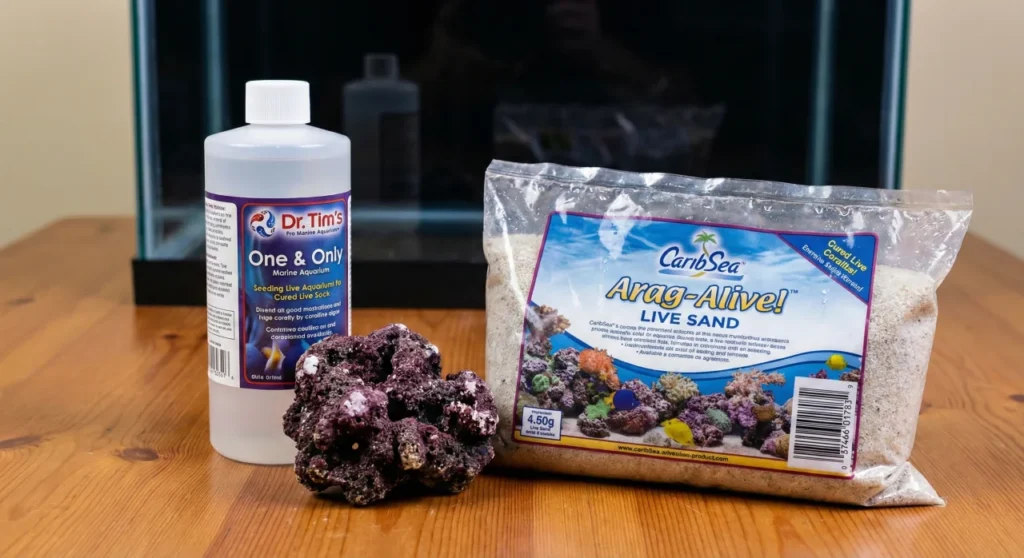
If it’s rock or sand, just add it as you would normally. Rock can be placed on or next to your existing rockscape. Sand can be poured over the bottom or over your existing sand bed.
Just remember to turn the filters and powerhead off while adding sand because it is going to get cloudy. There’s probably a clarifying sachet to add that will clear things up so follow the instructions on the back. Every brand of Live Sand differs ever so slightly.
⚠️ Warning: Always Place Your Rocks BEFORE Your Sand
If you are adding both rock and sand to your new aquarium before starting your cycle, your rocks must go in first! They need to sit securely and flat against the bottom glass of the tank.
If you build your aquascape on top of a bed of sand, burrowing fish, snails, and shifting water currents will eventually wash the sand out from underneath. This will cause a catastrophic rock avalanche that can crush your new pets or, even worse, shatter the bottom of your aquarium. Place the rocks firmly on the glass first, and then pour the sand around the base to lock them in place.
For bottled bacteria, follow the instructions on the bottle. Every brand differs slightly; some require powerheads off, some need mixing in tank water before adding, some prefer to be added to the filter. Once your beneficial bacteria source is added, we can move onto feeding that bacteria.
Feed Your Beneficial Bacteria
Once your bacteria is in the tank, you must immediately provide it with an ammonia source so it can begin multiplying (splitting).

Pick one of the three methods below and stick to it for the entire duration of your cycle.
- 🧪 Method 1: Liquid Ammonia (The Precise Way)
Using a commercial product like Dr. Tim’s Ammonium Chloride, follow the instructions on the bottle to calculate the number of drops for your tank’s water volume. Add this exact dose to the water. Crucial step: You must repeat this exact same dose every single day at the same time to keep the bacteria fed. Set a daily alarm on your phone so you don’t forget! - 🐟 Method 2: Ghost Feeding (The Flake Method)
Take a small pinch of standard marine fish flakes or pellets and drop it into the completely empty tank. Pretend you are feeding a single “ghost fish”. Do this every single day. As the uneaten food sinks and rots in the warm saltwater, it will create a continuous, steady supply of ammonia. When you are done, give your filter media a clean but leave your bio-orbs, blocks, or balls uncleaned. - 🦐 Method 3: The Raw Shrimp (The Old-School Way)
Go to the supermarket and buy one raw, unseasoned, frozen shrimp. Defrost it and drop it directly into your aquarium. (Pro tip: Place it inside a mesh filter bag or an old pair of tights so it doesn’t blow all over your rockscape as it turns to mush). Just leave it in the tank to rot. It will release a massive spike of ammonia over the next few weeks. Once your cycle is completely finished, net out whatever gross mush is left and throw it away. Oh and don’t forget to give your filter media or filter socks a clean, just leave any bio-balls or bio-orbs alone.
💡 Pro Tip: Daily ammonia dosing is a simple way to ensure your bacteria always have food, but if you are using premium bottled bacteria like Dr Tim’s One & Only, strict daily dosing is less critical. Follow the instructions on the bottle, and be careful not to overfeed – the bacteria will catch up naturally.
The Testing Timeline (Week by Week)
Okay, your saltwater is mixed and heated, your filters are running, your bacteria is in the tank, and you have added your first dose of ammonia. Now, the waiting game begins.
You need a reliable liquid test kit (we highly recommend Salifert over cheap test strips) to track your progress. Here is what your testing timeline should look like over the next month.
Week 1: The Ammonia Spike – Ammonia ~2–4 ppm, Nitrite 0 ppm, Nitrate 0 ppm
For the first few days, nothing seems to happen and you are probably going to feel a bit disappointed. But as you continue to dose liquid ammonia (or as your raw shrimp/fish food rots), you will test your water and see a massive spike in Ammonia (usually reading between 2.0 ppm and 4.0 ppm).
This is a great sign! It means the food is in the water, waiting for the bacteria to wake up and eat it.
⚠️ Bare-bottom tanks may take longer to show the first ammonia drop because there’s less surface area for bacteria to colonise. Be patient and keep feeding your bacteria daily.
⚠️ Warning: Don’t Suffocate Your Bacteria (Keep Ammonia Under 5ppm)
It is easy to assume that adding more ammonia will build a bigger, faster biological filter, but doing so will actually have the exact opposite effect! If your ammonia levels climb above 5ppm, the water becomes so toxic that it will stall your cycle and literally suffocate the beneficial bacteria you are trying to grow.
The Fix: Always test your water to see where your levels are at. You want to keep your ammonia in the “sweet spot” of 2.0 ppm to 4.0 ppm during the initial spike. If you accidentally overdose and hit 5ppm or higher, stop adding ammonia sources immediately. If it spikes way off the chart, perform a partial water change to dilute the ammonia back down to safe levels so your bacteria can recover and get back to work.
DON’T be tempted to add ammonia binders like Seachem Prime as this will cause the cycle to take even longer. A partial water change is literally all you need.
Week 2-3: The Nitrite Transition – Ammonia dropping to 0 ppm, Nitrite spikes ~2–4 ppm, Nitrate rising

Around week two or three, your first wave of bacteria (Nitrosomonas) has multiplied enough to start eating the ammonia.
When you test your water, you will notice your Ammonia levels rapidly dropping, while your Nitrite levels suddenly spike off the charts. This means Stage 1 of the Nitrogen Cycle is working! Keep dosing your ammonia source so the bacteria doesn’t starve.
Week 4-6: The Nitrate Finish Line – Ammonia 0 ppm, Nitrite 0 ppm, Nitrate 10–40 ppm
Eventually, the second wave of bacteria (Nitrobacter) catches up. They will consume that massive Nitrite spike and convert it into relatively harmless Nitrate.
You know your cycle is officially complete when:
- You dose the tank with ammonia.
- 24 hours later, you test the water.
- Ammonia reads 0 ppm.
- Nitrite reads 0 ppm.
- Nitrate reads 10 – 40 ppm.
If your tank can process a full dose of ammonia completely down to zero in 24 hours, your biological filter is fully established and strong enough to handle fish waste!
💡 Tip: Don’t Panic Over Lingering Nitrite
If your tank is processing Ammonia down to zero in 24 hours, but your Nitrite test is stubbornly holding onto a slight reading, don’t panic! In freshwater tanks, Nitrite is highly toxic. But in marine tanks, the heavy concentration of chloride in the saltwater actually blocks Nitrite from entering a fish’s gills, making it virtually harmless at typical post-cycle levels.
Furthermore, most hobby-grade Nitrate test kits will give you a “false high” if Nitrite is present. Even a tiny trace of lingering Nitrite in the water will severely skew your Nitrate reading, making it look terrifyingly high. If your Ammonia is clearing quickly but Nitrite is lagging behind, just be patient. The nitrite-eating bacteria simply take a little longer to multiply than the ammonia-eaters! They appear later in the cycle and have a lot of catching up to do.
Optimal Cycling Conditions (Cheat Sheet)
Bacteria are living organisms, and they reproduce fastest when they are comfortable so you have to make your tank nice and cosy for them. To speed up your cycle, keep your tank parameters strictly within these ranges:
- 🌡️ Temperature: 77°F – 79°F (25°C – 26°C). Bacteria multiplies faster in slightly warmer water.
- 🌊 Salinity: 1.024 – 1.026 SG (33-35 PPT). Keep this stable by topping off evaporated water with fresh RO/DI water.
- 💡 Lights: OFF. Do not run your expensive reef lights. The bacteria does not need light, but nuisance algae does. Keeping the lights off prevents the “Ugly Phase” from starting prematurely.
- 🫧 Protein Skimmer: OFF. Your skimmer will actively pull the rotting organics out of the water before it can turn into the ammonia your bacteria needs to eat.
- 💨 Oxygenation: Gently agitate the water surface with a powerhead, wavemaker, or air stone. Well-oxygenated water helps bacteria thrive and speeds up the cycle.
- ⚠️ Bare-Bottom Tanks Take Longer: Tanks without sand or substrate have less surface area for bacteria to colonise, so they often take longer to cycle.
⚠️Note: Always use liquid test kits rather than test strips. Test strips are very unreliable and easily thrown off by environmental factors.
What if my cycle stalls?
If you hit week 6 and your Ammonia or Nitrite levels stubbornly refuse to drop to zero, your cycle has likely stalled. This usually happens if you accidentally overdosed the tank with too much ammonia, which actually suffocates the bacteria, or if your pH dropped too low.
If you find yourself stuck, don’t panic! Check out our dedicated troubleshooting guide on Why Your Marine Cycle Has Stalled (And How to Fix It).
The Final Step: Adding Your First Fish
Once your tests read 0 Ammonia and 0 Nitrite, you made it! Your tank is cycled.
Because your tank just finished processing all that waste, your Nitrates will likely be sky-high. Before you buy any fish, perform a large 25% to 50% water change to flush those excess nitrates out of the system. Turn your protein skimmer and your lights back on.
You can now head to the local fish store and buy your first residents! Go slowly! Add a hardy pair of Clownfish or a small cleanup crew (snails and hermit crabs).
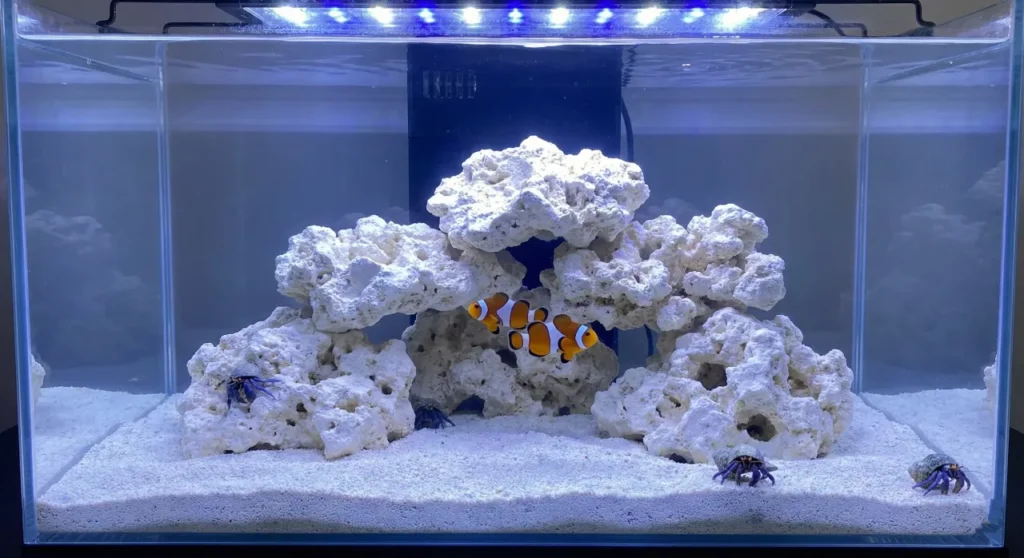
Never dump five fish into the tank at once, as the sudden massive increase in waste will overwhelm your newly established bacteria and cause a secondary mini-cycle.
Add one or two and wait a few weeks. Your cycle will adapt to those new fish and strengthen so that you can add more. Remember: nothing positive in marine aquariums happens fast.
✅ You’re Ready to Start Your Reef Journey!
By completing your fishless cycle, you’ve done the hardest part of keeping a marine tank safely and responsibly. Your beneficial bacteria are thriving, your water parameters are under control, and your tank is ready for its first residents.
With the cycle complete, you’re officially on your way to a healthy, thriving reef tank. Happy reefing!
Frequently Asked Questions
How long does a marine aquarium take to cycle?
A typical marine aquarium cycle takes between 3 to 6 weeks. If you use high-quality bottled bacteria and a precise liquid ammonia source, you can sometimes complete the cycle in as little as 14 to 21 days. If you start with dry rock and use raw shrimp, expect it to take closer to 6 weeks.
Do I need to do water changes during the cycle?
No. Doing water changes during the cycle actively removes the ammonia and nitrites that your growing bacteria needs to consume as food. Only do a water change at the very end of the cycle to lower your final Nitrate readings before adding fish.
Can I speed up my aquarium cycle?
You can accelerate the cycle by increasing the temperature slightly (around 79°F/26°C), ensuring heavy oxygenation with your powerheads, and dosing a premium bottled marine bacteria (like FritzZyme TurboStart 900 or Dr. Tim’s One & Only).