
Filter Options for Freshwater Conversions & Sumpless Aquariums
Welcome to Simple Reefs. We are a brand new website designed to take the stress and expense out of starting your very own marine aquarium. We recently talked all about the importance of filtration when it comes to running a healthy marine aquarium or reef. That brings us onto today’s topic – Filter Options for Freshwater Conversions & Sumpless Aquariums.
Table of Contents
When I started Simple Reefs a few months back, I had one intention and one goal. I wanted to show how marine aquarium ownership could be accessible to everyone with only a small budget. There’s a lot of negative rhetoric in this hobby. People are obsessed with insisting you need this piece of expensive equipment or that type of specially built aquarium. It simply isn’t true.
If all you have is an old freshwater aquarium with no sump, you can still turn it into a marine aquarium. In fact, it doesn’t even have to be that much more difficult than owning a purpose built tank. Naturally, it will present us with a few specific conundrums that come along as part of the conversion process but there is no reason why it can’t be done.
A Few Specific Freshwater Conversion Problems
Let’s take a minute to look at some of those specific issues that might come as a result of converting a freshwater aquarium into a marine aquarium.
- Less Availability of Equipment: Your choices are a bit more limited when it comes to filtration and things like protein skimmers or refugiums. Everything has to either hang off the back or sit in the tank itself so that has to be taken into consideration.
- Less Aesthetically Pleasing: You are going to have extra pipes and equipment visible in your display so it may not be as aesthetically pleasing as a custom made marine aquarium.
- Additional Maintenance Requirements: You are going to have some additional maintenance requirements. Filters need cleaning more, media might need changing more often.
- Visible Wiring: The equipment being in your display or hanging off the back of your tank may mean you have more visible wiring which can be a bit unsightly and will require careful management with drip loops and the like.
Those are some of the downsides and specific freshwater conversion problems you may face when looking to turn a sumpless aquarium into a marine aquarium. When it comes down to it, most of the problems are simply convenience or aesthetic related. There’s isn’t anything that is likely to prove entirely prohibitive to keeping a thriving marine aquarium or reef.

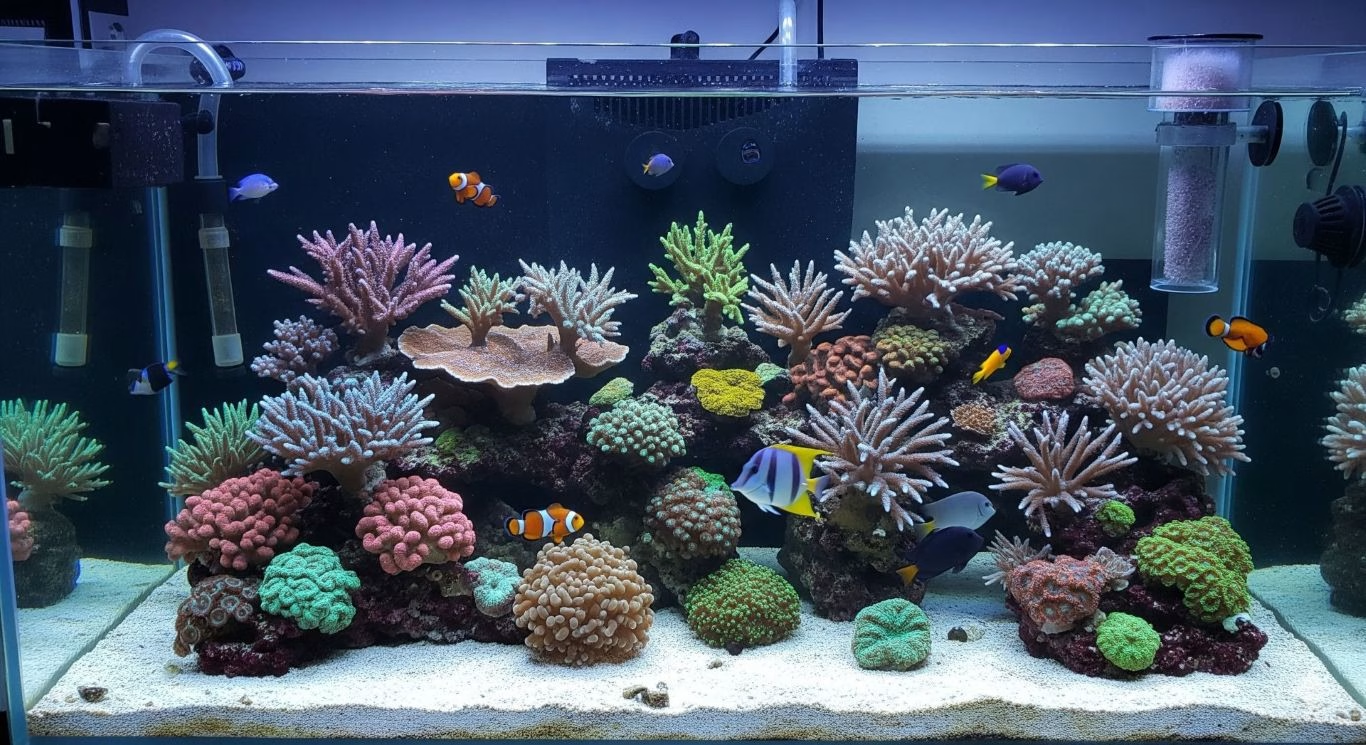
In fact, I started out with a 260 litre freshwater conversion. I, only made the switch because the stand was looking a bit worse for wear and I got a good deal on a marine aquarium. By the end, I had stony coral, LPS coral, a decent array of fish, and very low nutrients. I had acquired a hang on back filter, a hang on back protein skimmer, decent lighting, and even an algae reactor which I plumbed in below the tank. It’s entirely possible.
Filter Options For Freshwater Conversions & Sumpless Aquariums
Before we actually get into the specific filter types for your sumpless tank or freshwater conversion, we really need to clear something up. It’s important to understand that, in a marine aquarium, the entire tank is part of the filtration system. The rocks, the sand, even the glass.
This is even more of a crucial point for tanks that don’t have a sump or an all-in-one filtration system. Whereas sumps can hide extra filtration media like bio-rings and bio-blocks out of sight, you simply can’t do that in a freshwater conversion. You really need to embrace the added filtration that comes from two of the most critical elements in a sumpless setup – live rock and water flow.
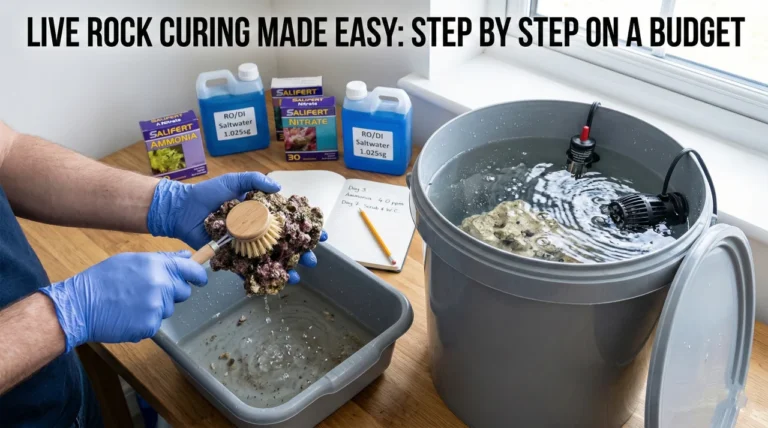
Live Rock (or its Alternatives): The Biological Heart of Your Aquarium: Live rock is the cornerstone of biological filtration in a saltwater aquarium. We talk all about live rock and its alternatives in this article. Its ridiculously porous structure provides a huge surface area for beneficial nitrifying bacteria to colonise. These bacteria are essential for breaking down toxic ammonia from fish waste and turning it into nitrite before it is transformed into the even less harmful nitrate. In a sumpless system, your live rock will be your primary biological filter and it is crucial that we include it in our setups.

Believe it or not, for those converting a freshwater tank, your existing ceramic rings, bio-balls, or other filtration media can help kick-start the cycling process. But porous live rock or high quality artificial alternatives (like Marco Rocks or CaribSea LifeRock) are vital for long term, sustained, stability in a sump-less tank.
Water Flow: The Circulatory System: Adequate water flow is, actually, far more important than you might think. In fact, having a significant amount of flow is non-negotiable in a marine tank. It ensures that unwanted particles like poo and waste food are kept suspended in the water column so it can be removed by mechanical filtration. Decent water flow also delivers oxygen to all the inhabitants and provides corals with the necessary movement to thrive and feed.
In a sumpless system, this is achieved with the use of submersible powerheads or wavemakers placed strategically within the display tank. A good rule of thumb is to aim for a turnover rate of at least 10-20 times the total volume of the aquarium per hour, though this can be higher for tanks with a lot of coral or more delicate SPS (Small Polyp Stony Coral).
Filtration Hardware for the Sumpless Tank
With your biological filtration and flow established, you’ll need equipment to handle the mechanical and chemical aspects of filtration. That equipment is going to need to be capable of either pulling water from your tank into the filter itself or integrating into your setup via hanging on the back of the tank.
Here are the most popular and effective options for tanks without sumps. Obviously, there are alternatives but these are the gold standards which means they are the most well tested and have the largest collection of experience should something go wrong.
1. Hang-on-Back (HOB) Filters: The Versatile Workhorse
Modern HOB (hang-on-back) filters are far more capable than their predecessors and are an excellent choice for small to medium-sized marine tanks. As I said earlier, I have a tank with a sump now but I genuinely miss how efficiently my hang-on-back filter worked and how easy it was to maintain.
Their primary role in a saltwater setup is to provide customisable mechanical and chemical filtration. Most hang-on-back filters work in a similar way.
- Fill the filter with filter medium. Usually in layers so bio-balls or some ceramic media at the bottom to do the biological filtration, chemical (something like carbon or GFO) in the middle to capture smells, discolouration, and micro particles, and a few layers of filter foam or floss at the top to trap larger particles.
- Attach the filter to the back of your tank.
- The filter features a water inlet which pulls water from the tank.
- Water is pulled through your various filter media and cleaned.
- Water exits the filter via a waterfall like lip, effectively moving the water and aerating it in the process, or the water exits via a water outlet pipe.

They are incredibly simple in design but tremendously effective. Most will look quite similar and they tend to come in different sizes that are rated by the amount of water they can process in one hour. We are going to be talking a lot more about hang-on-back filters in the future. Let’s take a look at the pros and cons.
Pros:
- Easy to install and maintain: No plumbing is required and media changes are straightforward.
- Customisable: Media baskets can be filled with your choice of filtration media. The possibilities are endless depending on the space inside your filter.
- Affordable: A very cost effective way to add powerful filtration.
Cons:
- Limited capacity: Not suitable for very large or heavily stocked tanks as they are highly limited by size of filter.
- Aesthetics: Equipment is visible on the back of the tank.
- Space Requirement: You need a gap behind your tank as they can take up quite a bit of space.
- Maintenance: You really need to be rinsing the foam or replacing every few days and removing the filter for a thorough clean once a week.
Optimal HOB Filter Media Setup for Saltwater:
Let’s take a look at the optimal filter media setup for a marine aquarium as it will differ slightly from a freshwater tank.
- Mechanical Filtration: Start with a coarse sponge or filter floss at the intake to trap large debris. This should be cleaned or replaced twice weekly to prevent it from becoming a source of nitrates.
- Chemical Filtration: Utilise a media bag with high-quality activated carbon to remove impurities, odours, and discolouration. Another bag containing a phosphate removing media like Granular Ferric Oxide (GFO) is also highly recommended to combat algae growth.
- Additional Biological Filtration: While your live rock is the primary bio-filter, adding a porous biological media like MarinePure spheres or ceramic bio-media can provide extra surface area for beneficial bacteria.
Hang-on-back filters are a fantastic option for a freshwater conversion or a sumpless marine aquarium. To be perfectly honest, I think they are my number one choice but that doesn’t mean they are everyone’s preference. Some people have tremendous success with the next option.
2. Canister Filters: The Powerful, All-in-One Solution
Often a staple in the freshwater hobby, canister filters can be successfully adapted for marine aquarium use. In fact, many find them preferrable to hang-on-back filters as they provide a larger media capacity and more powerful flow. Let’s take a look at how they work.

- Fill the canister with various filter media. Usually in layers so bio-balls or some ceramic media at the bottom to do the biological filtration, chemical (something like carbon or GFO) in the middle to capture smells, discolouration, and micro particles, and a few layers of filter foam or floss at the top to trap larger particles.
- Place the canister filter somewhere out of sight as, let’s be honest, they are a bit ugly.
- Plumb the filter in via the instructions. You should have a water outlet and a water inlet though some filters combine these into one piped in system. Simply follow the manufacturer’s instructions.
- Water is pulled from your tank and pushed through the filter media where it is cleaned.
- Water is returned to the tank.
It’s a pretty simple system, despite the somewhat complex look. With that being said, canister filters require a very disciplined maintenance schedule to prevent them from becoming “nitrate factories.” Dirt can quickly accumulate inside them and begin rotting which can cause more problems than they actually solve. Let’s take a look at more of those pros and cons.
Pros:
- High Media Capacity: Can hold significant amounts of mechanical, chemical, and biological media.
- Excellent Water Polishing: Their high flow rates and multiple media stages can result in crystal-clear water.
- Hidden from View: The filter itself sits in the cabinet below the tank which keeps it hidden out of view and the amount of equipment in the tank to a minimum.
- Can Be Used In-Line With Other Equipment: Many canister filters allow you to use them in-line with other equipment like UV sterilisers or additional filtration.
- Some Include Heaters and UV Sterilisers: Some canister filters come with built in heaters to remove another piece of equipment from your display. Some even feature UV sterilisers to help reduce free floating algae.
Cons:
- Potential “Nitrate Factory”: If not cleaned regularly, trapped detritus will break down and elevate nitrate levels. This i9s the big negative of canister filters that everyone talks about.
- More Intensive Maintenance: Cleaning requires disconnecting hoses and opening the entire unit. You really want to be giving these things a thorough clean very often, too.
- Potential Leaks: Anything that is plumbed in has the potential to leak and I have heard about this happening far too often with canister filters. People have their entire floor soaked because something came loose and the filter kept on pumping water from the tank.
- Expensive: A decent canister filter is going to cost a fair bit of money. They are much more expensive than an equivalent hang-on-back filter.
Preventing Nitrate Build Up in a Marine Canister Filter:
This is something that absolutely needs to be repeatedly emphasised with canister filters. Cleaning frequently and thoroughly is absolutely essential.
- Frequent Mechanical Cleaning: The key is to clean the filter floss and sponges at least once a week. This removes organic waste before it has a chance to decompose and produce nitrates.
- Layer Your Media: Place mechanical filtration (sponges, floss) as the first stage to capture debris. Follow this with chemical media (carbon, GFO), and finally your biological media. This stops the waste getting into the bottom of the canister and ensures the bio-media stays cleaner for longer.
- Don’t Overdo the Bio-Media: Since your live rock is doing the heavy lifting for biological filtration, you don’t need to pack the canister with an excessive amount of ceramic rings. A single tray is often sufficient.
3. Hang-on-Back Protein Skimmers: The Essential Waste Exporter
You really don’t have to stop at just a canister filter or a hang-on-back filter when it comes to sumpless marine aquariums or freshwater conversions. If there is one piece of equipment that dramatically increases the chances of success in a sumpless marine tank, it’s a protein skimmer.

This device removes dissolved organic compounds from the water before they break down into nitrates, effectively removing waste from your aquarium. We explain how protein skimmers work in this article right here. Hang-on-back models are designed specifically for tanks without sumps and are, frankly, a bit of a life saver if you are looking to own coral.
How it Works: A HOB protein skimmer pulls water from your aquarium and injects fine air bubbles into a reaction chamber. Organic waste sticks to the surface of these bubbles, creating a foam that rises and is collected in a cup for easy removal. the clean water is then returned to your tank.
Pros:
- Powerful Waste Removal: Significantly reduces the nitrate load on your system by removing dissolved waste before it can completely rot.
- Improved Water Clarity and Oxygenation: That dissolved waste will reduce the clarity of your water so removing it polishes your water. The process of removing said waste also has the added benefit of oxygenating your water thanks to all those bubbles.
- Relatively Easy to Install and Operate: Hang-on-back protein skimmers are designed for the task at hand. They are easy enough to install and dialling in is pretty straight forward.
Cons:
- Space Requirement: Some of these hang-on-back protein skimmers can be quite large and require a good amount of space behind your tank.
- A Bit Ugly: Again, it is more equipment in your tank and, let’s be honest, that skimmer cup full of brown skimmate isn’t exactly pretty.
- Maintenance: You need to be emptying the cup frequently and cleaning the skimmer neck once a month.
- Potential For Leaks: Hang-on-back protein skimmers do have the potential to leak. If they are running wet, they can overflow quickly and most will do that straight onto the floor. Take a look at this article on when that exact thing happened to me.
- Size Limited: Larger tanks may struggle to find a hang-on-back protein skimmer capable of working sufficiently.
When choosing a HOB skimmer, select a model rated for the size of your aquarium and be prepared to “tune” it to produce a consistent, dark skimmate. You can read all about hang-on-back protein skimmers in this article right here.
Getting a Bit More Advanced
Believe it or not, we can get even more advanced when it comes to freshwater conversions and sumpless tanks. If you thought it was impossible to have things like UV Sterilisers, Refugiums, or Algae Reactors, think again.
Modern solutions are actually designed to make all of this possible. As I mentioned earlier, I actually had an algae reactor on my sumpless aquarium and it grew chaetomorpha incredibly well. It’s all possible with just a little extra work.
Needless to say, those are discussions for a future article. Right now, we are just focusing on the basics and making it more than apparent that converting a freshwater tank into a marine aquarium is very possible.
Putting It All Together: A Sample Sumpless Setup
So let’s pretend we have a basic 75 litre freshwater conversion with a few fish and some coral. We have opted for live rock to increase the amount of biological filtration and we have chose to add a sand bed, as well. What would that look like?
For a 75-Litre Converted Freshwater Tank (Fish and Soft Coral with Live Rock):
- Biological Filtration: 10-15 kg of live rock and a 1-inch deep sand bed.
- Mechanical/Chemical Filtration: A high quality HOB (hang-on-back) filter with filter floss (changed twice weekly), bags of activated carbon and GFO (changed monthly), and a bag of bio-orbs (rinsed in used tank water once a month).
- Waste Export: A hang-on-back protein skimmer rated for 75-100 litres.
- Water Flow: Two small powerheads positioned on opposite sides to create varied flow around the rockwork.
By embracing the basics of marine filtration and leveraging modern, efficient equipment, running a beautiful saltwater aquarium without a sump is more accessible than ever. Whether you’re giving your dusty old freshwater tank a new life as a glorious living reef or starting a new nano tank, these powerful and compact filtration strategies will set you on the path to a thriving underwater ecosystem. Thanks for reading and spending your time at Simple Reefs.