

A Simple Guide to Marine Aquarium Filters And Filtration
Welcome to Simple Reefs. We are a brand new website designed to take the stress and expense out of starting your very own marine aquarium. With us being a brand new website, we have been looking at some of the basics of Marine Aquarium ownership. That brings us nicely onto today’s topic – A Simple Guide to Marine Aquarium Filters And Filtration.
Table of Contents
Marine Aquarium Filters and Filtration
What inspired you to get into the world of marine aquariums and reefs? I am willing to bet it was a display at your local fish shop, zoo, or even an image on Instagram. The one thing that so many marine aquarium displays don’t reveal is the importance of a great filtration system. After all, in a lot of marine aquariums this part is completely hidden.
The truth of the matter is that most marine aquariums are a delicate miniature ecosystem of vibrant corals, fascinating invertebrates, and dazzling fish. The key to maintaining this balance lies in the unseen systems that keep the water pristine. Filtration is, without a doubt, one of the most critical component of a successful saltwater aquarium and we are going to be talking about it a lot on Simple Reefs.
Unlike the ocean which, if we are being objective, is absolutely huge, an aquarium is a closed system. In the sea, the sheer amount of water dilutes the toxins and the complex biological ecosystem removes many of the unwanted nasties that will lead to poor water quality.
In your aquarium, there is no way for this to happen naturally so waste products can quickly accumulate to toxic levels. Effective filtration removes this waste, processes it into less harmful substances, and ultimately keeps the water clear, stable, and healthy.
We are going to take a bit of a dive into the essential types of filtration available for your marine aquarium and the equipment used to achieve them. First, however, let’s answer a common question.
Why Do We Need Filtration?
Before we explore the ins and outs of filtration and marine aquarium filters, it’s important to answer the question – Why Do We Need Filtration? It all starts with what we were just talking about. Your aquarium is a closed box. Every bit of waste produced by its inhabitants stays there unless it is physically removed or biologically processed.

Without filtration, this would lead to a rapid decline in water quality but why is this? Well, it is because of the nitrogen cycle. The nitrogen cycle is, basically, something we utilise as the first line of defence in our aquariums. Here’s how it works..
- The Nitrogen Cycle and Toxic Waste: Fish and other inhabitants release waste, it’s a natural part of metabolism. This waste, be it poo, pee, or even waste created by respiration, primarily comes in the form of something called ammonia (NH3). Uneaten food and decaying organic matter also break down into ammonia. The problem with ammonia in a marine aquarium, or any aquarium for that matter, is that ammonia is highly toxic and will quickly kill fish and invertebrates.
- The Biological Filter: Ammonia is processed by our first line of defence – the biological filter. The primary goal of our biological filtration is to cultivate beneficial bacteria that process this waste through the Nitrogen Cycle:
- First, bacteria convert toxic ammonia into nitrite (NO2−), which is slightly less toxic.
- Then, a second type of bacteria converts the toxic nitrite into nitrate (NO3−). Nitrate is far less toxic and is the desired end-product of the cycle. We then remove nitrates with water changes.
- Nuisance Algae Fuel: The end product of the nitrogen cycle (nitrates) and other waste products (phosphates) are powerful fertilisers for nuisance algae. Without systems to remove or “export” these nutrients, your aquarium would quickly be overrun with unsightly green, brown, or red algae that can smother corals and ruin the tank’s appearance. Forcing you to spend hours upon hours attempting to manually remove it.

All of the above is a predictable result of owning fish. We know that we will have to feed them and we know that they will defecate. As long as we have a functioning biological filter, the ammonia that comes from food and waste can be processed and the water will stay safe for our inhabitants. Our biological filter is the living, breathing, life support system of your tank. We talk all about it in this article right here.
But how does it work? It’s actually pretty simple. All we need to do is provide a home for nitrifying bacteria and feed them so that they grow. These homes can consist of…
- Live Rock: The classic and still one of the best methods. The immense porous surface area of live rock provides a home for billions of nitrifying bacteria.
- Bio-Bricks & Ceramic Media: These are man made, highly porous, blocks, cubes, rings, or spheres designed to maximise the surface area for bacterial colonisation in a small space, often used in sumps or in the back chambers of AIO tanks.
- Sand Beds: Sand beds allow, once again, for a porous surface area for bacteria to colonise. Eventually spreading and increasing your aquarium’s ability to process harmful toxins.
- Deep Sand Bed (DSB): A sand bed of 4-6 inches allows for an anoxic (low oxygen) zone deep down, where anaerobic bacteria can consume nitrate and convert it into harmless nitrogen gas, helping to complete the nitrogen cycle.
Even your tank’s glass and surfaces can provide a home for nitrifying bacteria. We have a guide on the entire process of creating a biological filter in your new aquarium that you can check out right here.
The Saltwater Filtration Staples
Marine aquarium filtration doesn’t stop at biological methods, though. We actually want to give the biological filter a bit of a helping hand and we do this by utilising a couple of different types of physical or chemical filtration systems in tandem with the biological filter.
These filtration systems are going to allow us to remove large particles, smaller particles, dissolved waste, and other unwanted nasties from the water which will reduce the load placed on our biological filter. It will also help to minimise the unwanted end parts of the nitrogen cycle like excessive nitrates and phosphates.
Every successful filtration strategy is built upon a few core types of filtration working in harmony. In most ideal setups, we will have each of these processes covered via one mechanism or another. We have already talked about biological filtration, the next in line would be..
1. Mechanical Filtration
When someone says aquarium filtration, this is probably the first thing you think of. A mechanical filter is designed to actually remove particles from the water. When we say particles, we mean things like fish food, poo, and unwanted stuff like dust and hair. The idea here is that we remove it from the water and trap it so it can’t rot in the water itself.

- What It Is: The physical removal of particulate matter from the water column before it can decompose. This includes uneaten food, fish waste, and other floating debris like hair, skin, and even household related stuff like cat and dog dander.
- Why It’s Important: It improves water clarity by removing organic waste before it breaks down into ammonia, reducing the overall load on your biological filter.
- Common Methods:
- Filter Socks/Cups: Water drains through a felt or mesh sock that traps debris. These must be cleaned or replaced every few days to be effective. They can be clogged up with debris, poo, and food.
- Filter Floss: A simple and effective sponge like material placed in a filter or sump to catch particles.
- Filter Foam: These look kind of like a sponge and are cut to the size of your filter to trap food and waste. They often come in different grades that reflect how tightly woven the sponge is and the size of particles that can pass through.
- Automatic Filter Rollers: A modern version of the filter sock. They look like a big roller with foam designed to trap particles that your water is pushed through. A sensor detects when the filter material is clogged and automatically advances a clean section of the roll, providing consistent mechanical filtration with less frequent maintenance.
Mechanical filtration, obviously, needs to be contained in something and that’s where the type of aquarium you have comes into play. Regular marine aquariums should have a sump where you can store your filter roller, filter floss, or filter socks. All in One (AIO) aquariums will have a separate section at the back of the tank or side which should feature a holder for a filter sock or a section to place mechanical filter medium.
Things get a bit more complicated with converted freshwater aquariums and sumpless, non-AIO aquariums. This is where hang-on-back filters, canister filters, and internal filters come in. These, basically, have sections to place whichever mechanical filtration media you want to use in them. They then pull water in from the tank, the filter medium traps the particles, and the filter pushes the clean water back out. We will be covering this much more in depth in the future.
2. Chemical Filtration
Chemical filtration is a little different and it is typically used to trap extremely small particles or actively remove toxins and dissolved waste from the water. This is used for stuff that both mechanical and biological filters are incapable of processing. Think minute particles that contribute to smells and discoloured water.

- What It Is: The use of specific media to absorb or adsorb dissolved impurities, toxins, and organic compounds that mechanical and biological filtration can’t handle.
- Why It’s Important: It “polishes” the water, removing odours, discolouration, medications, and harmful substances like phosphates and silicates that can fuel nuisance algae growth.
- Common Methods:
- Activated Carbon: The most common chemical media and a staple of aquarium keeping for decades. It effectively removes odours, yellowing compounds, and toxins from the water, making it crystal clear.
- Granular Ferric Oxide (GFO): Specifically used to bind and remove phosphates, a primary driver of algae growth in marine tanks.
- Specialized Resins: A wide variety of synthetic polymers are available to target specific pollutants like nitrates, silicates, or a combination of impurities. Some work really well, others not so much.
3. Foam Fractionation
This one is very specific to Marine Aquariums. The good old protein skimmer. A protein skimmer replicates a natural process called Foam Fractionation which traps dissolved waste and removes it from the water column. You can read all about how protein skimmers work right here.

- What It Is: The use of a device known as a protein skimmer to replicate a natural process called foam fractionation. This process uses aerated water to create a foam which traps dissolved waste that binds to the oxygen in the bubbles.
- Why It’s Important: It removes the dissolved waste before it has chance to become algae fuelling elements like Nitrates and Phosphates.
4. Natural Organic Filtration
This is a type of filtration that removes unwanted nitrates and phosphates from the water via the medium of algae growth.
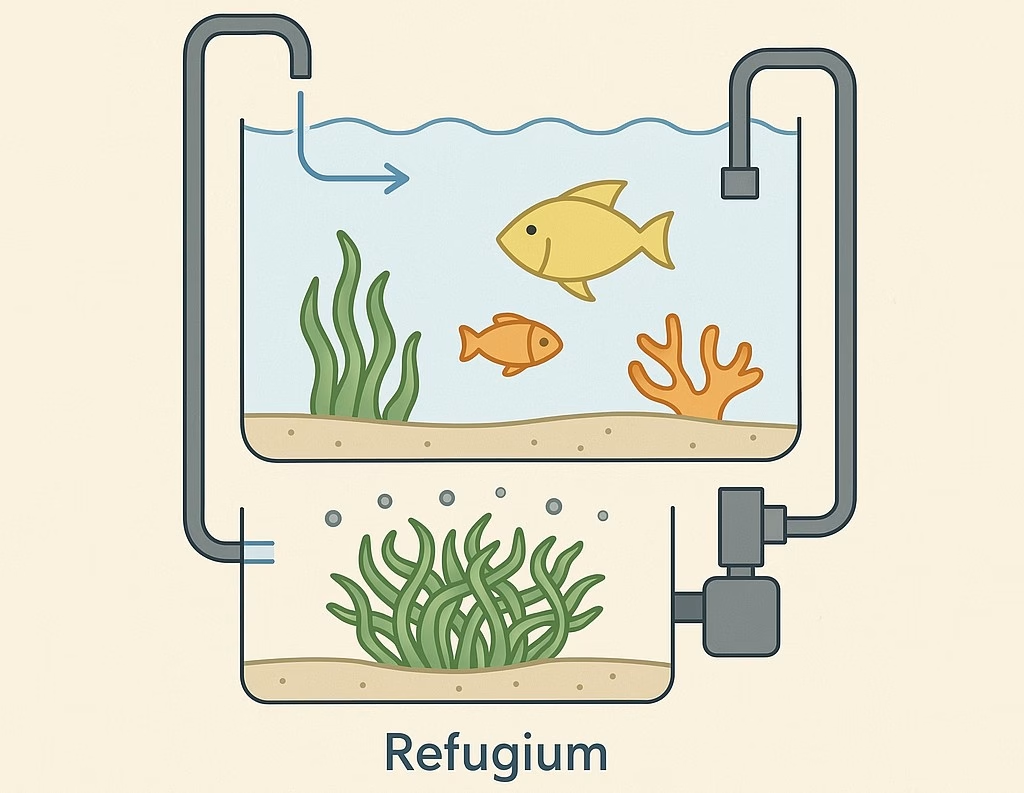
- What It Is: The growing of specific types of algae in a controlled environment. The algae will consume phosphates and nitrates to aid its growth, effectively removing them from the water column.
- Why It’s Important: It reduces the amount of phosphates and nitrates available to unwanted types of algae like bubble and hair algae.
- Common Methods:
- Refugium: The most common way of growing macro algae like Chaetomorpha. This is a small area of your sump or a small tank with a powerful light designed to be seeded with an algae, grown over a period of weeks, and then harvested, thereby removing unwanted nutrients.
- An Algae Reactor: A similar concept to a refugium only in a controlled, often tube-like, container with powerful lights to more directly control the amount of water and light the algae is exposed to.
- Algae Turf Scrubber: A contained device featuring a platform to grow things like turf algae on, a powerful light to fuel the algae’s growth, and a water pump to pull water through. The idea is to grow unwanted algae in a controlled environment, thereby reducing available unwanted nutrients, before harvesting the algae and disposing of it.
5. Specialised Filtration
This can be a whole range of different filtration systems designed to do specific jobs. The most common of which might be a UV Steriliser which is used to remove free floating parasites and algae.
- What It Is: Different devices designed to do specialised jobs like removing free floating algae or to increase oxidation potential.
- Why It’s Important: Really depends on the task the device is intended for. For example, UV sterilisers can really improve water clarity.
- Common Methods:
- UV Steriliser: Reduces free floating algae, bacteria, and parasites. Some even use it to help keep things like ICH in check.
- Ozone reactor: Improves water clarity and oxidation potential.
Common Filtration Setups For Marine Aquariums
Aquarists typically combine many of these individual forms of filtration to create one all encompassing approach designed to remove as much unwanted waste as possible. For example, a marine aquarium hobbyist might have a hang on back filter filled with filter floss and granulated carbon, a hang on back protein skimmer, and an algae reactor. This way, they can remove large particles, micro particles, dissolved waste, and the unwanted elements of the nitrogen cycle Nitrates and Phosphates.
In my own aquarium, I have gone a bit overboard, I suppose. I have a sump so the water goes through two filter socks, one is slightly tighter woven to remove smaller particles of food and waste. The water then goes to my Algae Turf Scrubber where nitrates and phosphates are removed to grow the algae. I will then scrape this algae off the platforms when it gets too thick. The water is then returned to the sump where it goes to my refugium full of Chaeto and Caulerpa as another way of removing nitrates and phosphates.
After that, it’s time to be skimmed by my protein skimmer. It then heads into my GFO reactor and then back into the display. This might be overkill but I like to feed heavy and this setup keeps my nutrient levels quite a lot lower.
In Short
Filtration is an incredibly important part of marine aquarium ownership. Whether it is your biological filter or more simple mechanical filters. A combined approach utilising a few different methods can set you up for big time success, clear water, minimal algae, and a more positive environment for your fish and coral. Thanks for reading and spending your time at Simple Reefs.