
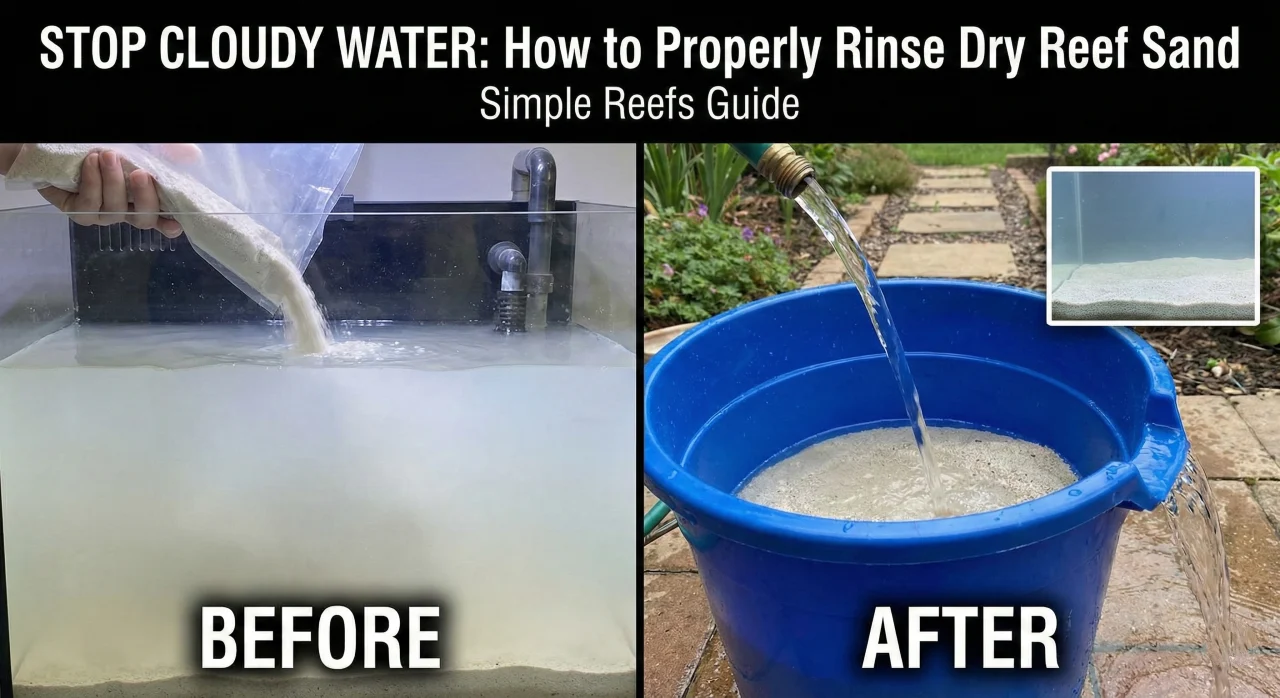
Stop Cloudy Tank Water: How to Properly Rinse Dry Reef Sand
Welcome back to Simple Reefs. In this article, we are bringing you another handy guide – Stop Cloudy Tank Water: How to Properly Rinse Dry Reef Sand.
Table of Contents
Key Takeaways
- Avoid the Sandstorm: Rinsing removes fine dust and coral fragments that cause chronic cloudiness.
- Dry Sand Only: Never rinse live sand, as tap water will kill the beneficial bacteria instantly.
- Safety First: Using a dechlorinator after rinsing is vital to prevent tap water chemicals from entering your reef.
If you are still undecided on which substrate to buy, you might want to check out our guides on choosing the best sand type or the differences between live and dry sand before you start.
The Milkshake Mistake: In this guide, we are going to help you avoid a weeks-long sandstorm in your living room. We will look at the most efficient ways to rinse your dry sand, why your garden hose might be your best friend, and most importantly, how to ensure your new substrate is chemically safe for your reef.
Dry Reef Sand Saves Money But Needs a Little Work

We can safely make the assumption that, if you are reading this article, you decided to save yourself a bunch of money by opting to use dry sand in your marine aquarium rather than live sand.
Dry sand is fantastic value and will save you a ton of cash in the long run. If you have opted for a sand bed and decided dry sand is the most affordable route, you are likely aware of one major downside: that stuff is dirty as hell.
If you were to just throw it into your aquarium without any preparation, it would turn your water brown almost instantly and that sediment wouldn’t settle for days. That’s without mentioning what it would do to your filters.
You are going to need to rinse it. Now, a quick caveat before we start, none of this applies to live sand. Live sand does not need rinsing and should be placed into the aquarium wet, straight out of the bag.
⚠️ The Golden Rule: Never Rinse Live Sand
Before you pick up a bucket, we need to make one thing crystal clear: this guide is for dry sand only.
If you have purchased Live Sand (such as CaribSea Arag-Alive), do not rinse it. Rinsing live sand with tap water will kill the beneficial bacteria you paid extra for. The chlorine in your tap water acts as a disinfectant, meaning you are effectively turning your expensive, biology-rich substrate into regular dead sand instantly.
If you are using live sand, simply pour it directly into the tank. Any initial cloudiness will be handled by the water clarifier sachet usually included in the bag.
Why Do I Need to Rinse Dry Sand?
The simple reason that you need to rinse dry sand is that there is a lot of ground up coral skeleton and dust bound up in the bag, along with other potential loose contaminants. Dry aragonite sand is mined and bagged dry, which means fine dust accumulates during processing and transport.

Not only will these make your water dirty straight away, they will remain in the sand, potentially causing problems further down the line.
If you do not rinse your dry sand, you will end up with enormously cloudy water that can last a ridiculously long time and filters that will need cleaning every single day. I don’t even want to mention the cloud of dust that will be kicked up every time a fish gets to close to the substrate.
Rinsing the sand sends those much finer particles down the drain rather than leaving them in your tank. This is one of the easiest ways to make your long term maintenance much more straight forward.
💡 Help! I Added the Sand Already and My Tank is a Milkshake!
If you have already poured in your sand and your aquarium now looks like a thick fog bank, do not panic. While it is a bit of a nuisance, it is not a disaster. Here is your emergency action plan:
- Turn Off Wavemakers: Stop the internal pumps from blowing the dust around. You want the particles to settle, not stay in a permanent storm.
- Heavy Mechanical Filtration: Pack your filter or sump with fine filter floss or poly-fill. This acts like a net for the dust. Be prepared to change this every few hours, as it will clog up very quickly.
- Use a Water Clarifier: Products like Seachem Clarity can help clump the tiny particles together. This makes them “heavier” and easier for your filter floss to trap.
- Be Patient: It can take forty-eight hours or even a few days for the water to truly clear. Do not keep stirring the sand to “check” it, as this just resets the clock!
How to Rinse Dry Sand: 3 Proven Methods
All of these methods require a few basics:
- A food-safe bucket.
- Your dry sand.
- A plate or pan lid to help drain water.
- A dechlorinating liquid to make the sand safe for immediate use.
We’ll start with the easy way because, as is often the case in life, easy way sometimes equals the best way. You just need a garden hose.
Should I Use RO/DI Water to Rinse Sand?
We can save a lot of money and time here by not wasting RO/DI water. You do not need to use RO/DI water to rinse dry sand. Tap water is perfectly fine because the sand is not yet in your aquarium system.
The only important step is neutralising chlorine or chloramine afterwards using a dechlorinator.
Using RO/DI for rinsing works, but it wastes a lot of purified water unnecessarily. Dechlorinator is a much more cost effective solution. Some concentrated brands are under £5 and last a long time.
Comparison: Which Rinsing Method is Right for You?
| Method | Best For… | Pros | Cons |
|---|---|---|---|
| The Easy Way (Hose) | Hobbyists with gardens | Least physical effort, water runs clear very quickly, keeps the mess outdoors | Very wasteful of water, requires a garden and a hosepipe |
| The Long Way (Tap) | Flat dwellers or those on water meters | Least water waste, easy to do indoors, provides total control over sand loss | Very time consuming, requires heavy lifting and manual stirring |
| The Risky Way (Overflow) | Heavier sand and high-pressure taps | Fast and convenient, minimal manual agitation required | High risk of losing expensive sand, significant risk of blocking indoor plumbing |
Method 1: The Easy Way (Garden Hose)
This is the least effort, but it does require a garden. Keep in mind that this method is rather wasteful with water, so you might want to do it where your flowers or grass can benefit from the run-off. I should add that certain sands are just too light to actually hold the hose in place so need more manual agitating.

- Fill a food-safe bucket around half way with dry sand.
- Place the bucket outside where water run-off won’t be an issue.
- Shove a garden hose right through the middle of the sand, right to the bottom.
- Turn the hose on and watch to make sure the sand itself does not overflow.
- Leave the water running until it begins to run clear.
- Move the hose around to agitate the sand, making the water cloudy again.
- Repeat until no amount of agitation makes the water cloudy.
- Fill the bucket of sand with water one last time and add some Dechlorinating liquid to the water, as instructed on the bottle. Leave it an hour, or two, to do its job and then it should be good to go.
- Use a plate over the sand, or a pan lid, to keep the sand from pouring out of the bucket and pour the water away. It’s now ready to add to your aquarium.
⚠️ The Tap Water Trap: Why Dechlorinating Matters
Tap water is brilliant for getting your sand clean, but it leaves behind a hidden danger: chlorine and chloramines. These chemicals are added to our drinking water to kill bacteria, which is the exact opposite of what we want in a reef tank. If wet, untreated sand is added directly to your saltwater, residual chemicals can harm livestock and interfere with your cycle.
The Soaking Solution: After your final rinse, you should always soak the sand in a bucket of water with a dose of dechlorinating fluid for an hour or two. This neutralises the chemicals instantly and ensures your sand is safe for the tank.
What if I don’t have any dechlorinator? If you find yourself without any dechlorinating fluid, you have a backup option. If your water supply uses chlorine only, allowing the sand to dry completely for forty-eight hours can allow it to evaporate. However, many UK water suppliers use chloramine, which does not evaporate easily. In that case, only a proper dechlorinator guarantees safety. An alternative would be to rinse thoroughly in RO/DI water but this isn’t very cost effective.
Method 2: The Long Way (Bath or Tap)
If you do not have a garden or a hose, you can do this in your bath or a large sink. This is the least wasteful method, but it takes longer.
I suggest doing this in your bath, but make sure to clean it out afterwards: you don’t want anyone’s butt being accidentally exfoliated by sand residue left in the tub!

- Fill a food-safe bucket half way with sand and place it under the cold tap.
- Fill the bucket with water, turn off the tap, and stir the sand thoroughly by hand or with a wooden spoon.
- Pour the cloudy water away, using a plate or pan lid to stop the sand pouring out.
- Repeat this process over and over until the water remains clear after stirring.
- Fill the bucket of sand with water one last time and add some Dechlorinating liquid to the water, as instructed on the bottle. Leave it an hour, or two, to do its job and then it should be good to go.
- Use a plate over the sand, or a pan lid, to keep the sand from pouring out of the bucket and pour the water away. It’s now ready to add to your aquarium.
Method 3: The Risky Way (The Overflow)
I am not strictly promoting this method as you will almost certainly lose some sand over the side of the bucket. It also works best with heavier grains, as fine sand will just float away. It’s quick and easy, though.

- Fill a bucket one-third full with sand.
- Turn on the tap and allow it to overflow the top of the bucket.
- Observe carefully to ensure only the dust, not the sand, is leaving the bucket.
- Once the overflow runs clear, stir the sand and repeat until it stays clear.
- Fill the bucket of sand with water one last time and add some Dechlorinating liquid to the water, as instructed on the bottle. Leave it an hour, or two, to do its job and then it should be good to go.
- Use a plate over the sand, or a pan lid, to keep the sand from pouring out of the bucket and pour the water away. It’s now ready to add to your aquarium.
Note: Very fine, sugar-sized sand is easily lost during this method. If you are using ultra-fine sand, rinse gently and expect some unavoidable loss.
⚠️ Warning: Protect Your Plumbing
While rinsing your sand is vital for the tank, you must be incredibly careful about where that cloudy water is going. Aquarium sand is essentially ground rock and coral. It is extremely heavy and does not dissolve. If you pour large amounts of sand-heavy water down your bath or sink, it will settle in the “U-bend” or the main pipes and cause a massive, solid blockage that is a nightmare to clear.
Top Tip: If you are rinsing indoors, always use the “plate or pan lid” method to ensure as much sand as possible stays in the bucket. If you do accidentally spill a lot of sand into the bath, flush immediately with a large volume of water. A visit from a plumber will cost far more than a new bag of sand!
The Painful Reality Of Certain Sands
One of the most frustrating and painful realities of certain sands is that no amount of rinsing will ever completely prevent some cloudiness. I experienced this recently as I started a brand new tank and decided to opt for some sparkling white Bahama’s Oolite sand.
I sat in my garden for over an hour rinsing the sand. I used a hose, rinsed, agitated, emptied, and repeated over and over again. Despite the sand looking completely clean, I decided to rinse a bit more before adding.
I went off to the sink and another half an hour later, I figured I was done. I gently added the sand to my new tank, added water, and surprise surprise it looked like I was whipping up a protein shake. It took nearly two days to settle. Not all sand is created equal and some is harder to rinse than others.
When Should I Add the Sand to the Tank?
Now that you are all done rinsing, you are probably left with the most obvious question: when should I add sand to the tank. Well, it depends on whether you are adding it to a new tank or and established tank.
For a Brand New Tank
Add your rinsed sand before filling the aquarium with saltwater. Place a plate or plastic bag on top of the sand and pour the water slowly onto it. This prevents disturbing the sand bed and reduces cloudiness. We have a simple guide to help you add your sand right here.
Adding Sand to an Existing Tank
If your tank is already running, turn off wavemakers and pumps first. Use a large cup or section of PVC pipe to gently lower sand directly to the bottom rather than pouring it from above. Expect some temporary cloudiness. Some people prefer to do this a little at a time. Maybe a portion each day.
In Short
Rinsing dry sand is really not optional – it is absolutely essential to keeping your reef tank looking immaculate. It is a time consuming task, but it will save you a lot of pain in the long run.
Use your dechlorinating liquid to make the sand safe, and you are ready to move on. Now that your dry sand is in the tank, we can look at the process of making it “live”. We have a guide for turning dry sand into live sand right here so take a look.. Thanks for reading!
Frequently Asked Questions
Do I need to rinse live sand?
No. You should never rinse live sand. Doing so with tap water will kill the beneficial bacteria that you paid extra for. Simply pour live sand directly into your aquarium and let the included water clarifier handle any temporary cloudiness.
Is it safe to use tap water to rinse dry aquarium sand?
Yes, tap water is perfectly fine for the cleaning process. However, you must use a dechlorinating liquid (like Seachem Prime) after the final rinse to neutralise any residual chlorine or chloramines before the sand goes into your tank.
How long does it take for aquarium sand to settle?
If the sand was rinsed thoroughly, it should settle within twenty-four hours. If your water is still like a “milkshake” after forty-eight hours, you should use fine filter floss and a water clarifier to help speed up the process.
Can I add sand to a tank that is already full of water?
Yes, you can. The best method is to turn off all pumps and use a large cup or a length of PVC pipe to lower the sand directly to the bottom. This prevents the sand from “snowing” through the water column and causing excessive cloudiness.
Do I really need to use RO/DI water for rinsing?
While you can use RO/DI water, it is often a waste of purified water. Tap water is much more cost-effective for the initial cleaning. As long as you dechlorinate the wet sand at the end, it is perfectly safe for your reef.