
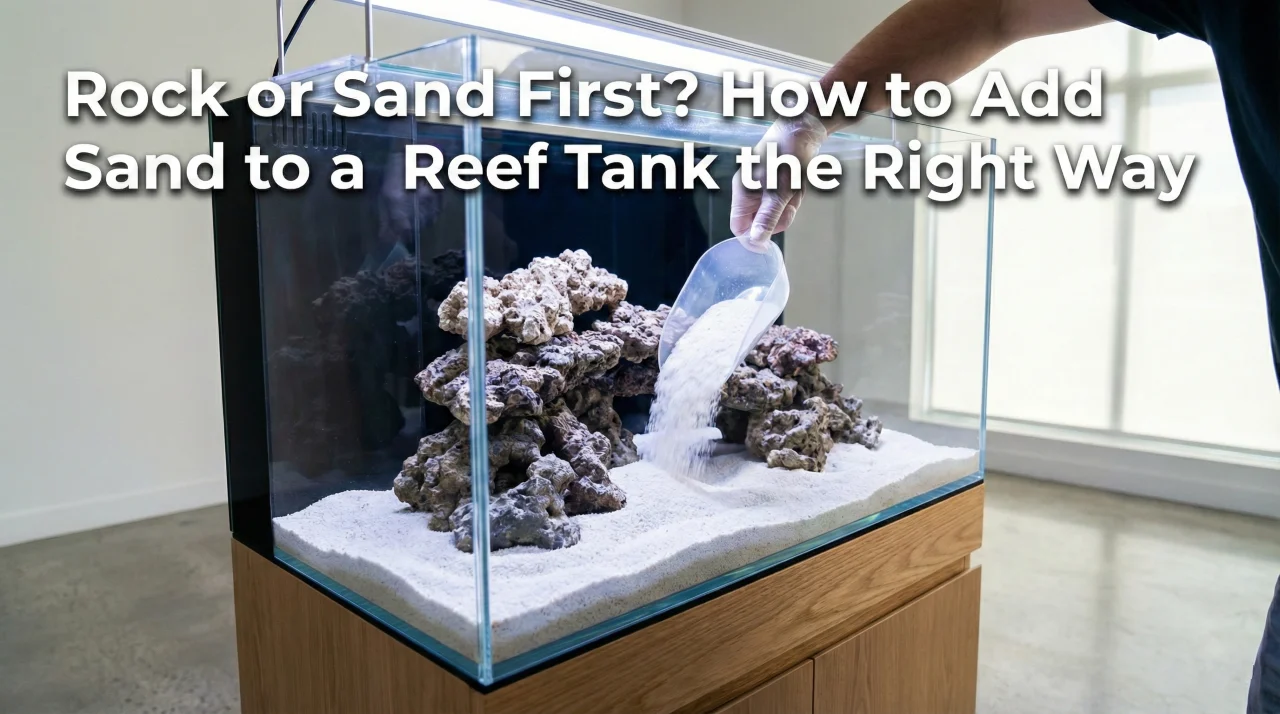
Rock or Sand First? How to Add Sand to a Reef Tank the Right Way
Welcome back to Simple Reefs. We have been on a bit of a journey with sand lately, covering everything from the different types of aragonite to the best ways to rinse your substrate. Now, we have reached the most exciting part: actually putting it into the tank. In this guide, we are looking at Rock or Sand First? How to Add Sand to a Reef Tank the Right Way for a clean, stable, and safe setup.
Table of Contents
Key Takeaways
- Place rock directly on the glass first. Never build your aquascape on top of sand. Burrowing fish and inverts can destabilise it.
-
Decide your sand depth intentionally.
2–5 cm works for most reef tanks.
10 cm+ deep sand beds require specific maintenance and planning. - You can add sand to an established reef tank. Turn off pumps, rinse the sand thoroughly, and add it slowly in small sections to avoid burying livestock or triggering a major sandstorm.
- Add water gently using a plate or bowl. This prevents craters, shifting rock, and sandstorms.
- Expect temporary cloudiness. Fine dust and minor bacterial blooms are normal and usually clear within 24–72 hours.
Most reef keepers ask one of two questions:
- Should sand go in before or after rock in a brand new tank?
- Can you safely add sand to an established reef system without causing chaos?
This guide covers both scenarios step by step, so whether you are starting fresh or rethinking your substrate months later, you can make the change confidently. Let’s take a look.
Have Your Reef Sand at the Ready!
If you have already made your decision on Live vs Dry sand, you are in the right place. Let’s get that slice of the ocean looking authentic.
This guide assumes that you have picked out and purchased the exact type of sand you want in your marine aquarium. It also assumes that, if you have purchased dry sand, you have already rinsed it.
If you haven’t rinsed it yet, check out our handy guide on how to rinse dry sand and come back here to get started on adding the sand to your new aquarium.
💡Note on Live Sand: Remember, you do not need to rinse live sand. You only need to rinse dry sand. If your sand is live and comes moist, you can, and should, add it to the tank as is with no rinsing. If unsure, read the directions on the back of the sand.
Before You Add The Sand
We have a couple of steps to go through before we can add our sand to the tank itself. These steps mostly revolve around preparing the tank so that we are ready to roll.
1. The Golden Rule: Rocks Before Sand
This is the single most important piece of advice in this guide. A common mistake some beginners make is filling the tank with sand first and then placing their rocks on top. This is a recipe for disaster.

The golden rule is that your rocks should always go into your display before your sand. Get your rock layout all planned out, make sure they are secure, and then you are ready to start adding your sand to the aquarium.
⚠️ Warning: Never Stack Rocks on Sand
You must always place your rocks directly on the bottom glass of the tank. Many reef inhabitants, like gobies and pistol shrimp, are obsessive diggers. If they tunnel under a rock that is sitting on sand, the entire structure can shift. This can lead to crushed fish, collapsed coral scapes, or even a cracked bottom pane of glass. Build your rockscape first, ensure it is stable, and then add the sand around it.
2. Plan Your Sand Depth
The amount of sand you need depends on your personal preference and the livestock you plan to keep. We want to make sure we decide on how deep we want out sand bed before we start.
There are generally two approaches in the hobby:
- Shallow Sand Bed (SSB): Usually around 2.5cm to 5cm deep. This is purely for aesthetics and a little biodiversity. It is much easier to keep clean and is the most common choice for beginners.
- Deep Sand Bed (DSB): Usually 10cm or deeper. These are designed to house anaerobic bacteria that help process nitrates. However, they require specific maintenance and can be a “nitrate factory” if not handled correctly. We’ll go into more depth on this subject in a future article.
As a rough guide, 1kg of sand per 10 litres will give you roughly a shallow bed. To calculate exactly how many kilograms you need, you can use a sand bed calculator. I am currently working on a custom Simple Reefs calculator for the site, so keep an eye out for that very soon!
Plan out and purchase the amount of reef sand you need beforehand, so you aren’t left needing to wait for more to be delivered or settling for less.
3. Verify Your Stand Stability
Before you commit and dump all that sand into your tank, give your stand one final check, particularly if it is a secondhand stand. Remember, sand is heavy and a stable base is very important.

For a medium sized tank, you might be adding 20kg to 40kg of extra weight on top of your rocks and water. A stand that’s loose or rickety could leave you with a floor full of water and rocks if it collapses.
If you are converting an old freshwater stand, be especially careful. Marine setups are significantly heavier, and you want to ensure there is no creaking or swaying when the tank is full.
I converted a 4 foot freshwater into marine and the stand gave me endless sleepless nights. It’s always worth double checking.
⚠️ Common Mistakes to Avoid
Setting up a reef is an exercise in patience, but it is very easy to get excited and skip a crucial step. Here are the top five mistakes that can turn your exciting setup day into a stressful cleanup operation:
- The Structural Slide: This is the big one. Never place your heavy rocks on top of the sand. Always ensure they are sitting firmly on the bottom glass so that burrowing fish or shifting currents cannot cause a collapse.
- The High-Flow Sandstorm: This is a classic mismatch between equipment and aesthetics. If you are planning an SPS (Small Polyp Stony) coral tank with high-powered wavemakers, avoid ultra-fine sand like Oolite. The extreme flow will whip the fine grains into a permanent cloud, burying your expensive corals and damaging your pump impellers.
- The Displacement Disaster: If you are adding sand to a tank that is already full of water, remember that sand takes up physical space. If your water level is already at the very top, adding several bags of sand will cause an immediate overflow. Always lower your water level by at least ten percent before you start pouring to avoid a very wet carpet.
- The Milkshake Effect: Skipping the rinse for dry sand is a mistake you will only make once. Without a thorough rinse, your water will stay cloudy for days and your filter socks or sponges will be clogged within hours.
- Leaving the Pumps On: If you are adding sand to a tank that is already full, turn off every single pump and wavemaker. If you leave them running, the sand will be caught in the current and distributed over your rocks, corals, and equipment.
- The Weight Oversight: People often calculate the weight of the water but forget that sand is incredibly dense. Adding 30kg or 40kg of sand to a large tank is a significant amount of extra pressure. Always ensure your floor and stand are stable before the sand goes in.
- Going Too Deep Too Fast: Unless you have a specific plan for a deep sand bed, aim for a depth of around 2 to 5 centimetres. Going much deeper without the right “cleanup crew” to stir it can lead to dead spots where waste can accumulate over time.
How to Add the Sand (Two Methods)
You have two main options here, depending on whether your tank is already full of water or currently empty.
Sand before water is technically easier but there are ways to get around it if you have already added water or need to add sand to an established reef tank. Just expect a little extra, temporary cloudiness.
Should You Add Sand Before or After Rock in a New Reef Tank?
Ideally, in a new marine aquarium, we want to be adding the sand to the tank before the water. It’s just a lot more straight forward.
This is my preferred method for new setups because it allows you to be precise with your layout. It also minimises mess and cloudiness.

- Place your sand into the dry tank using a clean scoop or jug.
- Distribute it evenly around your rocks, filling in gaps and caves.
- The Plate Trick: Place a dinner plate or the plastic bag the sand came in on top of the sand bed.
- Slowly pour your saltwater directly onto the plate. This breaks the force of the water, preventing it from kicking up a massive cloud of dust.
- Remove your plate, make your final adjustments, and add any sachets or bottles of bacteria or clarifying fluid.
- Turn your wavemakers, powerheads, heaters and filters on. If they push the sand around, adjust their power or positioning and redistribute the sand.
💡 The Science of the Splash: Why the Plate Trick Works
It might look a bit strange to put your kitchen crockery at the bottom of a fish tank, but there is a very good reason for it. A concentrated stream of water from a jug or hose carries a surprising amount of kinetic energy. If that stream hits the sand directly, it acts like a miniature pressure washer, digging a massive crater and launching fine dust particles into the water column.
By using a dinner plate or the original sand bag, you are forcing the water to hit a solid surface first. This spreads the force of the water horizontally across the surface of the plate. The energy is dissipated, allowing the water to rise gently and fill the tank without disturbing a single grain of your carefully levelled sand bed.
It’s that simple. If you have any cloudiness, it should clear up in a matter of hours. You may need to change the filter floss or filter medium in your filter after a day or so but it shouldn’t be too severe. You are now ready to begin cycling your aquarium.
Can You Add Sand to an Established Reef Tank? (The PVC Trick Explained)
If the tank is already full or established with fish and coral, don’t just pour the sand in from the surface of the water. The flow of sand will create a total white-out that takes days to clear. If you have fish and coral in the tank, this can be a disaster as the sand can coat the coral.
Instead, we have a couple of little life hacks. One is perfect for those of you who only have a cup or a jug lying around, the other is handy for those with a tube of PVC spare. We will still be dealing with some stubborn cloudiness but it will clear up pretty quickly.

- Make sure your water level isn’t right to the top of the tank or overflow. We are about to be adding a lot of sand which will displace water so we need some room at the top. Remove some water, approximately 10% of the total volume, if necessary and place it in a clean bucket so you can add some back later, if needed.
- Turn off all wavemakers, filters, powerhead, and return pumps.
- Use a large cup or jug to take a scoop of sand and then lower the sand to the bottom of the aquarium before tilting it out slowly.
- Alternatively, use a wide length of PVC pipe. Place the pipe against the bottom glass, pour the sand through the pipe, and lift it slowly to “trail” the sand where you want it. You can purchase PVC pipe from DIY stores for very little money.
- Add any sachets or bottles of bacteria or clarifying fluid.
- Leave your wavemakers or powerheads off for now. We don’t want to kick up more sand. Turn on your filter though, it will help with clearing up the water.
You are going to be dealing with a little bit of cloudiness for about 12-24 hours. Let it settle and give your filter media a change (or rinse your filter socks) when it’s done.
A great tip for active, established reef tanks is to complete this process over a series of days. Just add a portion of your sand every few dasy over the period of a week or so. This minimises cloudiness and limits how upset your biological filter might get from being disturbed.
If this is a brand new tank, you are now ready to begin cycling your aquarium.
🎉 Next Step: Let the Nitrogen Cycle Begin
Congratulations! With your rocks stable and your sand bed neatly laid, the physical construction of your reef is officially complete. It looks like a real aquarium now, but it is not quite ready for residents. Your water is currently sterile, and we need to invite some “good” bacteria to the party before you add any fish.
The next phase of your journey is the nitrogen cycle. This is where you build the biological engine that will process waste and keep your livestock healthy. It requires a bit of patience, but getting it right is the secret to long term success. Ready to bring your tank to life? Check out our Ultimate Guide to Cycling a New Marine Aquarium to start the process.
What if the Water is Still Cloudy After 24 Hours?
In a perfect world, your water should be crystal clear within twelve to twenty-four hours of adding your sand. However, if you wake up the next morning and your tank still looks like a bowl of soup, do not reach for the “panic button” just yet.

There are usually two very different reasons why this happens, and the solution depends on which one you are facing. Let’s take a look at the problem.
1. The Mechanical Filter Blockage
If the water looks “milky” and you used dry sand, the issue is almost certainly mechanical. Your filters are trying their best to pull the dust out of the water, but they have likely become completely clogged with fine aragonite powder.
When a filter sponge or sock is full of dust, it can no longer “trap” new particles, so they just keep spinning around in the water column. Luckily, this is very easy to fix.
- The Fix: Check your filter socks, sponges, or filter floss. If they look grey or brown, they are full. Rinse them out or replace the floss immediately. You may need to do this two or three times in the first forty-eight hours to finally get the water clear. It’s a bit annoying but it’s not a major problem.
2. The Bacterial Bloom (Common with Live Sand)
If you added Live Sand (like CaribSea Arag-Alive) or you added a bottle of nitrifying bacteria as soon as the water was in, you might be seeing a “Bacterial Bloom” rather than sand dust. This looks less like milk and more like a shimmering white haze or mist.
This happens because you have just provided a massive amount of new “real estate” (the sand grains) for bacteria to grow on. The bacteria population is exploding and trying to find a home. This is actually a very positive sign that your biological cycle is starting.
As long as you don’t have any fish in the tank (which you shouldn’t as the tank is new) you can leave it to settle naturally.
⚠️ Livestock Alert: Bacterial Blooms and Oxygen
If a bacterial bloom occurs in an established tank that already contains fish or corals, you need to act fast. These massive explosions of bacteria consume an enormous amount of dissolved oxygen in the water.
- Increase Surface Agitation: Aim your powerheads and wavemakers toward the surface to create a strong ripple effect. This maximises gas exchange and keeps the water oxygenated.
- Optimise Your Skimmer: Ensure your protein skimmer is running efficiently, as this is one of your best tools for aeration.
- Add an Air Stone: Consider adding a temporary air stone to provide an extra boost of oxygen until the water clears.
Do not remove the extra oxygenation until the water is completely clear again. If you see your fish gasping at the surface, they are struggling to breathe and you must increase the water movement immediately.
💡 How to Tell the Difference
It can be hard to tell dust from bacteria, but there is one simple test. Look at your filter floss. If the floss is physically caked in fine, gritty mud, you are dealing with sand dust. If the water is hazy but your filter floss is staying relatively clean, you are likely witnessing a bacterial bloom. In the case of bacteria, the best thing you can do is simply wait. It will settle on its own once the bacteria find a permanent home on your rocks and sand grains.
Managing Flow and “Bald Spots”
Once the water is clear, turn on your wavemakers. This is the moment of truth. You may find that your gyres or powerheads start moving the sand, creating “bald spots” where the bare glass shows through.

This is an ongoing battle for many reefers and, truthfully, you will need to dial things in which can take awhile. Repositioning and adjusting until you find the sweet spot is quite frustrating. It’s important to get right however, as bald spots grow algae fast and blown sand can cover coral.
It would be ideal if you could position your flow to keep detritus off the top layer of the sand without blowing the actual sand around. This is very difficult to achieve and takes practice. Try not to get too frustrated if you can’t get it right at first. I still battle with this now.
It’s worth mentioning that fine grain sand will be much more prone to blowing around and you may end up having to lower your flow levels dramatically to accommodate. Heavier grains of sand are much better for this.
💡 Pro Tip: The Bacterial Film
If your sand is blowing around on day one, do not panic. Fresh sand is very light. After a week or two, a thin layer of bacteria and “biofilm” will coat the grains, making them slightly heavier and stickier. They will eventually stay in place much better than they do during the first 24 hours.
Enjoy Your New View
Congratulations, the hard work is officially done. Take a moment to step back and look at your aquarium. There is something genuinely quite special about those first few hours where the sand is bright white, the rocks are clean, and the water is finally crystal clear.
I remember staring at my first tank in awe. Let’s be honest, though… It is the closest your tank will ever look to a pristine “designer” reef before the messy, wonderful reality of biology takes over. Things are going to get very ugly before they look like all those gorgeous photos you see.
Hold onto that feeling, because it will help you stay motivated through the “ugly stages” and the algae blooms that every successful reef must go through.

You have built a solid foundation, quite literally. By placing your rocks on the glass and adding your sand correctly, you have avoided the most common structural disasters that plague beginners. Your future fish and corals will thank you for the stability you have provided today.
Thank you for trusting Simple Reefs to help you through the setup process. This hobby can be as complicated or as straightforward as you make it, and you have just taken a massive step toward the “straightforward” side of the scale. Happy reefing!
Frequently Asked Questions
Can I mix different brands or types of sand?
Yes, you can certainly mix brands as long as they are both aragonite based. Many hobbyists mix a fine sand like Fiji Pink with a slightly coarser Special Grade sand to get a natural look that resists blowing around in the current. Just ensure you rinse all dry components thoroughly before mixing them together.
Can I reuse old reef sand from a previous setup?
While it is possible, I generally do not recommend it. Old sand is often packed with trapped detritus, fish waste, and potentially harmful bacteria or parasites from the previous tank. Even with heavy rinsing, you risk a massive ammonia spike or an algae nightmare. Given the relatively low cost of new dry sand, starting fresh is almost always the safer and easier option.
Can I add sand to an established reef tank?
Yes, but do it slowly. Adding too much sand at once can smother the beneficial bacteria or stir up detritus. Add a small cupful every few days until you reach your desired depth.
How deep should my sand bed be for a Pistol Shrimp?
Pistol shrimp and gobies need at least 5cm to 7cm of sand to build stable burrows. It is also a good idea to mix in some coarser crushed coral or shell fragments to help them reinforce their tunnels.
Do I need to clean the sand bed?
For shallow sand beds, a light vacuum during water changes is helpful. However, you should also rely on sand-sifters like Nassarius snails or Fighting Conchs to do the work for you.