

Why You Should Still Use a Marine Aquarium Heater in Warm Houses & Climates
Welcome to Simple Reefs. We are a brand new website designed to take the stress and expense out of starting your very own marine aquarium. We have been talking about aquarium heaters a lot, as of late. Today we are going to be talking about why you should still use a marine aquarium heater in warm houses and climates.
Table of Contents
Maintaining Thermal Stability
We talked all about thermal stability in our article on The Importance of Marine Aquarium Heaters. We also talked about how heaters are a rather underappreciated part of your marine aquarium equipment. There’s nothing all that interesting about the humble heater.
They aren’t exciting like a fancy new set of lights, they aren’t interesting like the coral you will be adding to your tank, they are just there to do a simple job. With that being said, it is easy to underestimate just how important that job is.

Thermal stability, or maintaining a consistent temperature in your aquarium, is incredibly important to the residents of your aquarium. Most of the creatures you can add to a marine tank come from a tropical climate and are adapted to live in a very narrow temperature range – between 24°C and 28°C (75°F to 82°F). When the temperature drops, or rises, outside of these numbers, you can start to see big problems.
The sea acts as a massive thermal buffer which prevents large temperature fluctuations. This means that your fish, inverts, and coral simply haven’t evolved a way to cope with large changes in temperature. This is one of the reasons why stony coral can bleach. In fact, a worldwide bleaching event is taking place right now due to sea temperatures rising.
With this in mind, it should be easy to understand just how important maintaining thermal stability is to your aquarium. To avoid causing stress and potentially even death to your critters, you want to keep the temperature in your tanks at a set level and make sure it doesn’t deviate too much from that temperature. This is where heaters come in and I am going to explain why a heater is important, even in warm climates and warm homes.
Marine Aquarium Heater In Warm Houses – More Than Just Heat
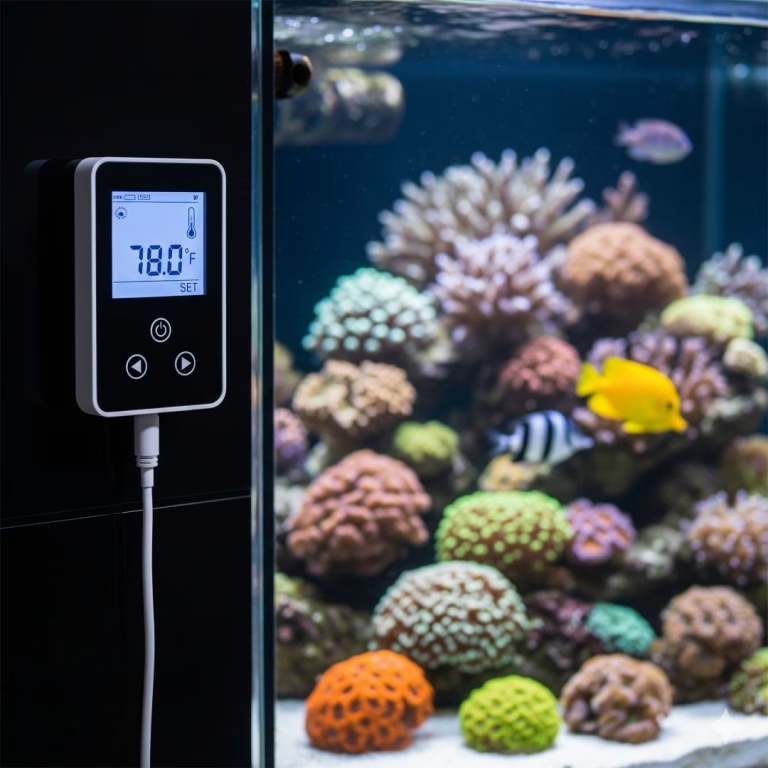
Marine aquarium heaters are more than just a way to warm up your water. They play a crucial role in keeping your aquarium’s water at a consistent temperature. Most heaters will measure the temperature of the water and, when it drops slightly, will turn on to warm the water back up.

This prevents large temperature fluctuations, maintains thermal stability, and keeps your tank’s residents happier and healthier. But what causes your tank’s water to fluctuate? Well, the main reason is due to evaporative heat loss but there are other reasons that we will go into in just a tick.
The water in your tank will evaporate over time, that is a guarantee. As water turns from a liquid into a gaseous state, it consumes heat to make the process happen. It’s the reason why humans can regulate their body temperature.
As long as we can sweat and the water on our skin’s surface can evaporate, we can lose heat. Your tank works the same. As the water evaporates, it takes some of the heat with it.
This will result in cooling of your water as your tank is a closed loop with only a small body of water; this water is nowhere near enough to act as a competent thermal buffer. There are a number of other factors that can lead to fluctuations in your tank’s water temperature and that’s what I want to talk about today.
Environmental Causes of Heat Loss
When we talk about environment, we aren’t really referring to the environment all around us. We are actually referring to the environment that your aquarium is kept in. In this case, your house. While outside temperatures demand consideration when it comes to whether or not you should use a heater in your marine aquarium. Your house will play an even bigger part in the decision.

You may wonder why you should use a heater in your aquarium. After all, your house has central heating and air conditioning. It should stay consistently warm. That’s correct, in theory. In reality, however, your house will still experience fluctuations in temperature. Let’s take a look at some of the reasons why.
- Use of air conditioning in warmer months reducing house temperature.
- Use of heating in the winter making the house warmer.
- Placement of the aquarium next to a window, air conditioning vent, or radiator.
- Natural fluctuations of outdoor temperatures.
These are the predictable environmental factors that can cause aquarium fluctuations. We can assume that these things will definitely occur and they will definitely impact on the temperature of our aquarium. Let’s take a look at why.
Air Conditioning Dropping Tank Temperature
During the summer, nobody wants to sit in their houses sweating and slowly turning themselves into a steamed ham. In warmer climates, Air Conditioning is an ultra common addition to most homes. This is all well and good but people have a tendency to cool their homes to around 22 degrees Celsius during the day before dropping the temperature a few more degrees at night.
Ideal sleeping temperature is not equivalent to ideal marine aquarium temperature. This means there is a solid chance that the night time temperatures that are comfortable for you are not comfortable for your fish and coral. Dropping your home a few degrees at night will drop your aquarium’s water temperature.

You may assume that, because you live in a warm environment, your home will be warm enough to maintain a tropical temperature in your aquarium at all times. If you are cooling your home artificially, however, you will be introducing temperature fluctuations. Remember how we talked about the importance of thermal stability? This isn’t an ideal situation.
As long as you have a marine aquarium heater, this won’t be a problem. You can turn your home into a freezer using your air conditioning if you so desire. Your heater will detect the change in temperature, turn on, and keep your tank warm, maintaining that all important thermal stability.
Winter Heating Causing Tank Temperature Fluctuations
Much like with air conditioning, when it is cold outside, during the winter, you are going to artificially adjust the temperature in your home. Most of us will fire up the heating in the daytime to something that feels more comfortable. That’s great, your home might sit at 22 degrees Celsius all day long, perfect! But what about during the night time?
Again, most people will allow their homes to cool overnight. Whether that is to maintain a more comfortable sleeping temperature or simply to save money. While you are wrapped up in your duvet, your home is cooling and the temperature is fluctuating. When this happens, your aquarium will, inevitably cool, as well. This means we have immediately lost thermal stability which is not ideal.
You may not notice the temperature drop because you are sleeping. After all, most humans prefer to be cooler when they sleep. If you own a marine aquarium heater, your heater will detect the subtle temperature changes, turn on and warm your water back up, maintaining thermal stability in your tank and protecting your precious residents.
Tank Placement Causing Temperature Fluctuations
These are some of the more obvious, but often overlooked, factors that might influence the temperature of your aquarium. The placement of your aquarium is something that demands serious consideration. Let’s take a look at some of the ways your tank placement can impact the temperature of your water:
- Placement by a window causing draughts which cool the aquarium’s temperature.
- Placement in the view of a window allowing sun to hit the tank and warm the water.
- Placement by an air conditioning vent causing the water to cool.
- Placement by a radiator or heater warming the water.
- Placement of your aquarium against a cold outside wall causing the surrounding ambient temperature to be lower.
- Placement of your aquarium next to a door that causes draughts or variable ambient temperature.
These are just some of the ways that your aquarium’s placement in your home can impact the thermal stability of your tank. Try to avoid keeping your aquarium next to windows, in direct sunlight, next to air conditioning vents or heaters, and away from draughts.

Outside walls do deserve some consideration but they also tend to be the parts of your home that are most capable of bearing the weight of a tank so it is sometimes unavoidable. Fluctuations of temperature caused by tank placement can be completely avoided with the simple inclusion of an aquarium heater. When the temperature drops, the heater will turn on automatically and maintain thermal stability.
Outdoor Temperature Fluctuations
We definitely need to consider outdoor temperature fluctuations, as well. If you live in a house that isn’t particularly well insulated or is prone to trapping either cold or heat, the temperature outdoors can cause problems in your home. It is easy for a particularly cold night to drop the temperature in your house lower than expected.
It’s also possible for extremely warm weather to mean your indoor temperatures reach unexpected heights. On really hot days, your air conditioning may not be able to keep up, meaning your house warms beyond the expected point. We will go into this more in a future article on cooling your tank when it gets too warm. Today, we are more focused on heating your tank.

While you may not even notice these temperature drops, your home will and your aquarium will. If you own a marine aquarium heater, however, your heater will switch on when those temperatures unexpectedly fall and it will help maintain thermal stability in your tank. When that temperature drops, you will be very happy that you still purchased a heater even though you live in a warm climate.
Take a look at this calculator that I have put together. You can enter your tank’s volume, the ambient temperature of your home, and the temperature of your tank’s water. The calculator will then tell you how much heat you are likely to lose per hour in a typical situation. You might be shocked at the difference just a degree or two drop in ambient temperature makes to your thermal stability.
Aquarium Heat Loss Calculator
Estimate the heat loss from your aquarium to the surrounding room. This calculator should not be used as a replacement for professional tools and is only a very rough estimate from a person who isn't all that good at maths. Use at your own risk and Simple Reefs doesn't assume any responsiblity for external factors making the calculation innaccurate or just not very good.
Naturally, the calculator can’t adjust for your own living conditions and your tank setup. More surface agitation, for example, will lead to more heat loss, thicker glass will lead to less, etc. It’s a very, very, rough guide that you can use to make a very rough estimate.
Emergency Situations Causing Big Temperature Drops
Even in truly warm, tropical climates, temperature can drop unexpectedly and for extended periods of time. Due to climate change, places like Louisiana and Texas that simply aren’t used to horribly cold weather are experiencing unseasonable chills and even snow. I am a big fan of the New Orleans Saints NFL team and recently witnessed the city in the middle of a snow storm. Many of the people there don’t even own heaters for their homes as they just aren’t usually needed.
When these cold spells hit, your aquarium and its residents are going to be one of the first to suffer if you don’t have an aquarium heater. Your home, which is likely not built to trap the warmth due to living in a warm climate, will quickly cool. You will then be left with an aquarium that is unable to maintain its temperature. This could quickly result in thermal shock and even death for your fish, coral, and inverts.
Remember the big freeze in Texas a couple of years ago? One of the most frequent things that you would see in people’s home would be completely frozen fish tanks full of dead fish. While the electricity being out was, obviously, a contributing factor. I am sure many would have preferred to have the option to run a heater off of a generator to save their tanks. They just didn’t have the chance because people in warm climates don’t heat their tanks.
In Short
Even in warm climates and warm homes, temperature fluctuations are possible and, in some cases, even extremely likely. Even if you think you don’t need an aquarium heater due to where you live or how warm your home is, it is still a wise investment. If the temperature outdoors or in your home drops, a marine aquarium heater might be the difference between life or death. When temperatures are low, it will turn on and heat your water, helping to maintain thermal stability. Thanks for reading and spending your time at Simple Reefs.