
Do I Need Live Rock for a Successful Marine Aquarium? – A Beginner’s Guide
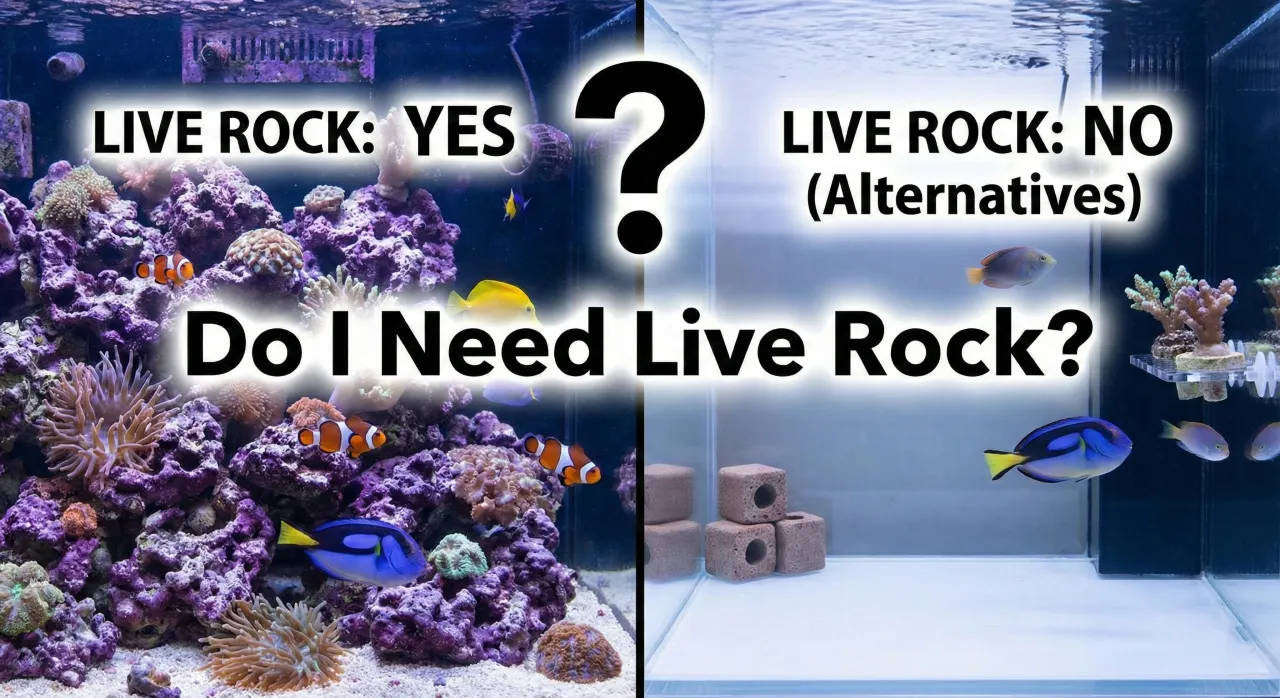
Welcome to Simple Reefs. If you have been pricing up gear for your new saltwater setup, you have probably noticed that reef rock is incredibly expensive. This leads to a very simple, yet highly important question: Do I Need Live Rock for a Successful Marine Aquarium?
Table of Contents
If you have questions about what exactly Live Rock is, you should check out our beginner’s guide to Live Rock, Dry Rock, and Life Rock first. Today, we are focusing purely on whether you can skip the rock entirely, and what that means for your filtration.
Key Takeaways
- Technically Optional: You do not strictly need live rock to run a successful marine aquarium. You can run bare tanks, frag setups, or use alternative biological filtration.
- The Bio-Media Alternative: If you skip rock, you must provide an alternative surface area (like ceramic bio-rings or bio-blocks in a filter) for beneficial bacteria to grow on.
- Your 5-Year Plan Dictates Your Needs: Fish-only tanks and dedicated coral frag tanks can easily run without rock. Mixed reefs (fish and coral together) almost always require a rock structure for stability and territory.
Quick Answer: No, you do not absolutely need live rock. However, because rock acts as your primary biological filter, skipping it means you must compensate with heavy mechanical filtration and dense ceramic bio-media in a sump or canister filter to process fish waste.
When Do You Need Rock? (The Scenario Matrix)
To figure out if you need rock, you have to look at what you plan to keep. Here is a quick breakdown of different marine setups.
| Tank Type | Do You Need Rock? | Why? |
|---|---|---|
| 🐟 Fish-Only (FO) | Optional | Fish don’t need rock to survive, just open swimming space and PVC pipes or alternative bio-filtration to handle their waste. |
| 🪸 Coral Frag Tank | No | Corals are often kept on plastic egg-crate racks. Since there are few fish producing waste, heavy biological filtration isn’t needed. |
| 🌿 Macroalgae/Seahorses | No | Seahorses prefer hitching posts like artificial plants or gorgonians rather than abrasive rocks. |
| 🐠+🪸 Mixed Reef | Highly Recommended | Fish create heavy waste, and corals need pristine water. Rock provides the massive filtration required to balance both. |
Deep Dive: Do I Need Live Rock?
Let’s be honest, Live Rock is expensive and it is bound to raise the question “do I really need it?” in new hobbyists.
Live rock is, strictly speaking, an optional extra. Now, I can already see marine aquarium veterans scoffing at that statement, but it is true.
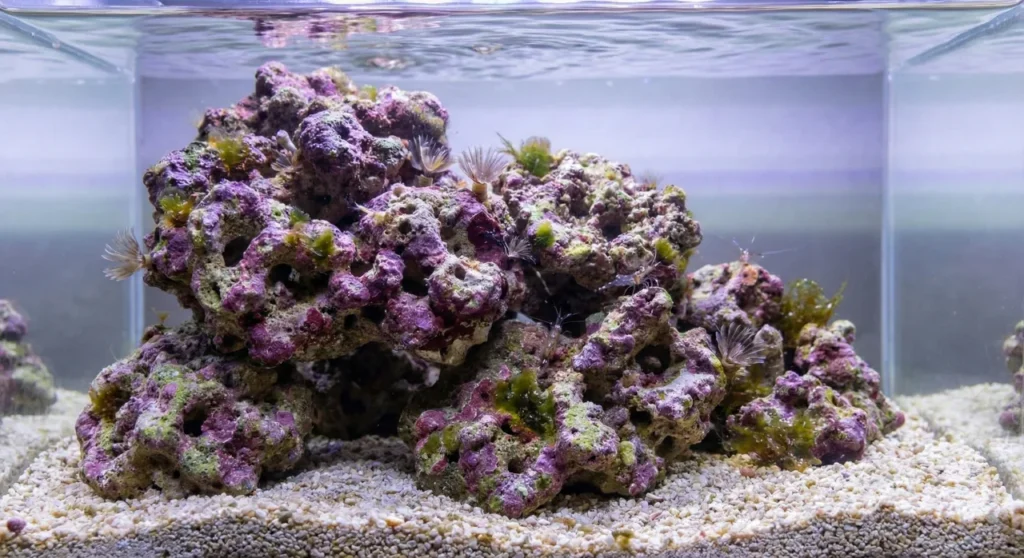
Some people simply don’t like the aesthetics of an aquarium filled with stone and prefer a minimalist look. Others want to avoid the extra hassle of blowing detritus out of crevices or scrubbing algae off rocks.
Some setups, Seahorses for example, simply don’t require it. Whatever the reason, you can start a marine aquarium with no rock at all. The truth is, however, it is far from optimal. Keep reading on, though. There are budget friendly ways we can include rock in our marine aquarium and still save money.
Let’s look at how that works in different scenarios.
Scenario 1: “I Only Want Fish”
Great! You are on easy street, as this is the simplest option you could possibly hope for. In fact, having a fish-only marine aquarium takes the difficulty and expense down to the level of a slightly advanced freshwater tank.
You don’t need a sump, you don’t need expensive reef lights, and you don’t technically need rock. However, because you won’t have porous rock to house beneficial waste-eating bacteria, you need an alternative.
💡 The “No-Rock” Filtration Hack: Bio-Media
If you don’t have rock in your display tank, you must place Ceramic Bio-Media (like Bio-Rings, MarinePure blocks, or Seachem Matrix) inside your hang-on-back filter, canister filter, or sump. These highly porous artificial materials provide thousands of square feet of surface area for your essential nitrifying bacteria to live on, completely replacing the biological function of live rock.
You can’t start an aquarium as quickly as you can with rock as many people will add a piece of live rock to their aquarium to get the bacteria reproduction started, completing the all important “cycle” a lot quicker. You won’t have this option so you need bacteria to populate the surfaces of the aquarium, the substrate (if you have any), and whatever filter medium you have.
You are going to need to cycle your aquarium in the old fashioned way with a bottle of bacteria and a source of ammonia. This could take upwards of six weeks. Take a look at our guide to cycling a marine aquarium for beginners.
You will also need a more effective filtration system. One that can house a decent amount of space for filter medium to trap suspended waste particles and some bio media. Bio media is a type of filtration media that is very porous and has a ton of surface area for nitrifying bacteria to grow on. This will be very important in keeping your residents happy and healthy.
You will also need to stay on top of your water changes, as fish poop a ton and that waste needs to be removed manually.
Scenario 2: “I Only Want Coral”
This is highly doable and, in a lot of cases, is the preferable option for coral farmers. After all, how many coral display tables do you see in fish shops that have live rock in them?
If you are choosing to propagate coral, a shallow aquarium with no rock and lights suspended just above it is the standard method. Your coral won’t produce heavy biological waste in the same way fish do. Your parameters can be kept stable with dosing, and basic water changes will keep everything fresh.
💡 Tip: The Budget “Coral Table” Hack
If you are setting up a coral-only display or a dedicated frag tank, skip the expensive rock entirely. You can build a professional-grade coral table for under £15.
Just head to your local hardware or DIY store and buy a sheet of plastic “egg crate” (often sold as suspended ceiling lighting diffusers) and a few lengths of basic PVC pipe to use as legs. Zip-tie it all together, and you instantly have a perfect, high-flow platform that holds hundreds of coral frag plugs securely.
You can use plastic egg-crate racks or specific magnetic coral mounts to attach your coral directly to the glass, bringing it closer to the light depending on its needs. It’s not as aesthetically pleasing as a natural reef, but it is vastly easier to keep clean.
Scenario 3: “I Want Fish AND Coral (A Mixed Reef)”
The problems come when you start adding fish into a coral tank that has no rock. Fish create heavy waste, and corals demand pristine, low-nutrient water. A lack of live rock means there is far less surface area for nitrifying bacteria to process that waste.

One or two small fish (like a Clownfish or a pest-eating Wrasse) shouldn’t be a problem. More than that, however, could be a disaster, causing wild nutrient swings that will make your coral very unhappy.
A sump can be used to mitigate a ton of these problems. You can fill your sump with a bunch of porous rocks or bio media blocks to increase bacteria reproduction. Keeping it out of sight but still reaping all the benefits of having live rock. You could also use canister filters in much the same way. Filling them with bio-media. Otherwise, you will likely encounter issues.
If you want a mixed reef, you highly benefit from a rockscape. It provides dynamic shelves to place your coral on, creates hiding spots to reduce fish aggression, and provides the massive biological filtration needed to balance the ecosystem.
The Budget Alternative to Live Rock
So, as you can see, while live rock is technically optional, in most standard setups, you are going to want a rockscape. The addition of rock turns your aquarium from a barren glass box into its very own micro-ecosystem. It looks so much better in most cases, as well. We are recreating a living reef, after all.
The problem for budget reefers is the price. Real ocean live rock or specially cultivated live rock is incredibly expensive, which we talk about in detail here. Furthermore, real ocean rock can be filled with nasty hitchhikers like Aiptasia anemones or predatory Mantis Shrimp that will emerge at night to feast on your livestock.
That’s without even talking about the ethical implications of removing it from the wild and the damage that does to delicate eco-systems. Luckily, we have a solution.
💡 The Simple Reefs Solution: Use Dry Rock
You do not need to spend hundreds of pounds on wet rock from the ocean. You can build your entire aquascape using cheap, 100% pest-free Dry Rock (like quarried limestone or Marco Rock).
You simply place it in your tank, add a bottle of marine bacteria, and over the course of a few months, your dead dry rock will naturally transform into “Live Rock” all on its own! You can read our complete guide to turning dry rock into live rock here.
In Short…
To make your decision, simply go back to our article on What Type of Marine Aquarium Do You Want? Picture your tank in five years’ time.
If you only want fish or plan on keeping seahorses, you can easily skip the rock and use artificial decorations and ceramic filter media instead. But if you see yourself creating your very own slice of the natural ocean with corals and fish interacting together, you are going to want to build a rockscape.
Can a saltwater tank survive without live rock?
Yes. While live rock is the standard method for biological filtration in a reef tank, you can run a saltwater tank without it. You must compensate by using porous ceramic bio-media (like bio-rings or bio-blocks) inside your filter or sump to house the beneficial bacteria needed to process fish waste.
Do fish-only marine tanks need rock?
No. A Fish-Only (FO) tank does not require rock. Fish require open swimming space and clean water. As long as you provide hiding spots (like PVC pipes) and strong biological filtration in your filter, rock is completely optional.
What is the cheapest alternative to live rock?
The cheapest alternative to expensive ocean live rock is Dry Rock. Dry rock is pest-free, highly affordable, and can easily be seeded with bottled marine bacteria to turn it into fully functioning ‘live’ biological filtration over time.