

Do Instant Cycling Marine Aquarium Products Really Work?
Welcome to Simple Reefs. This is a brand new website dedicated to taking the complexity out of Marine Aquarium Ownership. Our goal is to show you how you can own your very own slice of the ocean without spending a fortune. As well as giving you tons of easy to digest information on all things marine. In this article, we are answering a simple, yet important, question. Do Instant Cycling Products Really Instantly Cycle Your Aquarium?
Table of Contents
We are continuing our series on marine aquarium cycling today. We discussed marine aquarium cycling at the end of last week and broke down just what the term means and how aquarium cycling works. Today, I want to key in on a very specific term that comes up a lot when it comes to cycling your aquarium and that is “Instant Cycling”.
Cycling Your Aquarium is a Slow Process
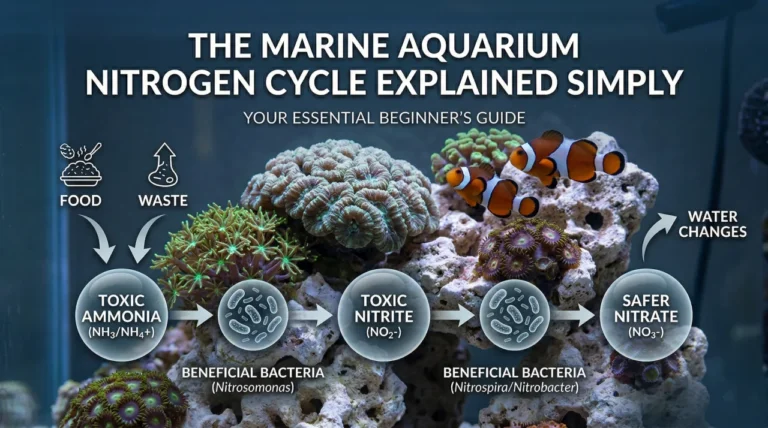
That term, right there, instant cycling, should clue you into what this subject is all about. We explained, in our last article, about the process of cycling your aquarium and how, basically, the term cycling means to establish a bacterial profile in your aquarium. Making the water safe for fish by creating a biological filter that can process toxic waste products like ammonia that come from rotting food and poo. This is known as the nitrogen cycle.

The truth of the matter is, cycling your aquarium is a slow process. You, basically, start with nothing, add ammonia to your aquarium and the bacteria begins to process it, converting it into nitrite. This bacteria splits in a process known as binary fission and your ability to process ammonia gets a little better. That’s where the waiting comes in. This bacterial splitting takes a decent amount of time.
Companies are well aware of the impatience that comes along with marine fishkeeping. Be it those aspiring owners who want to add coral within the first month or those who just can’t be bothered with how long things in this hobby actually take. Cycling is one of those things. It takes a long time and when there is a way to help people get this process over with as fast as possible. There is money to be made. Lots of money! Instant cycling products are a veritable gold mine for these companies.
What Does Instant Cycling Mean?
This is a term you will see a lot when starting a new aquarium. Many, many, products make the claim that they can instantly cycle your aquarium. Boasting in a variety of different ways, be it “Rapid Cycling”, “Instant Cycling”, “Safe Start”, “Rapid Start”, “Instant Start” and so on, that they can cycle your tank instantly. But what do they mean when they make this instant cycle claim?
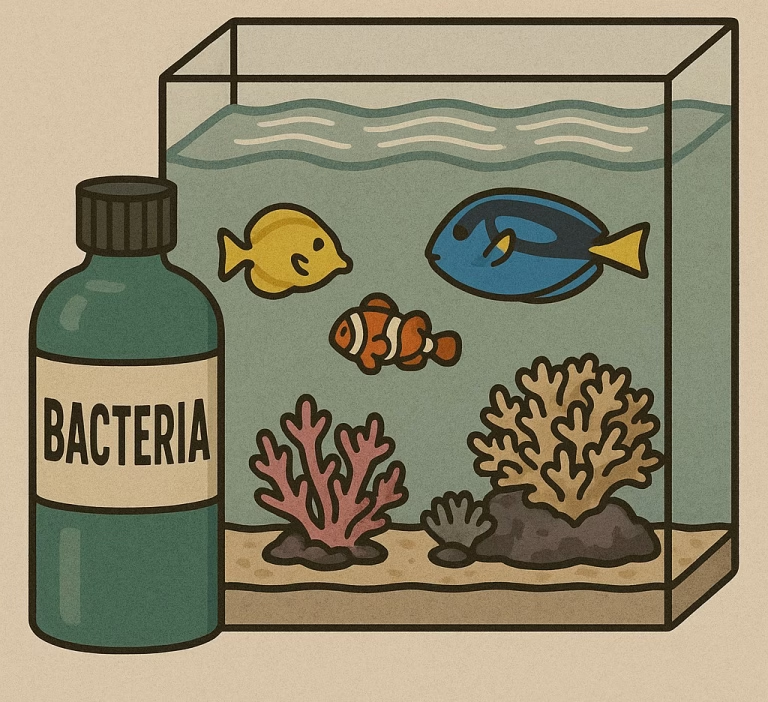
Well, the idea is pretty simple. These products contain nitrifying bacteria in some form or another. Meaning that, when added to your aquarium, these bacteria should get to work, instantly, converting ammonia into the less toxic compound nitrite. In our previous article on Marine Aquarium Cycling. We talked about the various different types of bacteria that take part in the oh so important Nitrogen Cycle that makes our aquariums safe for fish.

We have a type of bacteria called Nitrosomonas that converts toxic ammonia into the compound Nitrite. Before two further types of bacteria, known as Nitrospira and Nitrobacter, convert those nitrites into the even safer compound known as Nitrate. This can then be removed from the water with water changes.
So, in theory, if we add all of those different types of bacteria to our aquarium. We have thrown in everything we need to complete the nitrogen cycle, right? We have the three most important types of bacteria, Nitrosomona, Nitrospira, and Nitrobacter. We can remove ammonia from the water. Surely the aquarium should now be safe for us to add fish.
Not Quite That Simple
There are so many factors that make this bold claim regarding an instant cycle dubious, at best and a bit sinister at worst. How the product was stored, how old the product is, whether the instructions are followed to the letter, and a whole bunch of other unpredictable factors, can impact how effective this method is. The reality is that it is impossible to truly know whether instant cycling bacteria will actually work.

Let’s say, for example, that you purchase a bottle of starter bacteria from a shop that claims it can instantly cycle your aquarium and fish can be added straight away. Great! But there is a problem. The place that you bought it, or their suppliers, stored the bacteria incorrectly. Maybe near a source of heat, out in the broad daylight etc.
You get home, add it to your aquarium, and then throw in a pair of clownfish. These clownfish eat and crap so ammonia begins to accumulate. Most of the bacteria in the bottle was already dead and you now have a serious issue. Ammonia is building up and you are left having to perform daily water changes or dosing your tank with Seachem Prime to keep up.
It may seem like an insignificant gamble but the fish you add to the aquarium probably won’t agree with that sentiment. Ammonia poisoning is a horrible way to go and, even if it doesn’t kill your fish, the long term damage could seriously impact their quality of life.
Instant Cycle Products Can Help
Even if the bacteria in your “instant cycle” product is alive and well. It takes 16-24 hours for the bacteria that converts ammonia, Nitrosomonas, to split. Meaning the bacteria may be able to handle the ammonia for awhile but becomes quickly overwhelmed as it can’t reproduce fast enough. The bacteria that converts nitrites to nitrate reproduces even slower. Compounding the issue.
Even when instantly cycling products do work as intended. It can take around 2 to 3 weeks for the bacteria to establish and get to doing what it is intended to do. It is very easy to overwhelm it in this time frame by adding fish and feeding too much. Something which is known as stalling your cycle which we will be talking about in an upcoming article. This can lead to huge problems.
Unfortunately, many companies that make these products have an incentive to sell them to you in the form of money. They realise that most aquariums, that are started slowly using their products, won’t incur any deaths and the end result will be a completed cycle. But they can’t promise that there won’t be any suffering. That isn’t in their interests. Making money is. Notice how expensive all of these products are?

Many products are removing the whole “instant cycle” claim. Instead choosing to, more accurately, reflect the fact that these products can help speed up your cycle. Others are adding a note to say that it is best to go extremely slow. Things that claim to be instantly cycling should be taken with a grain of salt. They will, more than likely, help a great deal with kick starting your cycling process but you should always follow proper procedure.
We will have an article coming up this week on how to cycle your aquarium. But you want to be adding the bottled bacteria to your aquarium, adding a source of ammonia like Dr Tim’s Ammonium Chloride, a piece of shrimp, or some fish food, and testing your water daily. If your ammonia levels are going down and you have the presence of nitrates in your water, your bottled bacteria worked. If your ammonia levels aren’t going down, it failed but at least you know and didn’t add any fish.
But Other Aquarium Hobbyists Say..
You are going to see a lot of mixed opinions when it comes to the whole subject of cycling an aquarium. If you were to jump on reddit. You would see a range of people varying from those who leave it multiple months before adding fish to those who leave the aquarium up for a week before adding fish and just doing water changes to try and keep on top of the ammonia.
There is no strictly defined right or wrong way to do it, in this respect, because a lot of methods will get you to the end result of a cycled aquarium. But there is a way that could, rightly, be considered to be cruel and a way that has minimal risk. Any way you look at it, if you are not testing your water to confirm that the ammonia is being converted into nitrite. There is no way for you to know if the animal you have added to your aquarium is suffering.
Some people view fish as fairly disposable. If you have a love for your fish, do the kind thing and test your water. Don’t just add bottled bacteria and then throw a few fish in. It’s just not fair for the sake of being a little excited or impatient. Nothing deserves to suffer in any way if it can be avoided.
Patience Is Key
I know this isn’t, necessarily, what you wanted to read. Cycling an aquarium is a boring process. Staring at that empty tank while, seemingly, nothing happens gets old fast. Patience is key, however. Add your bottled bacteria and some ammonia then get testing your water every day. The instant cycling claims may just be true.
If they aren’t, however, at least you wouldn’t have put an animal through a torturous experience and you wouldn’t have wasted money, either. Do you want to see £40-50 of fish floating on the surface of your tank? You would feel guilty and you would be out of pocket. Instant cycling products are a very useful tool and may speed things up a bit. They aren’t a shortcut to an instant cycle, however, and shouldn’t be used as if they are. Thanks for reading and spending your time at Simple Reefs.