

Give Your Marine Aquarium Cycle a Big Time Boost Using Bottled Bacteria!
Welcome to Simple Reefs. This is a brand new website dedicated to taking the complexity out of Marine Aquarium Ownership. Our goal is to show you how you can own your very own slice of the ocean without spending a fortune. As well as giving you tons of easy to digest information on all things marine. We have been discussing Aquarium Cycling a lot, as of late. Today, we are going to show you how you can give your cycle a big time boost using Bottled Bacteria.
Table of Contents
The idea behind bottled bacteria is really very simple. You are adding living nitrifying bacteria to your aquarium that will get to work straight away populating your aquarium’s surfaces and processing waste. That is the short and narrow of it but to understand just what it is the bacteria is actually doing, we need to quickly recap the nitrogen cycle.
Boosting Your Nitrogen Cycle
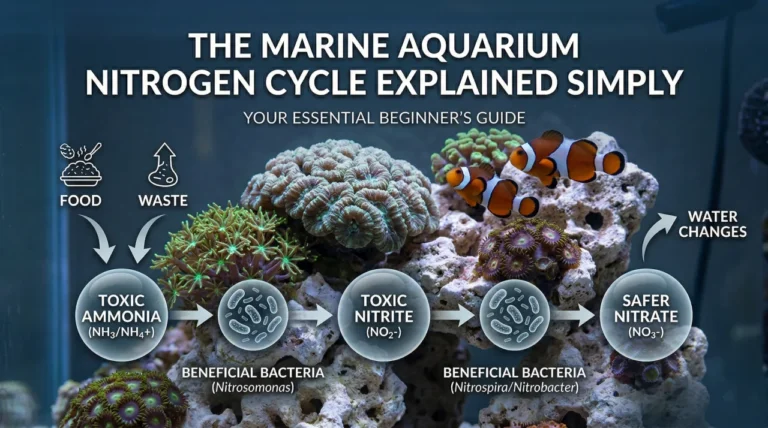
What is the Nitrogen Cycle in a marine aquarium? Well, to put it simply, it is the biological filter that makes your aquarium safe for fish and invertebrates. The same way that a hang on back filter removes particles from the water to make it cleaner, your biological filter removes toxins to make it safe.
The leftover waste from fish food and poo produces a very toxic compound known as Ammonia. To combat this, we need to encourage the growth of a type of bacteria known as Nitrosomonas. This bacteria will convert the ammonia into a less toxic compound known as Nitrite.

The presence of nitrite in the water will encourage the growth of a further type of bacteria, Nitrobacter and Nitrospira. These bacteria will convert the nitrite into an even safer compound known as Nitrate which can be removed from the water via water changes.
The importance of the nitrogen cycle (Wikipedia Article) to a healthy marine aquarium can’t be understated. It is the living, breathing, biological filtration heart of your tank. Without a thriving nitrogen cycle, your fish will quickly be poisoned by their own waste. The problem is, however, the nitrogen cycle can take a long time to get going.
The Nitrogen Cycle – A Lengthy Process
We talked all about this in our article breaking down the steps of the cycling process. The actual length of time it can take to cycle your aquarium can take from just a few weeks to over three months.
The bacteria in your aquarium have preferred conditions in much the same way as a house plant does. They like things a certain way with regards to temperature, salinity, how oxygenated the water is, and how much ammonia or nitrite is available to them.
If you fail to find a happy balance when it comes to the ideal conditions to help bacteria grow, the process can slow down. This is often referred to as your cycle stalling and we have talked all about it in a whole range of articles.
Even when your cycle hasn’t slowed down to a crawl, it can be frustrating to wait. The bacteria that processes ammonia takes upwards of 16 hours to duplicate and that stretches to over double that length of time with the bacteria that process nitrite. You can speed things up, though.
Give Your Marine Aquarium Cycle a Boost!

The easiest way to speed things up a little is by adding some bottled bacteria to the tank. After all, we could all use a helping hand, now and then. Why not kick start your cycle with some added fire power? Simply purchase some Dr Tim’s One and Only Nitrifying Bacteria, or your preferred brand of starter bacteria, and follow the instructions. Adding a little to the aquarium each day.
These magical bottles of cycle boosting awesomeness come teeming with life. Each capful contains millions of living bacteria just waiting to get to work. These bacteria include strains like Nitrosomonas for consuming Ammonia and strains like Nitrobacter for consuming Nitrites. They often contain additional types of bacteria to increase the level of biological diversity in your aquarium.
This should be enough to kick even the most stubborn of cycles into life. Getting things moving again and helping to speed up the process. A lot of starter bacteria is quite affordable, as well. You can turbo charge your cycle for about £10 and you may find that only one bottle is enough to get things going in the right direction.
Other Benefits to Bottled Bacteria
There are definitely other benefits to using bottled bacteria in your marine aquarium. For one, you’ll be adding a higher level of bacterial diversity to your aquarium. Many of the bacteria present are types that you wouldn’t automatically find in your aquarium. Products like Brightwell’s Microbacter 7 contain complex and diverse collections of microorganisms that you wouldn’t otherwise find in an immature tank.

The bacteria will help with inhibiting the growth of algae by reducing nutrients and coating surfaces. If your rocks are packed with bacteria then algae is less capable of growing. Bottled bacteria can be used to drop ammonia levels which can help fix a stalled cycle.
The bacteria contained in the liquid will begin processing ammonia straight away leading to a reduction in concentration. You can also use bottled bacteria to kick start physical filters by placing the bacteria directly onto the filter’s media.
Bottled bacteria can come in very hand when you are having algae problems. A regular cleaning routine combined with water changes and the addition of bacteria can fix stubborn issues like cyanobacteria. I have actually fixed dinoflagellates in multiple aquariums using nothing but UV and a bottle of Microbacter 7.
Bottled Bacteria Isn’t a Magic Bullet
I know, we would all like that one fix for every problem in marine aquariums but it just isn’t realistic. While bottled bacteria is a useful tool in your marine aquarium toolkit, it’s not a magic bullet solution for all issues.
Bottled bacteria, despite claims, shouldn’t be viewed as a way to instantly cycle a marine aquarium. You should still follow the full process of cycling and test your water frequently. It can speed things up dramatically but patience is still key.
Bottled bacteria can’t fix bad nutrient problems. While it can be a useful accessory in the fight against high nutrients, it isn’t a fix. I know, this one is frustrating because the way people talk about it, you would think that bacteria could fix any problem. It just isn’t the case, despite what hobbyists might say.
You still need to be keeping up with maintenance and checking parameters. Bottle bacteria should be looked at as a part of your maintenance and part of your plan to fix nutrient issues. Not as the be-all-end-all solution.
Bacterial Blooms and How To Fix Them
It is incredibly important to follow the dosing instructions when dosing bottled bacteria. Believe it or not, all of that bacteria can cause big problems when the instructions aren’t followed. Adding too much can cause a “bacterial bloom“.
A bacterial bloom is an increase in the bacteria in the water column. This can happen organically when there is a lot of uneaten food or waste that attracts bacteria. It can also happen artificially when we add bacteria to our tanks. The problem with a bacterial bloom is that the bacteria will quickly consume oxygen in the water. This can actually lead to the death of fish.

If you do overdose bacteria and notice that your water is suddenly cloudy, you have to react quickly. Point a wavemaker or powerhead at the top of the water’s surface to agitate the water and turn your protein skimmer on. If you have a UV filter, switch that on as well. We need to reduce the levels of bacteria and increase the oxygen in the water.
Pointing the powerhead at the surface will cause more movement of the water. This, in turn, will generate more oxygen which is the first step in dealing with a bacterial bloom. If you have an external water pump, feel free to throw a water stone in the water for a few hours. This will create a ton of oxygen which will help massively.
Removing the Bacteria After a Bacterial Bloom
The protein skimmer is going to remove all of that free-floating bacteria from the water. If you notice, they tell you to switch off your protein skimmer when adding bacteria. This is because the skimmer will remove the bacteria from the water while it is still free floating and trying to find a home. The skimmer will help massively by reducing bacteria numbers. Keep in mind that your skimmer may run wet.
The same principle applies to your UV filter. While your established bacteria isn’t impacted by UV because it isn’t free floating, the same can’t be said about bacteria in the water column. The UV will kill the bacteria, reducing the levels in the water and ending the bloom.
If you don’t have a skimmer, a UV filter, or an external air pump, don’t worry. You can take a cup or jug, fill it up with a decent amount of tank water, hold it about 12 inches above your tank, and pour it in slowly. This will create a bunch of bubbles that will oxygenate the water. Do this every 15-30 minutes until the bloom dies down.
Keep monitoring your fish for signs of oxygen deprivation like gasping at the top and stay calm. The bloom will pass, it just needs time.
In Short
Bottled bacteria can be a helpful tool to have in your marine aquarium kit. While it isn’t an instant fix for problems, it can help a lot. Bottled bacteria can be used to speed up a cycle, fix a stalled cycle, help with algae problems, help with nutrient issues, and be used to create more biological diversity in your aquarium. Thanks for reading and spending your time at Simple Reefs.