
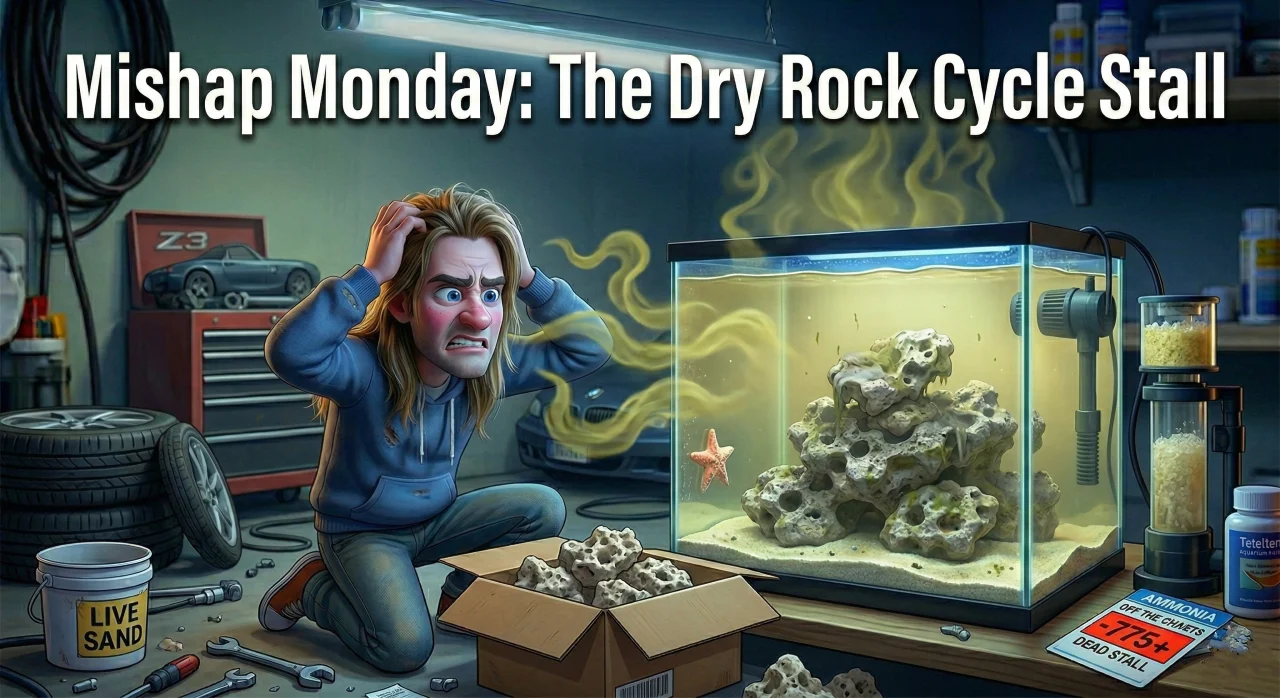
Mishap Monday: The Dry Rock Cycle Stall
Welcome to Simple Reefs. This is a brand new website dedicated to taking the complexity out of Marine Aquarium Ownership. Our goal is to show you how you can own your very own slice of the ocean without spending a fortune. As well as giving you tons of easy to digest information on all things marine. Today we are going to be talking about That Time My Dry Rock Stalled My Marine Aquarium Cycle.
Table of Contents
It’s Monday so that means it is time for another Mistakes and Mishaps story. I try to use these articles as a way to tie into a subject we are currently discussing, a way to show how easy it is to make mistakes in the marine aquarium hobby, and to maybe add a little cheer to your Monday. After all, like Garfield always said, Mondays are pretty awful!
We’ve Been Talking Stalled Cycles
We have been discussing marine aquarium cycling, lately. Both what it means and the reasons why your marine aquarium cycle might stall. While talking about this subject, I related a personal experience I had with a stalled cycle and it was a bit of a doozy. That’s what our story is for today’s mistakes and mishaps article.

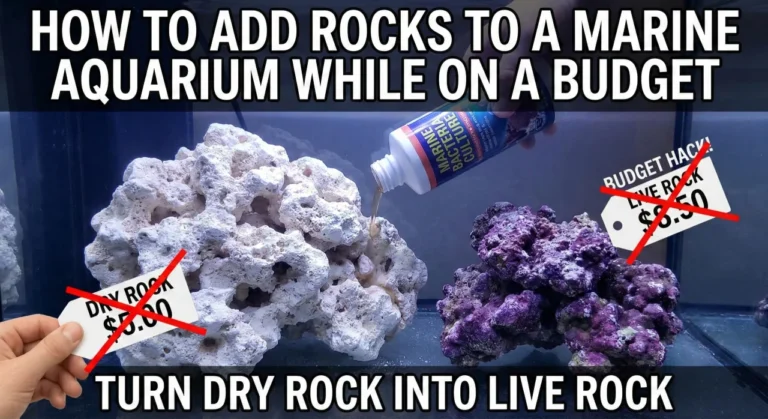
One of the easiest ways to stall your marine aquarium’s cycle is by not curing your dry rock before adding it to your aquarium. If you don’t mind things taking a bit longer and you don’t have fish, this is fine. You will be in for a hands off experience. If you are eager to get going, however, this is going to slow things down a lot.
The whole situation sounds a bit stupid, right? I mean, dry rock is dry. How can there be dead organic matter on it? Sometimes, this is true. Rock taken from a terrestrial source, like a quarry, is completely dry. Specialist rocks like Reef Saver and Life Rock are pre-prepared and totally safe to use without any preparation.
On the other hand, if the rock was taken from water. It can contain a whole lot of decaying matter and the reason for that is pretty simple. Any rock that has been in water for a decent length of time will have played host to life.
When that rock is pulled out of the water, it isn’t cleaned off. It is just dried and left on a shelf waiting for someone to buy it. When that person buys it, it arrives to them in a box looking pretty damn clean. In some cases, it will be completely bright white. This is where the problems can start.
Dry Rock Stalled My Cycle With An Overload of Ammonia
It is natural to wonder what is the point in cleaning something that looks immaculate? Little realising that the rock might have been home to old, dried out, sponges, invertebrates, algae and, even, coral. As soon as you add that rock to the aquarium, it is going to get wet, it is going to get warm, and it is going to rot. This is where the problems start when cycling your new aquarium.

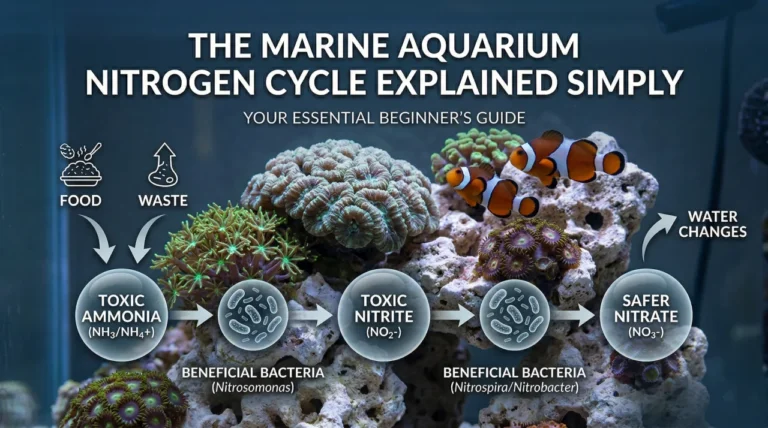
A typical cycling process involves you adding ammonia to your aquarium water to feed bacteria which will convert the ammonia to nitrite and begin reproducing (splitting). You can kick start things with some bottled bacteria to give yourself a boost or use something like live sand or live rock. I had chosen to go with live sand. Great, right? I had a source of bacteria, my rocks looked good; this shouldn’t take too long.
Boy did I not know what I was in for? I didn’t bother curing my dry rock. I figured the rock looked very clean so I could just give it a scrub and throw it in. Hell, if there was any die off, it would only help things along. Big mistake! Organic die off from the dry rock I had added to my tank quickly caused an overload of ammonia. Even without me adding any to the tank.
The die off on those rocks was legendary. I didn’t even need to test the water to know that ammonia was present. My living room stank for days! It was definitely not the best way to sell the benefits of adding a relaxing marine aquarium to our home, I can tell you that for sure. The abundance of ammonia in the water probably contributed to some die off in my live sand, too. Only worsening the problem.
A Very Long Wait!
I immediately decided not to add ammonia to the water. Knowing full well that this would slow things down even more. The precious bacteria I actually had in my aquarium was already working 24/7 to deal with everything that was rotting on the rocks. My cycle took a pretty long time and it was weeks before I saw ammonia dropping. If I was expecting a 2-3 week process, I was sorely mistaken. This took a couple of months.
The only plus point was that the entire process was very hands off. I didn’t need to add ammonia, I didn’t need to add food, I didn’t add any shrimp. The tank happily chugged along on its own, smelling pretty awful but, gradually, getting better. The ammonia levels stayed consistent until they randomly started to drop one day. It was around this time that I started to notice the presence of diatoms. Dusty, brown, patches of algae that appear as a fairly solid indicator that your cycle is going well.
I did manage to speed things up, as well, by adding a helping hand to my aquarium in the form of additional bottled bacteria. A trick that you can use too by clicking on the link. Bottled bacteria can the saviour for all kinds of different stalled cycle scenarios in marine aquariums. It helped me massively and I continued to use it on future cycles.
It Could Have Been Much Worse
The reason I wanted to bring this experience up was, not only, to illustrate how dry rock stalled my cycle with organic die off. But, also, to show how important it is to not start your cycle with fish. That’s the ultimate lesson when it comes to this situation as, in reality, the only thing this caused me was a bit more of a wait.
Loads of people recommend grabbing a couple of clownfish and cycling your marine aquarium using them to provide the ammonia. After all, clownfish are pretty tough. They should be able to tolerate the parameter shifts and ammonia issues.

In reality, a careless mistake like not curing your dry rock, beforehand, can lead to devastation. The ammonia levels in my aquarium would have been torture for any fish. Even something as tough and hardy as a clownfish. And that is with my aquarium having live sand that likes to boast that it instantly cycles your aquarium and bacteria that often makes similar claims.
It is very easy for these types of products to get overwhelmed by the amount of ammonia that can appear in brand new aquariums. Your tank will never be less capable of handling ammonia and more prone to problems than it is right at the start. It is a very unpredictable situation.
I was fine because I didn’t have any fish or residents. It was an inconvenience more than anything and something that makes me laugh all these years later. Nothing was harmed apart from my ego by, basically, tripping at the first hurdle. Other people, or their fish, may find themselves in a much worse situation purely from being careless.
How Can You Avoid This Situation?
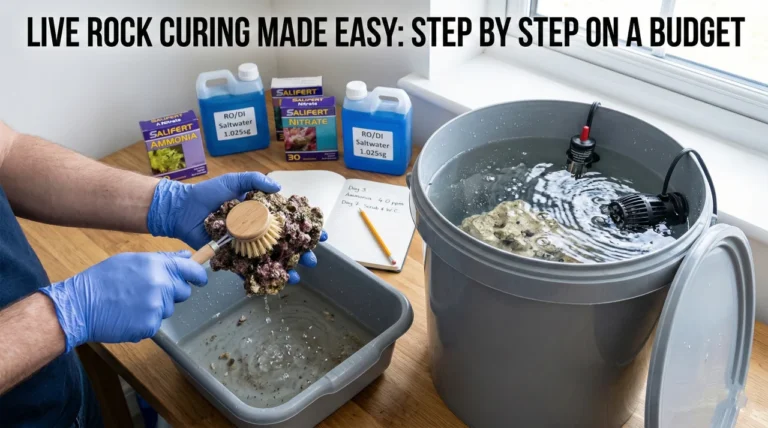
The simple solution to the problems caused if dry rock stalled your cycle would be to make sure you cure your dry rock before adding it to your aquarium. We tell you exactly how to do that in this article. Purchasing pre-prepared rocks like Life Rock and Reef Saver rock is another good alternative but they are very expensive.
If you have already added your dry rock and you are encountering organic die off in the same way I did. You are going to have to wait it out. Check out this article for some advice and get ready to purchase some bottled bacteria to give your aquarium a big time boost. Thanks for reading and spending your time at Simple Reefs.