
Mishap Monday: The Phantom Flow Fiasco
Welcome to Simple Reefs. We are a brand new website designed to take the stress and expense out of starting your very own marine aquarium. One of the most overlooked topics when it comes to this hobby is the importance of flow in a marine aquarium. Today, we are going to be talking about That Time Phantom Flow Made My Marine Aquarium a Complete Mess.
Table of Contents
The Story of a Messy Aquarium and Phantom Flow
We are going to be discussing flow a little over the next week, or so. It’s a massively underrated topic when it comes to marine aquariums. Having adequate and, above all, quality flow is one of the most crucial keys to keeping your coral healthy, your fish active, and your tank looking pristine. It’s that last little point that we are going to be talking about today.
All of my Mishaps Mondays articles are designed to help you learn from the mistakes that I, or people I know, made. After all, when it comes to the marine aquarium hobby, we all have slip ups and we all fall victim to some issues that we simply couldn’t predict or didn’t notice.
That doesn’t mean that some of the mishaps aren’t a little on the embarrassing side of life, though. Take today’s story, for instance. When I had realised what the problem was, I felt like, to put it bluntly, a dunce. I just couldn’t see how I hadn’t considered it and how I hadn’t noticed during my routine maintenance. First of all, let’s set the scene.
New Aquarium Equals New Equipment
Originally, I started my marine aquarium ownership journey with a 260 litre freshwater aquarium conversion. My father always kept fish and had recently passed away leaving a large, unused tank. I decided to do something I had wanted to do ever since I was first introduced to the simple majesty of the Skunk Cleaner Shrimp in my local fish shop. Yep, I got into marine fishkeeping to own cleaner shrimp, don’t judge me. We all have to start somewhere.
I started my first marine aquarium. Naturally, I made a few mistakes along the way but things were going fine. The only problem I had was an aquarium stand that was looking a little structurally unsound. And when I say unsound I mean simply brushing past it might result in its immediate collapse and the spilling of 200 plus litres of salt-water all over the floor.

I decided it was time to upgrade. Luckily, someone in my area was selling a Red Sea Reefer 425XL for a really reasonable price. I was about to own my first large marine aquarium complete with a sump. Pretty cool but that also meant I needed to upgrade a few things. The small wavemakers I had been using up until this point simply weren’t going to cut it in this larger tank. It was time to invest in some gyres.
Foolishly Frugal
Look, I won’t lie, I am pretty frugal when it comes to this hobby. I mean, that’s the entire reason why I made this website, to help other like-minded individuals be frugal too. With this in mind, I decided that a pair of expensive new gyres were not the best option for me. I was going to buy some broken gyres and repair them.
Long story short, that is exactly what I did. I purchased a Glamorca gyre and a larger Maxspect gyre that needed fixing, acquired the parts, and repaired them both. I saved an absolute ton of money and now had utterly ridiculous amounts of flow in my tank. Hell, I could have probably emptied the tank purely from the waves generated if I wanted to.

Obviously, I wasn’t going to do this. Instead, I set them up to create a nice dynamic series of waves in my tank that would adjust depending on the time of day. This took a bit of practice, of course. The sand-storm in the tank was the stuff of legends for awhile there but I finally got things nice and dialled in. We had no dead spots, the fish looked happy, and my coral gently swayed like the audience at a shoegaze concert.
And All Was Good… Until It Wasn’t
All was good with the aquarium and it stayed that way for a long time. Sure, the gyres needed a fair bit of maintenance. Cleaning was a regular task and these things chewed through rubber bushes in a way that would make a BMW blush but these parts were cheap and replacement was simple.
It wasn’t until a couple of years later that I started to notice a brown patch on my sand. “Hmm, seems a bit strange. Diatoms at this stage of the tank’s life?” I thought. “Better check my RO/DI filter”. Well, the filter was fine but I decided to do a full filtration media change anyway, just to be sure. Maybe some silicates were being leached into the water through my water supply.
Fast forward a few months and the problem isn’t fixed. In fact, it is getting worse. The entire front of my tank is starting to look like it is dusted with chocolate powder. Time to resort to more drastic measures! Out comes the sand vacuum and turkey baster, up goes the number of water changes.
Every week, I spent hours removing this brown crap from the sand and blowing it away. Every time, every single time, it would return within a few days. I just couldn’t understand it. I stirred up the sand as much as possible to get stuff suspended and kept changing water, just in case. I was completely running out of ideas.
Even More Drastic Measures
I decided it was time to up my bacteria count. Let’s grab some Dr Tim’s One and Only and start a dosing routine. Maybe we can outcompete whatever this is. A couple of bottles and another few months later and my situation is no better. I am almost out of ideas.

We are heading off to a cabin for a weekend getaway with a friend so I decided that this was my chance to really turn things up a notch. Let’s go full black out and try and kill whatever the hell this is for good. I turned all the lights off, taped up the glass to black out the tank, and kept my curtains shut for days on end.
When I got back and fired the lights back up, to my dismay, there was virtually no improvement. It was at this point that I started to really feel defeated. Nothing I was doing was helping and I couldn’t understand why.
Hell, I have beaten the dreaded tank ender Dinoflagellates in multiple tanks but never encountered anything like this. Was it a strange type of cyanobacteria? Was it a more stubborn form of Dino? What was going on…. That was when I noticed something.
Phantom Flow
Remember those gyres I talked about? Well, looking at the tank, completely lost for ideas, I suddenly noticed something. Why the hell are those mushroom coral so damn extended? That’s when it dawned on me.. Nothing in the tank was moving. Kenya tree, completely static like it was made out of actual wood. Toadstool, stubbornly resisting the slight flow caused by my return pump. Fish, casually gliding around the water effortlessly like manta rays.
Something was seriously wrong! Everything should be moving and the fish should actually be having to make at least some effort to not be pushed around. What was going on? I have two gyres in there. It was at that moment that I decided to put my hands into the water and see what was going on. What do you know? Both of the gyres had completely failed.
There was the slightest, most insignificant, ripple of water coming from one and nothing from the other. What had happened? I mean, I could hear the Glamorca gyre all the time. It was pretty noisy to be honest…. Or could I? No, I couldn’t. I had just gotten so used to tuning the sound of it out of my head when in the room that I hadn’t noticed that it wasn’t making any sound at all.
My Tank Didn’t Have Enough Flow Causing Detritus to Settle
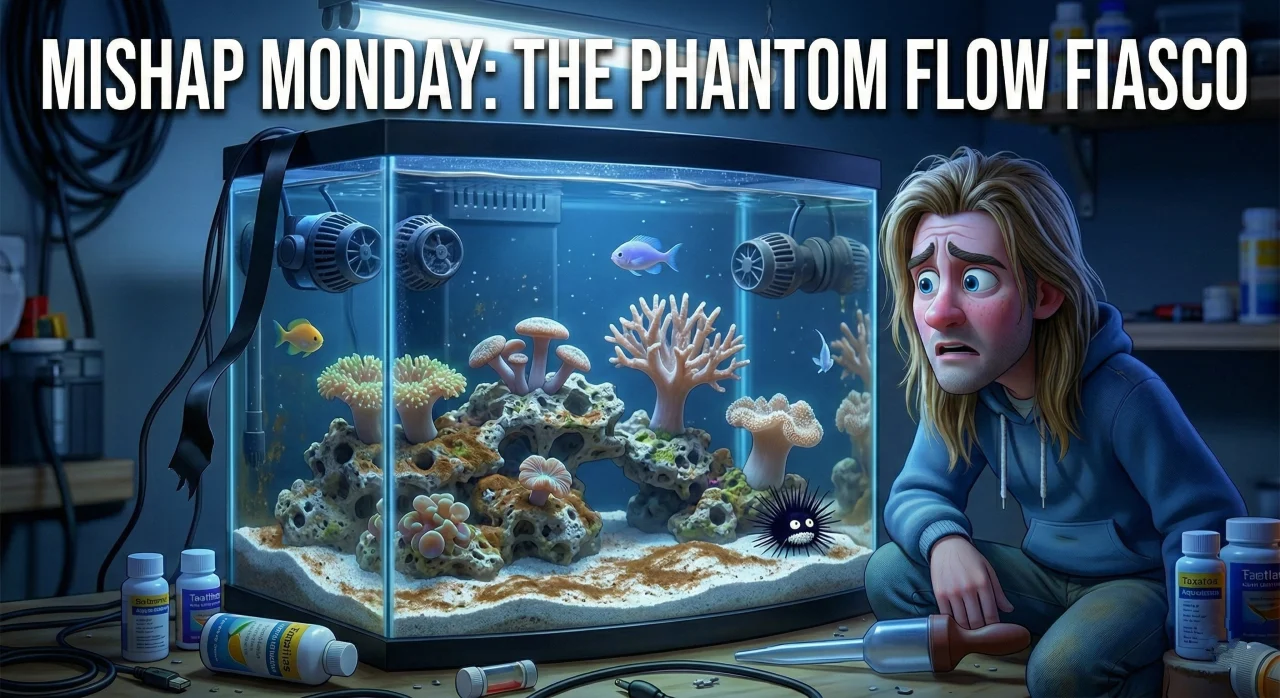
It was that simple. My gyres had stopped working which meant that my aquarium barely had any flow. This resulted in massive dead spots, basically, all along the front and back of my tank. When food was uneaten or when the fish crapped, much of it simply settled onto the sand bed.
All of that brown crap that looked like diatoms was rotting food and waste. Ordinarily, the flow would keep all of this stuff suspended in the water column. The waste would head down into the sump and be trapped in the filter socks or removed by the protein skimmer. It would never find its way back into my tank.

Wavemakers and gyres do a fantastic job of keeping your aquarium’s surfaces detritus free. Anything that does settle eventually gets blown into the water and taken away by your mechanical filtration. With my tank not having enough flow, or in this case Phantom Flow because I thought my gyres were working, this process couldn’t take place. But how is this possible?
How Didn’t I Notice That My Gyres Weren’t Working?
It seems ridiculous, right? How could I completely miss that both of my gyres weren’t working. Well, there are a few simple reasons for that.
- I always put them on feed mode when I fed the tank.
- I turned them off when cleaning the tank.
- I was still maintaining and cleaning them.
- Simple lack of awareness.
Everything that might automatically hint to me that there was a problem didn’t actually take place. For example, if I fed my tank with my gyres running, food would blow all over the place. Instead, I use the feed mode on my gyres so they switch off for a period of time, allowing my fish to eat in peace.
So what about when cleaning the tank or doing maintenance? Surely I would have felt the flow in the tank? Well, again, I would straight up switch them off when cleaning so that I didn’t create a sand storm. I was still taking the gyres out and cleaning them. I even replaced the bushes in one of them. How did I not notice?
A Simple Lack Of Awareness
The simple truth of the matter is that it was, pretty much, lack of awareness on my part. I have been extremely busy for quite awhile. A lot of my free time has been devoted to car work or home maintenance and I have had less time to sit and enjoy my aquariums. I have been looking after them as normal but not sitting and watching them, as much.
It can get to the point where your tanks are just “there” and you just expect them to keep on going. The truth is, however, every now and then you really need to check all of your equipment and make sure everything is working as it should.
It was unlucky that both my gyres failed. One seems like it needs a new motor, the other needed some other repairs so I am back to having one, albeit noisy, gyre. I added another large wavemaker at the back of my tank to make my flow more dynamic and we are now back in business.
In Short
The mess at the bottom of my tank cleared up within an hour. A quick clean of my filter socks and we have a beautiful white sand-bed again. Lesson learned. I need to make sure I actually look at my tank through a more critical lens. Flow is incredibly important to a marine aquarium and the lack of it can lead to much more than simply an ugly sand-bed. Thanks for reading and spending your time at Simple Reefs.