
How to Add Rocks to a Marine Aquarium While on a Budget – A Simple Solution
Welcome to Simple Reefs. Today’s article focuses on the ultimate budget hack that’s going to save you tons of money: How to Add Rocks to a Marine Aquarium While on a Budget. If you want a stunning rockscape in your marine aquarium but you simply can’t afford to pay the extortionate prices fish stores demand, this is exactly what you need to do.
Table of Contents
Key Takeaways
- The Budget Solution: You don’t need to buy expensive live rock. You can build your entire aquascape using cheap, dead “Dry Rock” for a fraction of the cost.
- The “Seeding” Process: By introducing a single piece of live rock or a bottle of marine bacteria to the tank, your dead dry rock will naturally transform into fully functioning live rock over time.
- The “Ugly Phase” Trade-off: Because dry rock starts as a sterile wasteland, it will go through a temporary phase of heavy, ugly algae growth before the beneficial bacteria takes over. Be patient!
This article solves the biggest financial hurdle of starting a saltwater tank – “How do I aquascape without spending a fortune?”. The process detailed here is the ultimate budget hack for new hobbyists. We will show you exactly how to bypass crazy fish store markups, avoid dangerous hitchhikers, and transform cheap, sterile stone into a thriving biological filter.
The Problem with Buying Live Rock
So you have decided to put together your very own marine aquarium, and you want a nice rockscape to serve as your biological filter and coral foundation. But when you headed down to your local fish shop to price things up, you got a nasty shock.
Live rock is incredibly expensive, ranging anywhere from £15 to over £25 per kilo. We talked all about the price of live rock in this article. Because harvesting rock directly from the ocean is largely banned, it has to be cultivated in vats for years, driving the price sky-high.

That presents us with a massive problem when building a budget marine aquarium. Even the smallest nano tanks need a fair amount of rock. For example, my 52-litre Fluval Evo holds about 6kg of rock.
Doing some quick math, that adds up to some serious money if I was to go to my local fish supplier and buy a bunch of cultivate live rock to populate it. If I had a larger 200-litre tank requiring 20kg of rock, buying real live rock would cost me over £500 just for the stones!
That’s ridiculous and not at all budget friendly. So what is the solution?
| Rock Type | Average Cost (Per Kilo) | Pest Risk | Aesthetic |
|---|---|---|---|
| 🪨 Live Rock | £15 – £25+ | High | Deep purples/reds, heavily encrusted. |
| 💜 Life Rock (Painted) | £10 – £15 | Zero | Painted purple to look instantly mature. |
| 🦴 Dry Rock | £2 – £8 | Zero | Stark white, requires patience to color up. |
The Solution: We Make Our Own Live Rock
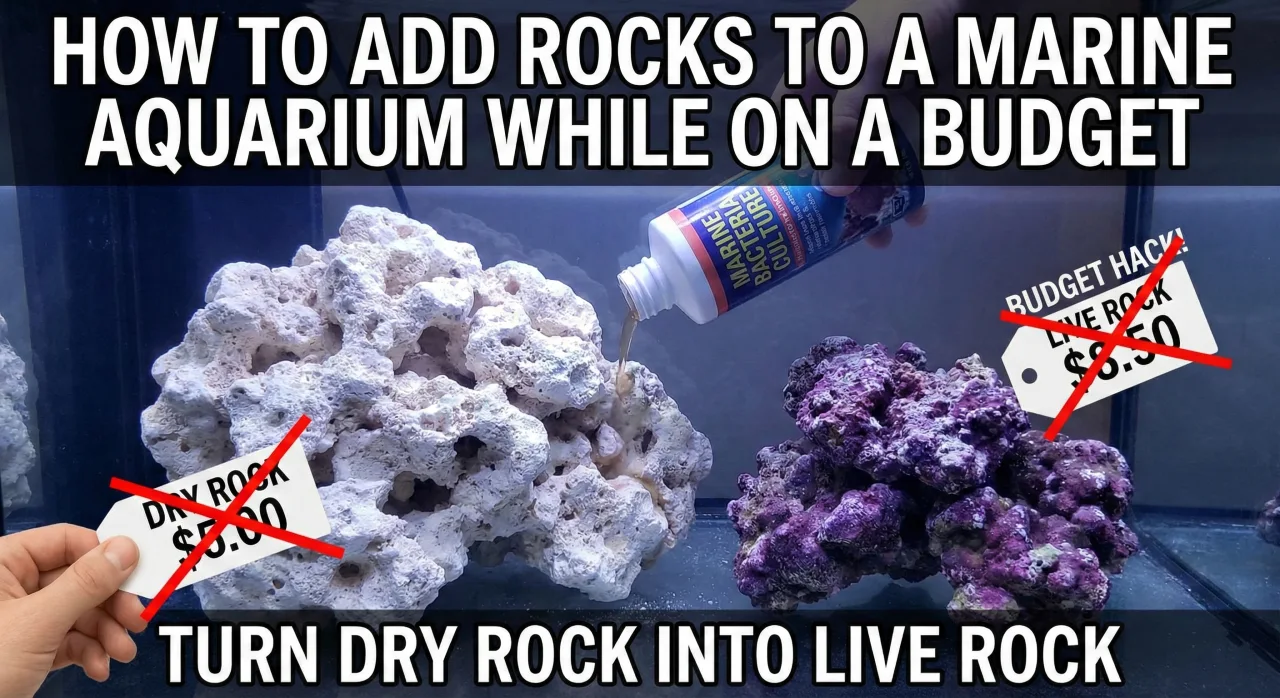
Quite simply, we make our own live rock. No, we don’t go diving into the ocean to hack away at a reef. We are simply going to take bone-dry, completely dead “Dry Rock” and transform it into live rock inside our own aquarium.

Dry rock is incredibly cheap in comparison to live rock. Large boxes can be purchased for a small percentage of the cost of biologically active equivalents.
In fact, if you calculate the price per kilo, dry rock often falls as low as 10% of the equivalent cost of live rock. That £500 live rock aquascape we mentioned earlier? You can build the exact same structure using dry rock for about £65.
Creating your live rock this way not only saves you hundreds of pounds, but it completely eliminates the possibility of introducing nasty hitchhikers (like the dreaded glass anemone, Aiptasia, or predatory crabs) into your new tank.
How to Turn Dry Rock Into Live Rock
Dry rock, in its base form, is a barren, sterile wasteland. It contains no bacteria, no algae, and no microfauna. To turn it into “Live Rock,” we just have to introduce life to it.
💡 The Hybrid “Seeding” Method
You don’t need magic to make rock live. You just need to “seed” it. Follow these three steps:
- Build your scape: Construct your entire rockscape using cheap, white dry rock.
- Add the “Seed”: Purchase one single, small piece of high-quality Live Rock from a trusted local fish store or fellow hobbyist. Alternatively, use a high-quality bottle of marine nitrifying bacteria (like FritzZyme TurboStart).
- Wait: The bacteria, microscopic copepods, and coralline algae spores on that single piece of live rock will naturally multiply and spread across your entire sterile dry rock structure.
We can do this one of a number of ways; we can use bottled bacteria, a piece of live rock or some rubble from an existing tank, or with live sand. We introduce this bacteria to the dry rock, they make friends, and the dry rock becomes live.
Over a few months, your dry rock will become completely populated by millions of bacteria that reproduce on its surface. These bacteria form your biological filter, consuming toxic fish waste (ammonia) and keeping your tank safe. Eventually, these bacteria will be joined by beneficial invertebrates, sponges, and purple coralline algae. Just like that, your dry rock is now live rock!
For a deeper dive into the actual chemical process, check out our dedicated guide on Turning Dry Rock Into Live Rock.
The Trade-off: Beware “The Ugly Phase”
As with most things in marine aquarium ownership, saving money comes with a trade-off. Because dry rock starts as a sterile, bright white canvas, it becomes a free-for-all battle royale for literally any organism that wants to populate it.
The problem is that ugly nuisance algae populates surfaces much faster than beneficial bacteria or pretty purple coralline algae does. Meaning that for the first few months, your pristine white rocks are going to look terrible.

You will quickly become familiar with brown, dusty Diatoms and thick green Hair Algae. After a couple of months, there is a strong chance your rocks will look like they are growing a terrible green toupee.
My Tuxedo Urchins, that were added to deal with this mess, decided they would prefer to fashion gorgeous flowing wigs out of it. They looked dazzling but my algae problem was still very much present.
⚠️ Warning: Do Not Panic (It Will Pass)
This period of rampant algae growth is affectionately known in the hobby as “The Uglies”. It is a completely natural, unavoidable part of starting a tank with dry rock.
Do not panic and do not pour chemical algae-killers into your tank! Chemicals designed to kill cyanobacteria or hair algae can destroy your developing bacterial filter, setting your cycle back by months. Stay patient, keep up with routine water changes, and let the ecosystem balance itself out. Usually, around the 6-month mark, the ugly algae dies off and is replaced by beautiful purple coralline.
In Short…
To summarise, the most affordable way to aquascape a new marine aquarium is to build your structure using 100% Dry Rock. By adding a single “seed” piece of real live rock, or a bottle of marine bacteria, you can naturally transform that cheap dead stone into premium live rock over time.
Yes, you will have to endure a few months of “The Ugly Phase” as algae battles for dominance, but that temporary visual annoyance is absolutely worth saving hundreds of pounds and keeping dangerous ocean pests out of your new reef! If you are ready to do just that, let’s move on to our series of articles on turning dry rock into live rock. Thanks for reading!
Frequently Asked Questions
How much money can I save using dry rock?
Real live rock generally costs between £15 to £25 per kilo. Dry rock usually costs between £2 and £8 per kilo. If you need 20kg of rock for a medium-sized tank, using dry rock will save you roughly £300 to £400.
How long does it take for dry rock to become live rock?
Biologically, dry rock will grow enough nitrifying bacteria to process ammonia (completing your cycle) in about 3 to 6 weeks if properly seeded. However, for the rock to look physically “mature” and be covered in pink and purple coralline algae, it usually takes 6 to 12 months.
Should I use CaribSea Life Rock instead?
Life Rock is essentially dry rock that has been painted purple to look like mature live rock, and is coated in dormant bacteria. It allows you to skip the stark-white look of dry rock, but it usually costs double the price of standard dry rock and will still go through an “Ugly Phase” of algae growth.