
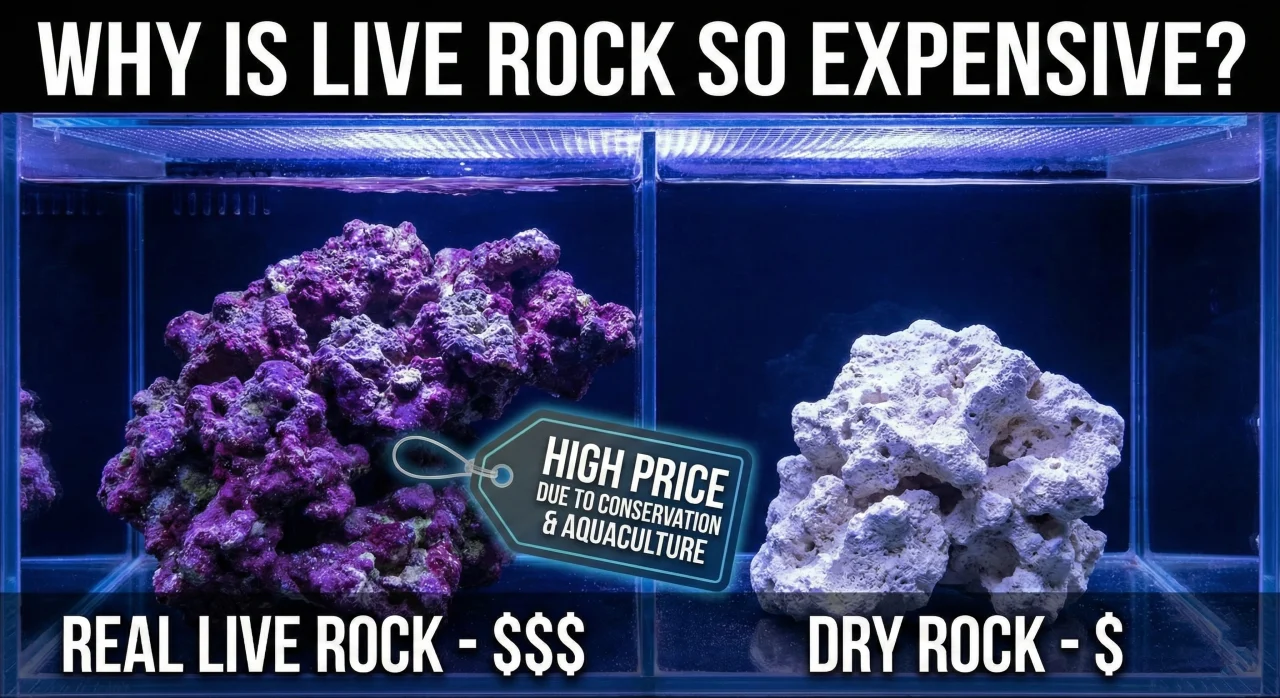
Why is Live Rock So Expensive? Answering a very important question!
Welcome to Simple Reefs. As part of our series on starting your own marine aquarium, we have been talking about the differences between Live Rock, Dry Rock, and Life Rock. We highlighted the massive biological benefits of live rock, but we also briefly touched on the elephant in the room: the price. Which begs the question… Why is Live Rock so expensive?
Table of Contents
Key Takeaways
- Conservation bans: Harvesting real rock from wild coral reefs is heavily restricted or entirely banned globally to protect the oceans.
- Aquaculture takes years: Fish stores and farmers now have to artificially “grow” live rock in vats, which takes years of expensive maintenance, driving prices sky-high.
- Beware the scam: Because of the high profit margins, some shady stores sell basic, wet dry-rock as premium “Live Rock”.
- The budget fix: You don’t need to fill your whole tank with it. Buy one small, high-quality piece to “seed” a tank full of cheap dry rock or make your dry rock live using bottled bacteria or live sand.
Quick Answer: Live rock is so expensive because harvesting it directly from natural ocean reefs has been banned to protect the environment. Today, live rock must be man-made (aquacultured) in large vats or ocean farms. It takes 2 to 3 years of maintenance, feeding, and water changes to grow the necessary bacteria, algae, and microfauna, resulting in massive overhead costs that are passed on to the buyer.
Why Is Live Rock So Expensive? The Real Reason Why It Costs So Much
Let’s imagine a scenario. You are taking the plunge and starting your own saltwater tank. You head to your local fish store to pick up a few pieces of rock to seed your tank for that all important cycling process.
You approach the saltwater section, look at the vat, and notice a sign that says: “Live Rock, £17 – £25 Per Kilo”.
You just about pass out. The smallest piece in there might weigh three kilos. That’s £50 for a single rock. What on earth is going on?
It’s quite simple, and the reason might actually make you feel a little better about dishing out the extra cash: It’s down to ocean conservation.
Live Rock Is Expensive to Preserve Ocean Habitat
Decades ago, Live Rock was actively dynamited and harvested directly from wild ocean reefs. It was both cheap and plentiful. Naturally, this came at a devastating cost to the health of the ocean. Reefs take millennia to form, and replacing harvested rock is not a quick task.
Thankfully, attitudes have changed, and reef preservation is now a global priority. Harvesting wild rock is heavily restricted, meaning you rarely see true, ocean-harvested rock in fish shops anymore.

That means fish shops and commercial farmers now have to essentially “manufacture” their own live rock. They take cheap Dry Rock, place it into massive holding vats with established rock, saltwater, and lighting, and wait…. and wait… and wait.
The problem? It takes a hell of a long time. For a piece of dry rock to become properly “live” with an extensive collection of beneficial bacteria, coralline algae, sponges, and invertebrates, you are looking at 1 to 3 years.
Housing rock in heated, filtered, lighted saltwater for years costs a massive amount of money in electricity, salt, and labor. Fish shops just don’t see the profit in it anymore, so the price of aquaculture is passed directly to the consumer.
Shady LFS Practices: The “Fake” Live Rock Scam
Even worse than the huge price is the fact that a lot of live rock sold at local fish shops (LFS) isn’t truly live at all. Because of the massive markup on live rock, some stores employ incredibly shady practices.
They will take a box of cheap, bright white Dry Rock, throw it into a dark sump out the back of the shop for three weeks, and then move it into the display tank labeled as “Premium Live Rock”.
⚠️ Warning: The Danger of “Fake” Live Rock
Sure, rock that has been in the water for a few weeks isn’t entirely “dead”, but it certainly won’t feature the rich menagerie of bacteria, coralline algae, and micro-invertebrates you are paying £20 a kilo for. In fact, if you buy this un-cured rock, it may release silicates into your tank, fueling massive blooms of brown Diatom algae. You will be paying premium prices for rocks that will actively make your tank dirtier.
You take this rock home, throw it into your tank, and it adds almost nothing to your biological profile. It’s almost as dead as the rocks you just pulled out of a cardboard box delivered from Amazon.
Disappointingly, many fish shops are in it purely for the money. Most inexperienced hobbyists don’t know the difference between a mature piece of rock and a wet piece of dry rock and they are all too keen to take advantage of that. So, how do you protect yourself?
How to Spot True Live Rock vs. Fake Live Rock
| Feature | True, Mature Live Rock | Fake Live Rock (Wet Dry-Rock) |
|---|---|---|
| Color | Deep purples, pinks, and dark reds (Coralline algae). | Bright white, stark grey, or covered in brown dust. |
| Smell | Smells fresh, like the ocean at low tide. | Smells like rotten eggs or sulfur (die-off), or smells like nothing. |
| Life Signs | Visible tiny tube worms, sponges, or small copepods scurrying. | Completely barren. Nothing moves on or inside the rock. |
| Texture | Smooth in patches due to encrusting algae, but highly porous. | Rough, chalky, and flakes off easily when touched. |
How to Beat the Prices: What Can I Do?
If you are building a marine aquarium on a budget, it is completely uneconomical to create your entire aquascape using £20/kg live rock. Here is how you bypass the fish store markups and save yourself a ton of money.
1. Turn to the Hobby Community
The simplest answer is to look locally. Tons of people are more than willing to help newcomers to the marine fishkeeping hobby. Check local Facebook Reefing Groups or forums like Reef2Reef.
There will almost certainly be an experienced reefer taking down a tank or clearing out their sump who is willing to sell you highly mature, beautiful live rock for £5 a kilo, or even give you a starter piece for free! You might be surprised at just how generous and helpful the reefing community is.
2. The Hybrid “Seeding” Method

If buying locally is out of the question, use the hybrid method. Build 90% of your aquascape using highly affordable Dry Rock. Then, go to the fish shop and purchase the smallest, highest-quality piece of true Live Rock you can find.
Place this single “seed” rock right in the middle of your dry rocks. Be patient. Over the coming months, the bacteria, coralline algae, and microfauna will reproduce and spread from that single live rock out across your entire dry rock structure, eventually turning your whole tank into a burgeoning ecosystem.
💡 Tip: The Sump “Rubble” Hack
One of the cheapest and most effective ways to seed a brand new tank is to ask a local reefing veteran for a handful of “rubble” (small, broken pieces of live rock) from their sump.
Because this rubble has been sitting in an established system for years, it is absolutely teeming with beneficial bacteria, copepods, amphipods, and miniature feather dusters. Better yet, hobbyists will often give you a bag of sump rubble for free or for the price of a pint!
Just toss it into your own sump or hide it behind your main dry rock structure, and watch the biodiversity spread to your dead rock.
We have an entire guide on how to turn dry rock into live rock so check it out. You don’t even need a piece of live rock to do it, you can do it using bottled bacteria or even live sand.
💡 Next Step: DIY Your Live Rock
Ready to save a fortune? Jump into our next guide: Live Rock On A Budget – How to Build an Affordable Rock Scape, where we walk you through exactly how to execute the hybrid method safely.
Frequently Asked Questions
Why is ocean live rock illegal to harvest?
Live rock is the foundational skeleton of coral reefs. Removing it destroys the habitat for thousands of marine species and contributes to coastal erosion. Most countries have strictly banned wild harvesting to protect these delicate and declining ecosystems.
Is man-made aquacultured rock as good as ocean rock?
Yes! Aquacultured rock (dry rock left in the ocean or specialized vats to mature) is fantastic. It develops the exact same beneficial bacteria and coralline algae as wild rock, but with a significantly lower risk of introducing devastating ocean pests like Mantis Shrimp.
Can I just use dry rock and bottled bacteria?
Absolutely. Starting a tank with 100% dry rock and a high-quality bottle of nitrifying bacteria is the most popular, pest-free, and budget-friendly way to start a modern reef tank. It just takes a few months longer to look fully mature.
In Short
Buy one high-quality live rock piece to seed your dry rock, use bottled bacteria if needed, and don’t hesitate to ask fellow hobbyists for help. With a little patience, you can safely build a thriving reef on a budget without overspending on live rock. Thanks for reading and happy reefing.