

10 Marine Aquarium Smart Upgrades for Beginners – Making Reefing Easier
Welcome to Simple Reefs. Today, we are taking a look at 10 Marine Aquarium Smart Upgrades for Beginners. In other words, the things you don’t absolutely need to start your marine aquarium journey, but are highly recommended to make your life easier.
Table of Contents
Key Takeaways
- Quality of life is key: The items on this list are designed to save you time, reduce maintenance headaches, and provide a more stable environment for your tank.
- Coral changes the rules: Things like expensive reef lighting and advanced wavemakers are entirely optional for fish-only tanks, but become mandatory if you want to grow coral.
- Protect your investment: A quarantine tank and a spare heater might seem like unneeded expenses on day one, but they act as vital insurance policies against complete tank crashes.
- Buy on your own schedule: Because these aren’t “Must Haves,” you can pace your budget. Start your tank now, and buy these upgrades months down the line when you can afford them.
This article is going to answer a very common question – “How can I make running my marine tank easier?” The items listed here are fantastic quality-of-life upgrades that will give you a better overall experience. Every item is ranked on our “Simple Scale”, giving it a value for Importance, Cost, and Convenience to help you prioritise your budget.
Building a Budget Reef – The Smart Upgrades
This article forms part of our series on getting started with your very own slice of the ocean without breaking the bank. If you missed my opening article on What Type of Marine Aquarium Should you Start?, you may want to give that a look to kick off your marine aquarium journey.
If you’re still building your foundation, start with the core reef tank essentials first. Those are the things we need to buy, or acquire, regardless of our 5 year plan. Without those things, you simply can’t start your saltwater journey.
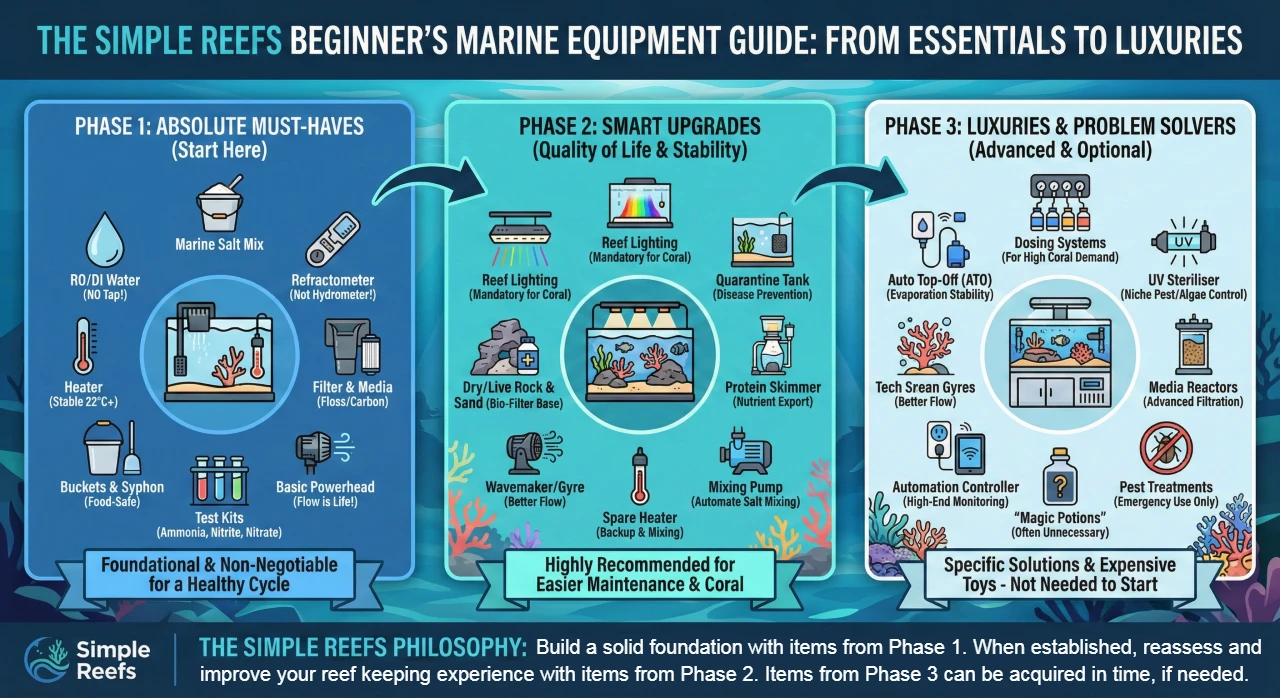
Today we are talking about something entirely less important. These “Smart Upgrades” are the things that you don’t strictly need to get water in your tank today, but they will certainly save you time, money, and stress if you do get them.
All of the items below are technically optional. I’ve weighed each item up by Importance, Cost, and Convenience to help you make an informed decision on how to spend your hard earned money.
The Smart Upgrades: Quick Shopping List
If you have the budget and want to make your reefing journey smoother right out of the gate, here is a quick overview of these smart upgrades.
| Upgrade Item | Why You Might Want It | Budget Recommendation |
|---|---|---|
| 🪨 Live/Dry Rock | Provides natural biological filtration and a place for coral. | Use dry rock to save a massive amount of money. |
| 🏖️ Sand Bed | Creates a natural look and houses beneficial bacteria. | Dry aragonite sand (skip the expensive “Live” sand). |
| 🫧 Protein Skimmer | Removes dissolved organic waste before it turns to nitrate. | A cheap nano-skimmer or a used HOB skimmer. |
| 🌊 Wavemaker/Gyre | Provides advanced, randomised water flow for corals. | A basic £30 controllable wavemaker from Amazon. |
| 🔌 Mixing Pump | Saves you from manually stirring saltwater for hours. | The absolute cheapest £5 submersible pump you can find. |
| 🌡️ Spare Heater | Crucial backup and used for heating newly mixed water. | A cheap 50w or 100w glass heater. |
| 💡 Reef Lighting | Mandatory if you want corals, brings out fish colors. | Basic LEDs for fish-only, budget “black box” LEDs for coral. |
| 🏥 Quarantine Tank | Prevents wiping out your display tank with diseases. | A cheap £10 food safe, plastic tub with a sponge filter. |
Deep Dive: The Smart Upgrades
All of the things listed here are optional. You can run a successful aquarium without these things, but your experience will likely be improved by accommodating for some, or all, of them somewhere down the line.
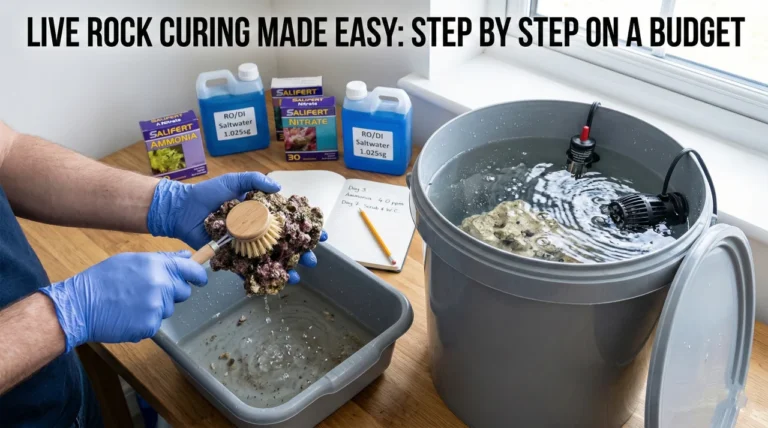
We are starting off with the most obvious thing – Live Rock. This is something most are going to want to include regardless but it is technically optional.
1. Live Rock
Live Rock can be an extremely important part of your marine aquarium ownership journey. It provides the foundation of a reef. Offering a home for small creatures to hide and reproduce, a place for bacteria to populate, a surface for algae to grow on, and somewhere for you to put all of that lovely coral you might want to buy.
The truth is, however, it is on the list of smart upgrades because not all tanks need it. We have put together a whole series of articles discussing Live Rock and I suggest you check them out.
- What’s the difference between Live Rock, Dry Rock, and Life Rock
- Do you really need Live Rock?
- What’s the most affordable live rock option?
💡 Budget Tip: Dry Rock is the Way Forward
Real “Live Rock” pulled from the ocean is incredibly expensive and often comes loaded with unwanted hitchhikers (like predatory crabs and bristle worms). Buying Dry Rock (quarried limestone) is a fraction of the price, 100% pest-free, and will eventually become “live” on its own once beneficial bacteria colonise it in your tank! Take a look at our guide to Dry Rock right here.
- 📊 Importance 7/10: Can be very beneficial but not essential for a basic fish-only setup.
- 💰 Cost 5/10: Can be expensive for premium options or quite affordable with dry rock.
- ⏱️ Convenience 6/10: Will make tank care easier and life in your tank more sustainable, but requires initial maintenance.
2. Epoxy or Cement
This totally depends on whether you are choosing to use rock and coral in your display. If you are planning a rock scape, a strong epoxy or suitable marine cement product is highly recommended.
You can’t just throw your rocks together in one elaborate structure and hope that they stay like that. They need to be bonded together and, even better, fixed with both rods and cement. There are lots of products that we can use for this and some are very affordable.
💰 Budget Tip: Companies like Aquaforest sell a cement that is mixed up with water and provides excellent value for money. I would only suggest using it when assembling your rock scape dry, however. It eats oxygen when used underwater and can cause major problems.
💡 Pro Tip: Build Your Aquascape Dry
Do not wait until your tank is full of water to start gluing your rocks together. Formulate your perfect reef structure while everything is completely dry. It is vastly easier and saves a massive headache. I was forced to restructure my entire 425 litre aquarium thanks to a plague of mushroom coral and it was, to put it bluntly, a nightmare.
- The Cardboard Trick: Cut a piece of cardboard to the exact internal footprint of your tank. Build your rock structure on this template on your living room floor so you know it will fit perfectly once transferred.
- Leave Room for the Scraper: Building dry makes it easy to ensure you leave at least two inches of space between the rocks and the glass so you can easily clean algae off later.
- Gravity is Unforgiving: Marine cement and epoxy are incredibly messy and hard to work with underwater. Building dry allows you to create gravity-defying caves and arches, letting the cement fully cure before you lift the finished structure into the empty tank.
- The Glue and Epoxy Trick: Add a blob of reef safe super glue to your ball of epoxy on each side it contacts. It will help hold the structure while the epoxy dries.
- 📊 Importance 10/10: If you have rock, you need to fix it together to prevent rockslides.
- 💰 Cost 4/10: Quite affordable with certain options.
- ⏱️ Convenience 9/10: You don’t want your rocks falling over and smashing your glass, do you?
3. Sand

This is entirely optional. Some people love having a sand bed in their aquarium, others absolutely hate the extra maintenance it requires. It can also cause some problems with regards to water flow and additional algae growth.
Personal preference is a big factor here. Do you want your aquarium to look like the sea bed, or are you happy to have a tank with a bare bottom?
We have gone over the pros and cons of a sand bed in this article, so definitely take a look at that before making your decision. It’s worth keeping in mind that starting your aquarium with something called Live Sand can slightly speed up your cycling process and have your aquarium ready for residents much quicker.
We have explained what live sand is in this article, so take a look at that if you are interested. Keep in mind, however, that it is a premium option and costs a lot of money.
💰 Budget Tip: Use Dry Sand and make it live using bottled bacteria. It would be worth looking at our article on Dry Sand and how it can save you money if you would like a sand bed but are on a budget.
- 📊 Importance 6/10: Totally optional but can be very visually appealing.
- 💰 Cost 6/10: Can be expensive for premium live sand or deep sand beds.
- ⏱️ Convenience 3/10: Needs maintenance, blows around, can be a lot of work to keep clean.
4. A Protein Skimmer
A protein skimmer can be an important part of your marine aquarium and it is something you will definitely want to carefully consider. Protein skimmers are one of those things that separate marine aquarium keeping from fresh water, as the process is much more common in marine setups.
When your fish poop, or when food rots, a lot of the waste dissolves into the water column. Obviously, we don’t want that dissolved crap staying there. It will make our water dirty and pollute it. We have to remove it, and luckily, a protein skimmer is a fantastic way to do that.
The great thing is, Protein Skimmers are available to accommodate any kind of aquarium. Fresh water conversions, AIO, tanks with sumps… There is a protein skimmer for every application and we cover them extensively on Simple Reefs.
💡 Do You Really Need One?
If you are running a small nano tank (under 30 gallons) with just a couple of small fish, a protein skimmer is overkill. Regular 10% weekly water changes will easily export those nutrients. However, as your tank gets larger or you add more fish, a skimmer becomes a massive time-saver and water quality booster.
We have put together a series of articles on protein skimmers, so feel free to click the links below to get informed on just what they are, how they work, and what the benefits are:
💰 Budget Tip: Second hand marketplaces can be a goldmine for decent protein skimmers at great prices. People are always upgrading so there is a constant flow of used equipment. I purchased a used protein skimmer that is still going strong now after many years.
- 📊 Importance 6/10: Depends heavily on livestock levels, coral, and frequency of water changes.
- 💰 Cost 6/10: Can be expensive for larger tanks, but cheap HOB options are available.
- ⏱️ Convenience 5/10: Vastly improves water quality, but the collection cup needs emptying and cleaning often.
5. A Wavemaker or Gyre
Again, this is all down to personal preference but there are some significant benefits to having a wavemaker or a gyre. A wavemaker is basically a small device designed to push water around your tank, creating what is known as flow. A gyre does the same thing, only at a much greater level.

Flow is incredibly important in a marine aquarium, particularly a reef; we talk about it in this article here. In freshwater keeping, flow is less important. In marine aquariums, we are trying to replicate an ocean environment where powerful waves are present at all times.
Certain corals absolutely demand a decent amount of flow because they need it to bring food to them. Without flow, they will be unable to feed and will gradually die. Carefully placed wavemakers can also aid in keeping your aquarium clean by keeping detritus and food off of the rocks and sand, suspending them in the water column for removal by your filter.
💰 Budget Tip: Buy second hand. Sellers are constantly upgrading and changing equipment. Forums and eBay are a great place for used wavemakers. Just inspect them before adding to your tank. Look for broken cables and exposed wiring.
- 📊 Importance 6/10: Essential if owning coral. Smaller, fish-only tanks can survive on filter flow alone.
- 💰 Cost 5/10: Expensive programmable options available, but standard powerheads are very cheap.
- ⏱️ Convenience 7/10: Will improve coral health and prevent detritus from settling in dead spots.
6. A Pump For Mixing Salt
This is very simple and will make your life way easier. If you don’t fancy the idea of sitting over a bucket of water stirring salt with a wooden spoon for twenty minutes just for it to not completely dissolve, you are going to want a little powerhead. Any old cheap pump will do as long as it is submersible.
💰 Budget Tip: Just buy the cheapest powerhead you can find, £5-10 should be fine. Give it a clean every now and then to make sure it carries on working.
- 📊 Importance 2/10: You can use a spoon if you really want to.
- 💰 Cost 2/10: You can buy a cheap pump for less than £10.
- ⏱️ Convenience 10/10: You would have to be a masochist to use a wooden spoon when a pump does it for you.
7. A Spare Heater
A spare heater is useful to have as a backup and it can also be used to make your salt mixing process much, much easier. Almost all salt mixes better when you are adding it to heated water. Plus, you have the added benefit of a spare heater should your main tank’s heater fail – something which can be worryingly common.
💰 Budget Tip: A basic glass heater should do the trick, don’t worry about high wattage.
- 📊 Importance 6/10: Important to have a backup, particularly in cold climates.
- 💰 Cost 4/10: Very affordable insurance policy.
- ⏱️ Convenience 8/10: Makes mixing water easier and will save a major panic in an emergency.
8. Water Testing Kits (Beyond the Basics)
While basic kits (Ammonia, Nitrite, Nitrate) are Absolute Must-Haves for cycling, the advanced kits are optional extras. In fact, many are only needed by very advanced saltwater hobbyists.
You can get tests kits for practically everything: Calcium, Phosphate, Alkalinity, Magnesium. When asking for help on saltwater hobbyist forums like Reef2Reef, they may ask for some of the more advanced parameters to help diagnose your issue.

Do you absolutely have to have these advanced water testing kits? No. Most of these are only necessary when you are keeping more demanding types of stony coral.
Fish don’t give a toss about most of the elements that you can test for, and easier-to-keep soft corals don’t mind a great deal either.
💰 Budget Tip: Most fish shops will allow you to take a water sample in and have it tested their. Some may charge a small amount but it’s a much cheaper option that shelling out for a master test kit.
- 📊 Importance 5/10: Crucial for advanced reefs, but unnecessary for basic fish-only setups.
- 💰 Cost 6/10: Buying individual kits for every element gets expensive fast.
- ⏱️ Convenience 6/10: Having them at home saves a trip to the fish shop.
9. A Light
This is less of a necessity but, in some scenarios, a light isn’t exactly optional. For example, if you want to keep coral, you are going to need a reef-spec light. Simply using room lighting won’t be enough.
Soft coral might survive with decent room lighting, but they won’t thrive, and you certainly won’t see their stunning fluorescent colors.

If you just want to keep fish, then a light is completely optional. The fish don’t mind either way. Lights will definitely bring out the best colors of your fish, but you can achieve that with a very cheap £20 freshwater LED strip. When it comes to coral, however, it’s non-negotiable.
💰 Budget Tip: Chinese LED Black Boxes made by companies like Viparspectra. I have used these in the past and the coral absolutely loved them. They can be picked up second hand on eBay for around £50, will grow mostly anything, and every single thing about them can be replaced with DIY including the LEDs themselves.
💡 Budget Tip: The “Black Box” LED Hack
If you start researching reef lights, you will inevitably hear the term “Black Box” thrown around. But what exactly is it?
- What they are: Generic, budget-friendly LED fixtures (usually found on Amazon or eBay for under £100) that literally look like heavy, black metal bricks, hence the name.
- The Trade-off: They don’t have sleek designs, fancy smartphone apps, or complex weather simulations. You usually control the blue and white light channels using simple manual dials on the top.
- The Big Win: They grow coral exceptionally well. For a fraction of the cost of a high-end £400+ light, a black box delivers the raw power (PAR) and spectrum needed to keep almost any coral alive and thriving. If you don’t mind a slightly clunky-looking light hanging above your tank, it is the ultimate budget hack.
- 📊 Importance 10/10 (Coral) | 1/10 (Fish Only): Entirely dependent on what you want to keep.
- 💰 Cost 8/10: High-end reef lights can be ridiculously expensive, though budget options exist.
- ⏱️ Convenience 5/10: Built-in timers and app controls make modern lights very easy to manage.
10. A Quarantine Tank
I am fairly sure much of the marine fishkeeping community would string me up for putting this into the optional upgrades category. The truth of the matter is, however, Quarantine Tanks are not needed if you don’t keep fish, and smaller bodies of water with powerheads can suffice for quarantining coral.
⚠️ Warning: The Risk of Skipping Quarantine
A quarantine tank doesn’t need to be extravagant – simply a plastic tub, some PVC piping for hiding, a heater, and a basic filter. If you skip this step, you risk introducing devastating parasites (like Marine Ich or Velvet) directly into your main display, which can wipe out your entire fish population in days. A few quid and a bit of hassle is worth it to save hundreds of pounds and many precious lives.
A quarantine tank allows you to observe your newly purchased fish and pre-treat them for parasites before introducing them into the main display. We will be going into this in a future article, as quarantining isn’t bulletproof and comes with its own risks and complications.
⚠️ Warning: Beware the “Ich Magnets”
If you plan on keeping popular, brightly colored fish like Tangs (Surgeonfish) or certain Angelfish, a quarantine tank suddenly shifts from a “Smart Upgrade” to an absolute necessity.
- Thin Slime Coats: Fish like Tangs have incredibly thin natural slime coats, making them highly susceptible to deadly parasites like Marine Ich (White Spot) and Marine Velvet. They are notorious in the hobby as “ich magnets”, a term you will hear a lot.
- The Wipeout Risk: These parasites reproduce rapidly in the closed environment of an aquarium. Introducing one infected fish directly into your display tank can easily wipe out your entire healthy fish population in a matter of days.
- The Quarantine Shield: Placing new arrivals in a bare-bottom quarantine tank for a few weeks allows you to monitor them for white spots or heavy breathing, and safely treat them with copper medications before they ever touch your main display.
- 📊 Importance 10/10: The best insurance policy you can have for your livestock.
- 💰 Cost 3/10: Can be set up extremely cheaply with spare parts.
- ⏱️ Convenience 2/10: Running a second tank requires extra maintenance and space.
Frequently Asked Questions: Marine Upgrades
Do I need to buy reef lights right away?
Not at all! If you are planning a “5-Year Plan” where you start with fish and add corals later, you can use a cheap, basic LED light for the first year. Only upgrade to an expensive reef-spec light when you are actually ready to buy your first coral frag.
Can I add a protein skimmer later?
Yes. Many beginners start without a skimmer to save money and rely on weekly 10% water changes. Once your fish grow larger and produce more waste, or you decide to add demanding corals, you can easily install a Hang-On-Back (HOB) skimmer to help handle the bioload.
What is the difference between a wavemaker and a powerhead?
A standard powerhead simply blasts water in one continuous, straight direction. A wavemaker is usually connected to a controller that allows you to randomise the flow, pulse the water, or create a back-and-forth sweeping motion that mimics natural ocean currents (which corals love).
Those Are The Smart Upgrades
So those are all of the Smart Upgrades. You don’t strictly need any of these things to get water in your tank, but you might want to prioritize them because they will make your reefing life a whole lot easier and your ecosystem much more stable.
Beyond this stage, you enter the world of automation and advanced control systems which are the expensive luxury items that are completely down to personal preference and big budgets! Click the link to take a look at those and thanks for reading!