

A Beginner’s Guide to Must-Have Marine Aquarium Equipment – The Essentials
Welcome to Simple Reefs. We recently brought you A Practical Guide to Marine Aquarium Essentials and Where You Can Save Money. Today, we are elaborating on the most important part of that article –A Beginner’s Guide to Must-Have Marine Aquarium Equipment.
Table of Contents
Key Takeaways
- Tap water is toxic: Never use untreated tap water for a marine aquarium. Pure RO/DI water and proper marine salt are absolute non-negotiables for a healthy tank.
- Test, do not guess: You cannot run a saltwater tank blind. A refractometer to measure salinity and basic test kits (Ammonia, Nitrite, Nitrate) to monitor your initial cycle are mandatory.
- Start small but stable: A smaller All-In-One (AIO) tank or a second-hand freshwater conversion is the most budget-friendly way to start, provided you keep up with your weekly maintenance.
- Flow and heat are life: A reliable heater, a basic hang-on-back filter, and a cheap powerhead are essential to recreate the warm, moving ocean environment your fish and corals need.
This article is going to answer one simple but crucial question – what do you absolutely have to buy before starting your marine aquarium? We’ll cut through the confusion and look strictly at the non-negotiable essentials, ensuring you have the solid foundation needed to build a successful reef on a budget.
Building a Budget Reef – The Absolute Must Haves
There are a bunch of ways to make marine aquarium ownership a lot more simple and a lot more affordable. With that being said, there are a few things we can’t do without. Some of these things are going to sound pretty obvious but we will talk about them anyways.
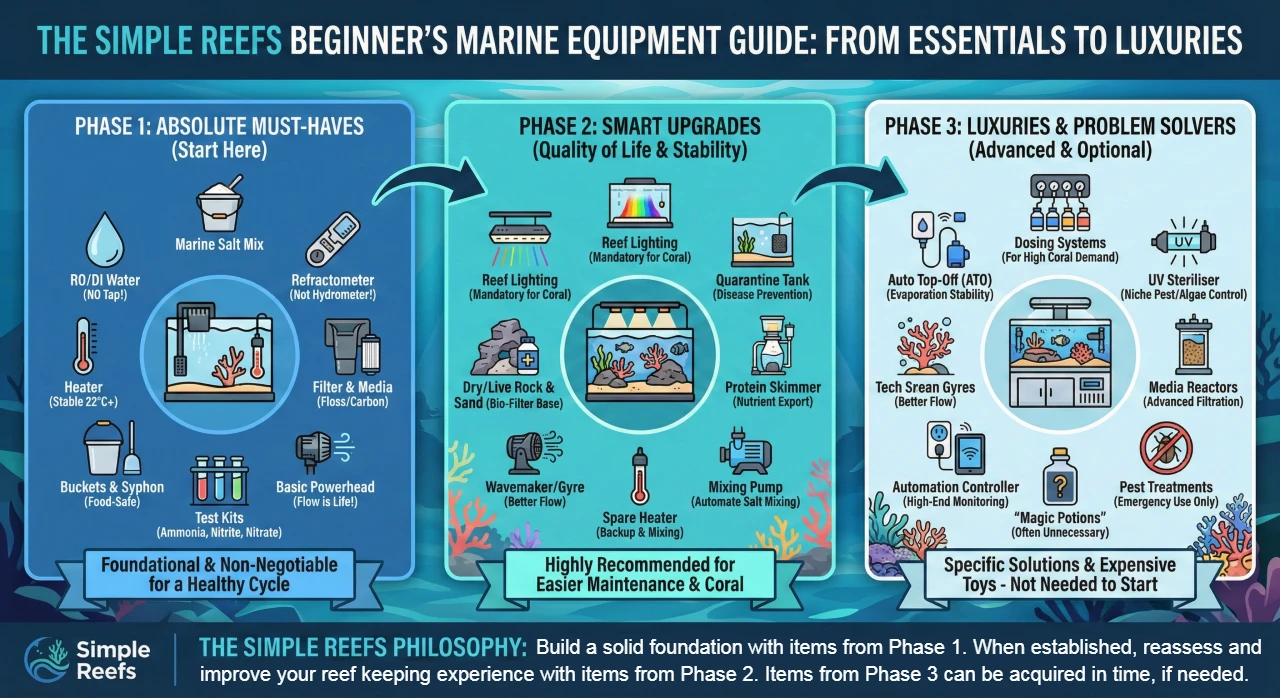
Needless to say, if it is on this list, we have to purchase it to get started, regardless of what the grand plan for our aquarium is… Make sure you have all of these before taking a single step forward on your marine aquarium journey. If you are missing anything, now is a great chance to run out and pick it up.
I should add, here, that we won’t be discussing live rock or sand in this article. They are still at least somewhat down to personal preference. Check out our article on whether you need live rock in a marine aquarium for more information.
The Absolute Essentials: Quick Shopping List
If you are heading to the fish store right now, here is a quick checklist of the exact items you absolutely must have to get your tank wet safely.
| Essential Item | Why You Need It | Budget Recommendation |
|---|---|---|
| 🪸 Aquarium | Houses your ecosystem | Second-hand tank or AIO (20–75 gallons) |
| 💧 RO/DI Water | Prevents toxic metal and algae issues | Buy pre-made from a local fish store initially |
| 🌊 Marine Salt | Creates the ocean environment | Buy a standard 25kg bulk box to save money |
| 🔬 Refractometer | Measures salinity accurately | £15 optical refractometer (skip cheap plastic hydrometers) |
| 🌡️ Heater | Maintains stable 22°C+ temperatures | £20–30 mid-range glass heater with a plastic guard |
| 🧹 Filter & Media | Removes waste and toxins | Cheap hang-on-back filter with filter floss and carbon |
| 🪣 Buckets & Syphon | For mixing salt and cleaning the tank | Food-safe home brewing buckets and a basic syphon |
| 🧪 Liquid Test Kits | Monitors the toxic “cycle” (Ammonia, Nitrite, Nitrate) | Salifert liquid drop kits (skip the paper strips) |
| 💨 Powerhead | Provides life-saving water flow and oxygen | A simple, basic £10–£15 wavemaker |
1. An Aquarium
Why Do We Need It: It’s obvious, right? This is where the fun begins.
No duh! Right? This is an obvious one but it is, also, one of the most important decisions that we can possibly make when it comes to building a budget reef. The options here range from brand new tanks that sit in the sub-£100 range right up to tanks that cost tens of thousands of pounds.

Aquariums designed specifically for creating your own reef for not a lot of money do exist. Just look at Fluval’s Marine range. It is, also, entirely possible to head on to eBay or Gumtree and purchase an old freshwater tank to use. I have done that myself, before. I picked up a couple of 60l freshwater aquariums for just £20 with stands from a guy on Gumtree – Awesome!
An important step here is to decide what size aquarium you would like. A larger tank is easier to maintain but harder to fix when things go wrong. It also brings along structural concerns as we go up in size.
🕵️♂️ Buying Second-Hand: What to Watch Out For
- Check the silicone seals: Look closely at the inner corners. The silicone should be smooth and fully intact. If it is peeling, bubbling, or cracking, the tank is a leak risk and will need resealing.
- Beware the “copper curse”: Ask the seller what the tank was used for. If they used copper-based medications for freshwater fish, those chemicals can absorb into the silicone and later leach out, which is fatal to marine invertebrates and corals.
- Inspect for deep scratches: Run your fingernail over any visible scratches. If your nail catches in it, it is a deep scratch that will be highly visible (and a magnet for stubborn algae) once the tank is filled and lit.
- The mandatory leak test: Never trust a dry tank. Always fill it to the brim outside, in a bathtub, or in a garage, and leave it for 24 to 48 hours before setting it up in your living room!
A large tank means a lot of water and that is something that certain floors won’t be all too happy with. A smaller tank is cheaper and easier to fix when encountering issues but more subject to swings in the parameters of the water. This is especially true where nutrients like Nitrates are concerned.
💰 Budget Tip: Our Recommendation
We are on a budget so, with that in mind, smaller will be better. A cheap AIO tank or a preowned freshwater tank would be the most economical option. For FO (Fish Only), let’s aim for between 20-50 gallons (approx. 75-190 litres). For FOWLR (Fish Only With Live Rock) or a reef, we can extend that range to 20-75 gallons (approx. 75-285 litres). Thanks to the small size we will get some benefits:
- We can maintain the tank easier
- Stocking with coral and fish will be cheaper
- Heating the tank will cost far less money
- We will spend less money on salt and water for the tank.
- It will be easier to filter it more effectively
Naturally, we will be going massively in depth on this subject in articles dedicated directly to it. For now, slap this one on the must list and lets move on.
2. Water
Why Do We Need It: It’s the starting point of any marine setup.
There are going to be a lot of obvious bullet points in the musts section, as you may have guessed. Water is the next thing we need, obviously. This is where we meet our first Marine Aquarium quirk.
Marine aquariums are not big fans of tap or well water. To be perfectly honest, that is a massive understatement. The various dissolved solids and chemicals in your average water supply will cause major problems in the long run.
⚠️ Warning: The Tap Water Trap
Using untreated tap water is the number one reason beginners quit this hobby in frustration. Here is exactly why it is disastrous for marine tanks:
- Toxic Chemicals: Tap water contains chlorine and chloramine to make it safe for us to drink, but it will instantly burn your fish’s gills and wipe out the beneficial bacteria keeping your tank alive.
- Lethal Heavy Metals: Trace amounts of copper from household pipes are harmless to humans but highly toxic to marine invertebrates, snails, and corals.
- Unlimited Algae Fuel: Tap water is packed with nitrates, phosphates, and silicates. Using it guarantees a never-ending nightmare of green hair algae, diatoms, and cyanobacteria. I know, I have been there and it was not pretty.
The Fix: Always use 0 TDS (Total Dissolved Solids) RO/DI water. It is non-negotiable.

Tap water contains a few things that play havoc with a marine aquarium.
- Chloramine and chlorine made to make tap water safe but which is toxic to marine life.
- Copper and other unwanted metals that can kill both fish and invertebrates.
- Silica that fuels the growth of unwanted algae like diatoms.
- Nitrate and Phosphate which will act like a superfood for things like hair algae.
The Solution – RO/DI Water
The reality is, you are going to want access to water treated with a reverse osmosis system. This is a type of filtration that, through a series of semi permeable filters, removes the dissolved solids from water. You can also add a further step which deionises the water too, making it as pure as possible. This water contains no nutrients or elements for algae to thrive off of and this will prevent myriad problems in the future.
💰 Budget Tip:
The good news is, we can do this on a budget and we will be going into the subject thoroughly in an upcoming article. There are cheap reverse osmosis systems you can buy that will have you purifying your own water in mere minutes. We can also grab perfectly pure water from most fish shops or even from automotive stores in the form of deionised water. There are plenty of affordable options.
3. Salt
Why Do We Need It: It’s absolutely essential to making our water suitable for marine life.

You knew this one was coming, right? We need salt to turn our freshwater into saltwater. When we refer to salt, we absolutely don’t mean table salt or other culinary salts. Salts for food have been harshly bleached, lack important elements, and are completely unsuitable for marine aquariums. We also don’t mean the fancy stuff you put in your bath to relax, either. We mean specific marine aquarium salt.
This is one of those unavoidable marine aquarium expenses that can seem a little ridiculous when compared to the costs of a freshwater tank. It’s one of those things that adds extra steps to every marine aquarium water change, as well.
💡 Pro Tip: Don’t Let Your Salt Turn Into a Brick!
Marine salt is highly hygroscopic, meaning it acts like an absolute sponge for moisture in the air. If left exposed, a £60 bucket of salt can quickly absorb humidity and turn into a solid, unusable block of concrete.
- Seal it tight: If your salt comes in a plastic bag inside a cardboard box, tightly roll the top of the bag down and secure it with a heavy-duty clip or zip tie after every single use. Ikea sell amazing bag clasps perfect for this task.
- Bucket discipline: If you buy a plastic bucket, make sure you press the lid down until it snaps completely shut all the way around. Prying it open next time is annoying, but it saves your salt.
- Location matters: Avoid storing your salt in damp garages, sheds, or right next to a humid aquarium sump. Keep it in a dry, room-temperature environment.
A number of companies produce marine salt, some are natural, some are synthetic. All will, in essence, do the job of turning fresh water into salt water. Fish shops often sell it pre-mixed as well but it comes at a premium. There are two types of salt to keep in mind:
- Basic salt for fish-only aquariums or aquariums with soft coral: It contains less added elements needed for coral skeleton growth and is often a lot cheaper.
- Reef salt for aquariums with stony coral: This type of salt is enriched with proprietary elements like Calcium and Magnesium. This makes it more suitable for advanced reefs with increased demands.
💰 Budget Tip: Our Recommendation
If we are sticking to the basics with our budget reef, we can start off with standard salt. To save the maximum amount of money, buy in bulk. Grab a huge box and it might even last you all year making it a once annual expense.
25kg boxes seem to be the sweet spot for saving the most money. If you later expand your aquarium to include stony coral, you can always switch to Reef salt later on. Take a look at our handy Salinity Calculator if you need help working out how much salt you need to add to your freshwater to reach a desired salinity.
4. A Refractometer
Why Do We Need It: Measuring salinity is a crucial part of maintaining stability in your marine aquarium.
A refractometer is a device used to measure the levels of dissolved substances in a liquid. It uses light refraction, i.e. the way light passes through water, to determine the concentration of, in this case, salt within the water. Creating a measurable number referred to as Specific Gravity.

Certain fish and coral prefer different levels of salinity. For a nice, happy, medium we tend to aim for a range between 1.025 – 1.026 SG (34PPT – 35PPT). This is the Goldilocks number, if you will.
Either way, your chosen salinity should correspond to a level preferred by the residents of your tank. You can read all about refractometers and the importance of testing salinity in this article right here.
⚠️ Warning: The Plastic Hydrometer Trap
It is incredibly tempting to buy a £5 plastic “swing-arm” hydrometer instead of a £15 optical refractometer. Do not do it. Here is why they are a false economy:
- Micro-Bubbles Lie: Tiny, almost invisible air bubbles love to stick to the plastic swing arm, making it float higher and giving you a falsely low salinity reading. You’ll end up adding more salt to compensate, which can be lethal to your tank.
- Salt Creep Ruins Accuracy: Over time, microscopic salt deposits build up on the hinge of the arm, changing its weight and making it permanently inaccurate.
- The Cost of Guessing: Thinking your water is at a perfect 1.025 when it is actually pushing 1.030 will heavily stress your fish and wipe out sensitive snails, crabs, and corals.
The Fix: Spend the extra £10 on a proper optical refractometer. It is the cheapest and most effective insurance policy you will ever buy for your reef.
💰 Budget Tip: Our Recommendation
As far as I am concerned, this is NOT optional. You really do need to be able to measure salinity as it is very prone to changes and swings over time. Very few coral will tolerate massive salinity swings. You want to keep things stable and a refractometer is essential to doing that.
The good news? They cost very little and can even be calibrated with deionised water. Grab a £15 refractometer from eBay or Amazon and literally never think about it ever again.
5. An Aquarium Heater
Why Do We Need It: It’s going to keep your water a good temperature and help maintain stability.

Again, I don’t consider this to be an optional item. Sure, you may live in Florida and it’s warm all the time. You may have a well heated house that never drops below 24 degrees. You may never ever need it, and that is great. But what about when you do? Take a look at our article on why you should always own a marine aquarium heater, even in warm houses, for more information.
There are virtually no marine fish, coral, or invertebrates in the consumer fish trade that are residents of cold water. The vast majority come from tropical climates and need water temperatures of 22 degree Celsius and above. In cold climates like the UK and northern Europe, a heater is essential. In warmer climates, it is a very important fall back should the worst happen.
Your heater must be rated (in watts) to heat your entire tank up to a stable temperature and keep it there. Generally speaking, 1 litre of water should require 1 watt of power. Many underpowered heaters can keep a tank warm but can’t heat it up from ambient room temperature. Take a look at our super handy heater calculator to find out what size heater you need for your tank.
💰 Budget Tip: Heater Safety First
You don’t need to splash out on fancy titanium heaters just yet. Grab a reliable mid-range glass heater with a plastic guard – brands like Eheim Jager or Fluval have models for £20–£30. The guard protects your fish and corals if the glass ever cracks (rare, but better safe than sorry).
Pop in a cheap £2 glass thermometer or a £10 digital thermometer to double-check the temperature, and you can sleep easy knowing your tank is cosy and safe.
💡 A Worthwhile Extra: The Heater Controller
For the ideal setup, we would have a separate controller that measures the temperature of the water independently. You will then plug the heater into this controller and the controller will turn the heater on and off, as and when needed.
It might seem like another unneeded expense but heater failure is one of the most common reasons for tank crashes. We talk all about it in this article right here.
This will measure the water temperature and guard you against sudden heater failure. Why not take a look at our article on why you should include a heater controller in your aquarium setup. The good news is, they are pretty affordable starting as low as £25.
6. A Filter
Why Do We Need It: It will remove dirt and contaminants from your water making it more stable and safer for your fish and coral.
We absolutely must have a filter. It doesn’t matter what you plan to house in your aquarium. We need something that is capable of housing things like Carbon, in the event of water contamination, and filter mediums to remove waste from the water column. This waste comes in the form of fish poop, uneaten food, or, simply, dust and dander from your home environment.
Water filters are also useful for oxygenating the water and creating extra flow, as well. Again, this is something we can do in an affordable way. If your aquarium has a sump or is an all in one with a separate partition at the back, won’t need a filter at all. If, however, you are converting a fresh water tank or you are using a very basic aquarium, a filter is a must.
💰 Budget Tip: A Hang on Back Filter
We have a lot of options here. So much so, in fact, that we have written an entire article all about filter options for sumpless tanks.. If you don’t have an all in one tank or an aquarium with a sump, we should opt for a hang-on-back filter.
They are efficient, affordable, easy to maintain, and far less likely to cause problems than a canister filter or internal filter. Take a look at our article all about hang-on-back filters for more information.
💡 Don’t Forget Filter Media
Filter media is extremely important. We need something to actually capture waste particles. Filter floss or filter sponges are very good at this and very affordable. We also may want some chemical media for removing toxins and smells from the water. Carbon is your best option here.
We can also throw in a bag or two of bio-balls or bio-rings for some extra biological filtration. If you really want to get exotic, you can even include things like GFO to remove phosphates or Purigen to further polish your water. This is something we have talked more about in our article on Filtration Media in Marine Aquariums.
7. Buckets, Jugs, or Syphon
Why Do We Need It: To mix saltwater and to remove old water from the tank.

This one is obvious. First of all, we are going to need buckets for changing water and for mixing our salt water, if we are doing that ourselves. Make sure you get at least two buckets. You want one for mixing the water and one for removing water from the tank.
A jug or a syphon will enable you to transfer the water from your aquarium and into a bucket when changing water.
It would be advisable to have both as a syphon will enable you to suck up detritus from the bottom of your aquarium. Keeping things as clean as possible. Syphons are extremely affordable. You can even go a bit more hi-tech with a powered siphon that will clean your substrate, too.
💰 Budget Tip: Buy Cheap But With Caution
The main thing to consider, here, is whether, or not, the buckets and jugs are food safe. You want to make sure there are no strong plastic smells or any use of toxic materials in the production of the bucket.
Salt Water will break down anything like this very quickly and can lead to serious problems when adding the water to your aquarium. Luckily, food safe buckets are still affordable and most food preparation jugs are food safe regardless. Siphons can be picked up for a few pounds from your local fish shop.
⚠️ Warning: Avoid Non-Food-Safe Buckets
It is incredibly tempting to grab the cheapest £1 builder’s bucket from the local DIY store, but standard utility buckets are often made with toxic plastics, chemical dyes, and mold-release agents. When exposed to highly corrosive saltwater, these chemicals can quickly leach out and poison your entire reef.
The Fix: Always ensure your buckets are made from food-grade plastic. Home brewing buckets are an incredible budget hack for this! They are guaranteed food-safe, come with tight-fitting lids, usually feature handy litre and gallon measurement markers on the side so you know exactly how much water you are changing, and they only cost a few pounds.
9. Water Testing Kits
Why Do We Need It: It’s your window into the world of your water’s parameters. Absolutely essential for cycling your tank.
Think of test kits as the dashboard for your aquarium. When something goes wrong, they are going to throw up a check engine light or an ABS light. They are the only way to see the invisible water parameters that determine whether your tank is a healthy, thriving ecosystem or a tank crash waiting to happen.
💡 Pro Tip: Ditch the Strips & Choose the Right Kit
When you walk into a pet store, you will see two main options for testing your water: cheap paper strips and liquid drop kits. Here is what you need to know before you buy:
- Paper strips are useless for saltwater: They are notoriously inaccurate, easily contaminated by moisture in the air just by opening the tube, and the colors bleed together. Always use liquid titration (drop) test kits.
- The API vs. Salifert debate: API Saltwater Master Kits are cheap and popular, but the colors can be incredibly hard to distinguish (is it light yellow or slightly darker yellow?). They are okay for a rough cycle check, but not precise enough for corals.
- The budget reefer’s choice: Salifert test kits are the gold standard for budget reefing. They cost a few pounds more than API, but they are vastly more accurate and use a clear “color-change” endpoint (e.g. the water turns from pink to blue) which removes all the guesswork.
For a new aquarium, regular testing is not optional, it’s essential for successfully establishing the biological filter. This process, known as “cycling,” is the cultivation of beneficial bacteria that process waste. We talk all about cycling right here. You will use test kits to track this process from start to finish.
The “Must-Have” Kits for Cycling
To start on a budget, you only need to purchase the kits required to monitor the nitrogen cycle. The others can wait until you need them, if you ever need them. The absolute essentials are:
- Nitrate (NO₃): The final, much less toxic product of the cycle. Seeing a nitrate reading is a key sign that your cycle is nearing completion.
- Ammonia (NH₃): The highly toxic waste produced by fish and uneaten food. Your first goal is to see this level rise and then fall to zero.
- Nitrite (NO₂): The toxic compound that ammonia is converted into. You will see this level spike after ammonia begins to fall.

Your tank’s initial cycle is finished only when you can add a source of ammonia and see it processed all the way through to nitrate, with ammonia consistently testing at zero.

💰 Budget Tip: Cheap Test Kits For Nitrate, Nitrite, and Ammonia
You should be able to pick up test kits for Ammonia, Nitrite, and Nitrate fairly affordably. I would recommend Salifert for their mix of low prices and reliability. API kits might be an option. They offer a starter SaltWater Master Kit that should do the job. They do tend to be less reliable and harder to read, though.
We have an in depth article on which test kits you should buy. This also goes into more advanced kits for when your reef starts to grow. Either way, test kits are not at all optional, they are crucial.
10. A Powerhead or Wavemaker
Flow is a very important part of the marine aquarium hobby. We need to keep the water moving to give your fish something to swim against, to pass nutrients to your coral through the water column, and to keep detritus suspended off the bottom of the tank.
💰 Budget Tip: A Cheap Powerhead
A simple powerhead or cheap wavemaker will do the job perfectly, here. You don’t need to get too fancy. If your tank is larger, opt for two smaller powerheads and slap one on each end.
We will be talking more about this in the future but you don’t have to break the bank. Some companies sell them for around £10-15 each. Second hand is another good option. I have picked up complex wavemakers for £30 in the past that are still working great now.
⚠️ Warning: Inspect Second-Hand Wires Closely
Buying pre-owned powerheads, wavemakers, and heaters is a fantastic way to save money, but it comes with a massive, invisible risk. Submerged electrical cords degrade over time in harsh saltwater environments.
- Stiff or Brittle Cords: Over time, saltwater and heat can make the rubber insulation stiffen and crack, particularly right where the wire enters the motor block.
- Exposed Copper: If you see even a tiny sliver of exposed wire, the equipment is garbage. Do not attempt to repair it with tape or silicone.
- Stray Voltage: Saltwater is highly conductive. A compromised wire will leak stray voltage into your tank. This will heavily stress or slowly kill your fish, and it poses a severe electrocution risk to you the second you put your hands in the water.
The Fix: Always physically run your fingers along the entire length of the power cord before buying second-hand submerged equipment. If it feels suspiciously stiff, cracked, or looks like it has been repaired in any way, walk away immediately.
Frequently Asked Questions: Marine Essentials
Do I have to buy all of this equipment on day one?
Not necessarily. To start the initial “cycling” process, you only strictly need the tank, RO/DI saltwater, a heater, basic filtration, and your test kits (Ammonia, Nitrite, Nitrate).
Things like your wavemaker, lights, and fish nets can wait a few weeks while your tank establishes its beneficial bacteria, spreading your costs out slightly.
What is the one piece of equipment I should never cheap out on?
Your heater. A cheap, unbranded heater is a ticking time bomb. If the internal thermostat breaks and sticks in the “ON” position, it will literally boil your tank in a matter of hours, wiping out everything.
Spend an extra £10-£15 on a reputable brand (like Eheim or Fluval) and, if possible, pair it with an external temperature controller for ultimate peace of mind.
Can I use my old freshwater filter for a marine tank?
Yes, absolutely! Many successful budget marine tanks are run using standard freshwater hang-on-back (HOB) or canister filters.
Just make sure you clean it thoroughly with white vinegar (never soap) and ensure it hasn’t been used in a tank treated with copper medications. Ditch the old freshwater sponges and load it up with fresh filter floss and marine-safe carbon.
⚠️ Do I need a protein skimmer to start?
No. While elitists will tell you they are mandatory, a protein skimmer is just a fantastic “Quality of Life” upgrade. It is entirely optional for a beginner setting up a small tank on a budget.
As long as you stay on top of your weekly water changes (usually 10-15% of the tank volume) and avoid overfeeding your fish, you can maintain excellent water quality without a skimmer for a very long time.
Those Are The Musts
So those are the absolute, bare minimum, must haves when it comes to running a marine aquarium. It sounds like a lot but, really, many of these things are fairly cheap and can be purchased on a budget.
Once you have these essentials running smoothly, you can explore stability-focused smart upgrades that make maintenance easier and corals happier. High-end automation and marine aquarium luxuries can wait until you really need it. See you there. Thanks for reading and spending your time at Simple Reefs.